Studio flash, close-up lenses and a 250 € telephoto
Where it turns up
Studio flash units, telephoto lenses, close-up lenses, flash triggers and light stands, between 20 € and 250 €.
The close-up set, and its odd sentence
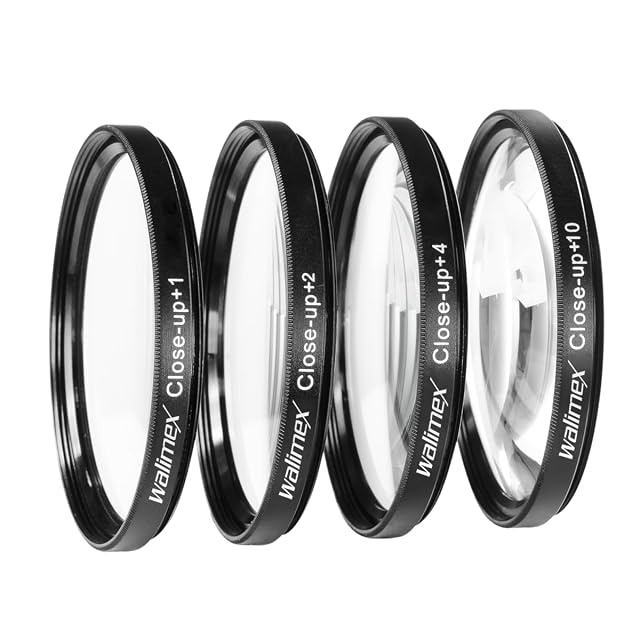
Four dioptres — +1, +2, +4 and +10 — in a 72 mm thread with a hard case, keeping autofocus and metering intact and costing no light. All true. And the first bullet says the range is extended “without the close-focus limit having to be changed”, which is the one thing a dioptre cannot mean: changing that limit is its entire mechanism.
Studio flash, where the figures are the argument
Energy in watt-seconds, a power range in stops, recycle time, a modelling lamp and a mount type are what that shelf compares, and they are the specifications that decide whether two heads can be balanced against each other.
The spelling on the page
The brand writes itself “Walimex pro”, with a lower-case p. It appears that way in the frontmatter of every entry here, because a brand name is not something to tidy up.
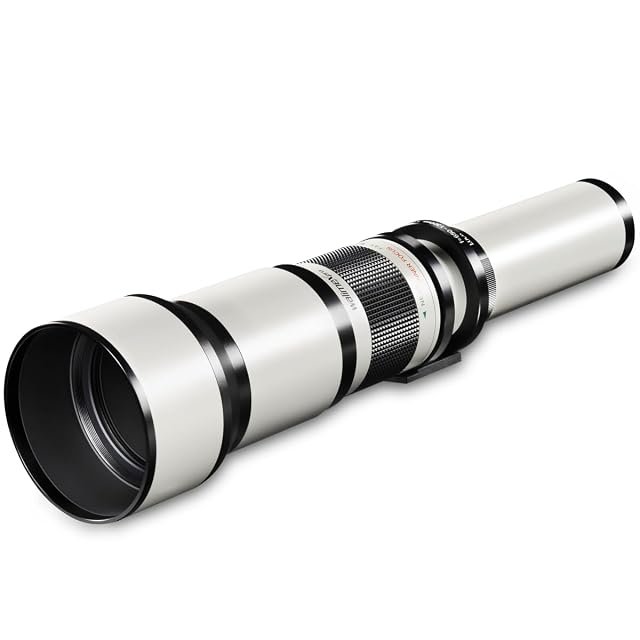
650-1300mm · f/8 at the short end, f/16 at the long one · manual focus, no stabilisation named · no tripod collar published · no minimum focus published · no filter thread published · no sealing claimed · no weight published · all-metal barrel with a pull-out hood · bag, caps and a T2 adapter in the box
The longest reach in the whole catalogue at 1300mm for 250 €, bought at the price of manual focus, f/8 at its widest and a page that publishes neither a weight nor a tripod collar for a lens of that length.
Best for: Daylight wildlife or the moon from a solid tripod, for someone who already focuses by hand and wants reach that costs four figures elsewhere.
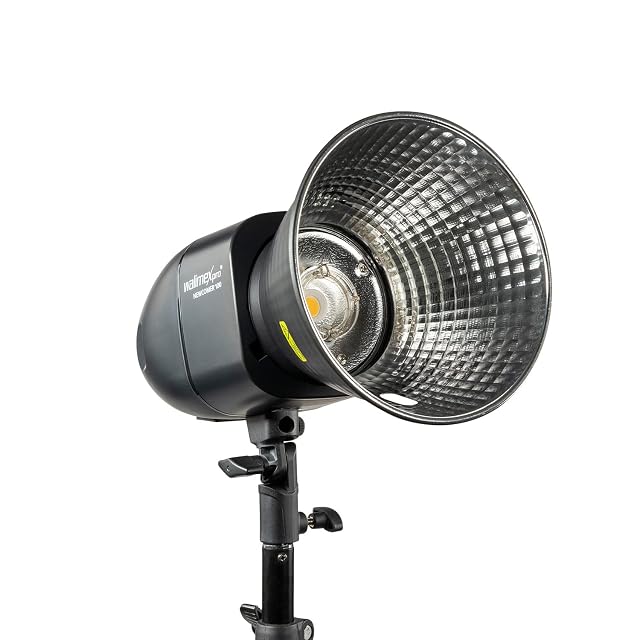
100 W published — watts, not watt-seconds · stepless from 1/1 to 1/32, five stops · no recycle time published · 5 W LED modelling lamp · Bowens and Walimex pro bayonet · built-in receiver, 16 channels and 4 groups, plus photocell and sync cable · under 1 kg, stated as a ceiling · passive cooling with overheat protection
The cheapest studio head here at 132 €, with a receiver already inside it and a Bowens mount that opens the whole modifier catalogue — and an output figure published in watts, which is not the unit this shelf compares.
Best for: A first studio light in a small room, where the Bowens mount matters more than the headline figure and the receiver being built in saves a purchase.
Twenty euros for the full +1 to +10 ladder in 72 mm, in a case, keeping every electronic function — from a page whose first bullet describes its own effect backwards.
Dioptre strength
Four: +1, +2, +4 and +10, in the first bullet. That is the complete ladder, and the intro above explains that the numbers add when two are stacked — so +1 and +2 together give +3, and the four supplied here reach seventeen combinations before the set is exhausted
Filter thread
72 mm, in the title and the third bullet, which says they screw onto any lens with a 72 mm thread quickly and need no other accessory. The buying advice above says to buy for the largest thread in the bag and step down, and 72 mm is the largest on this shelf beside the two 77 mm sets
Element count
NOT PUBLISHED. The second bullet says high-quality glass elements and nothing more: no count, no doublet, no achromatic claim. The intro above makes that the dividing line on this shelf — a single element is a magnifying glass and shows it at the edges, and only the 139 € NiSi here claims a corrected pair
Whether the set is achromatic
NO — nothing on the page claims it. The second bullet says high-quality glass elements and stops there: no doublet, no apochromatic design, no correction of colour fringing. The intro above makes that the dividing line on this shelf, so single elements should be assumed, with the softness at the edges that implies. Only the 139 € NiSi here claims a corrected pair. What this page does claim, in the same bullet, is that no light is lost and no exposure extended — which is true of every dioptre, corrected or not
Coating described
Not described at all. The 53 € K&F set on this shelf names a multi-layer AR nano coating and the 139 € NiSi a multilayer nano coating; this page names none
What a multi-piece set contains
Four lenses and a robust protective case, in the fifth bullet, credited with keeping the glass safe from scratches, dust and dirt
Amazon reference
B0073AMWO2 (same reference on 6 Amazon marketplaces)
EAN
4250234578608
The complete +1 to +10 ladder for 20 €, in a 72 mm thread
Autofocus and metering explicitly stated to remain unaffected
No element count and no achromatic claim, so single elements should be assumed
Best for: A 72 mm lens and a first look at close-up work, where four strengths for 20 € matter more than corrected colour at the edges.
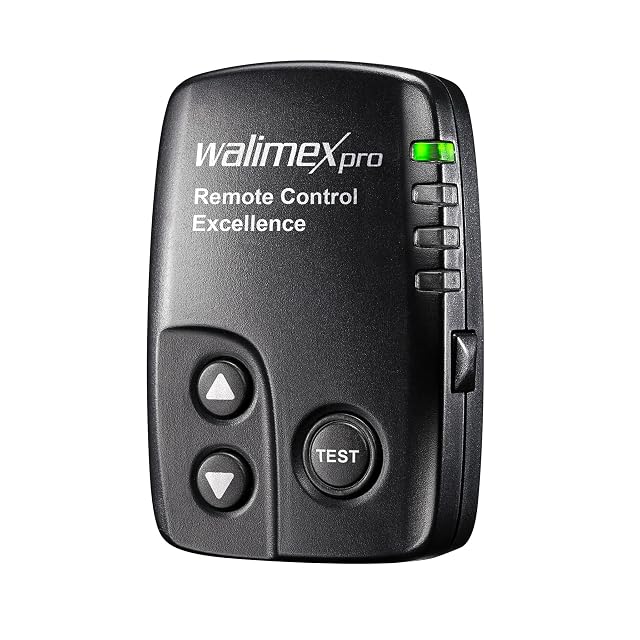
The one trigger here that controls its lights as well as firing them — modelling light and flash power from the camera, across 16 channels and 4 groups, for 34 €.
Radio system named
Named by the lights rather than by a protocol: the second bullet says it is for the Walimex pro VE, VC and Newcomer series and connects directly to the receivers built into those heads, so no separate receivers or cables are needed. The first bullet gives a stable 2.4 GHz link. That is a closed and clearly stated system — narrower than the Godox or NEEWER ecosystems, and unambiguous about what it drives
Camera mounts supported
Any shoe with a centre contact, per the fourth bullet, which names the centre contact as the means of firing. No camera system is named and none is excluded, which follows from the fact that nothing but the fire signal needs to pass — the control it offers goes to the lights, not through the camera
Channel and group counts
16 channels and 4 groups, in the third bullet, which explains what they are for: organising several heads into groups and using channels to keep multiple systems apart in a larger studio. Both numbers, and the reason for each — the only page on this shelf to do that
Remote power control
Yes, and it is the fifth bullet’s whole subject: the trigger fires the flashes and also controls functions such as the modelling light and the flash power, which the bullet says suits ceiling rail systems and heads that are hard to reach. This is the capability the hub above names as the reason to want a transmitter rather than a fire button
Metering and sync modes claimed
Sync to 1/160 second, in the fourth bullet. No metering and no high-speed sync is claimed. It is the lowest sync ceiling on this shelf — the two cheap sets claim 1/250 s — and it is stated plainly alongside a claim that it suits movement
Power source
Not published on the listing. The fourth bullet gives a weight of 25 grams and describes the unit as compact on the camera shoe, and no cell type appears anywhere
Amazon reference
B00I48K7D0 (same reference on 6 Amazon marketplaces)
EAN
4250234598996
Remote control of flash power and the modelling light, not just firing — the only trigger here that does both
16 channels and 4 groups, with the purpose of each explained
Sync at 1/160 s, the lowest ceiling on this shelf
Best for: A studio already built on Walimex pro heads, especially on ceiling rails, where reaching a light to change its power is the daily nuisance this solves.
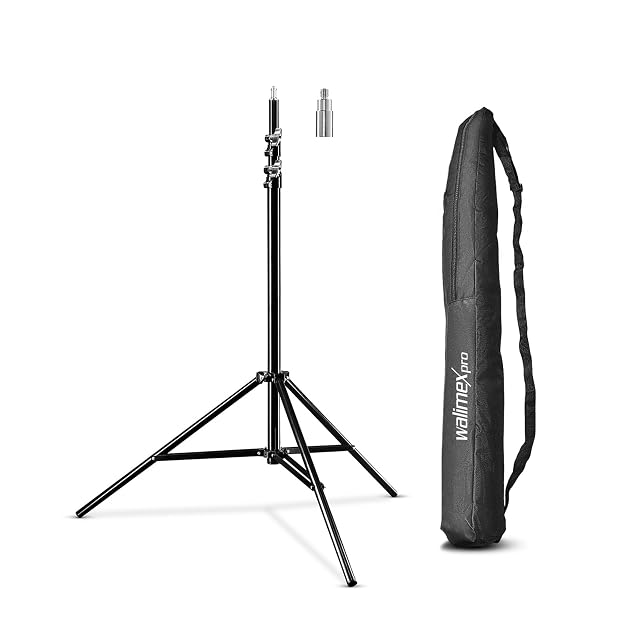
Two hundred and fifty-six centimetres and 6 kg for 39 €, with the only 5/8 inch spigot on this shelf and an air cushion that stops a section dropping on a hand.
Maximum and minimum height
102 to 256 cm, in the first bullet, described as a working height for studio and location. Two hundred and fifty-six centimetres puts it second here, 24 cm below the K&F and 46 cm above the EMART — and its 102 cm minimum is the least low of the four, so this stand does not work close to the ground
Folded length
Not published. The first bullet claims a compact packed size and a low weight without giving either figure, which the buying advice for this shelf calls the number people regret
Section count
Not published. The fifth bullet names high-grade metal locks and a solid build, and never says how many segments there are — though the third bullet implies several by describing the cushioning between them
Spigot and thread sizes
All three, and this is the only page here to name a spigot at all: a 5/8 inch spigot with a 1/4 inch thread, plus a 3/8 inch adapter supplied. The hub above calls the 16 mm stud the studio convention and notes that 5/8 inch names the same thing — so this is the one stand on the shelf that takes a softbox bracket or a studio head as designed
Declared load
6 kg, in the fourth bullet, credited to a stable aluminium construction and named for studio flashes, LED lights and softboxes. It is the strongest figure on this shelf, and it is matched by the fitting: 6 kg on a 5/8 inch spigot is a coherent pair, where 5 kg on a 1/4 inch screw is not
Leg spread
Not published as a figure. The fifth bullet claims a wide footing increasing stability on various surfaces, without a diameter
Material
Reinforced aluminium tubes with sturdy legs and high-grade metal locks, in the fourth and fifth bullets. No weight is published anywhere
Amazon reference
B000LWEA0I (same reference on 6 Amazon marketplaces)
EAN
2050018619358
A 5/8 inch spigot with a 1/4 inch thread and a 3/8 inch adapter — the only studio fitting on this shelf
Six kilograms declared, the strongest figure here, and 256 cm of height
No folded length, no weight, no section count and no footprint published
Best for: A studio head or a softbox on a proper stand, where the spigot, the 6 kg rating and the air cushion matter and the stand stays in one room.
Each amount in a write-up is what the listing showed when that page was written. The figure next to the product is pulled in as you read, and it is the one that counts.