Skip to content

The best grey cards and colour targets for 2026

These are the cheapest instruments in photography and the ones that remove the most guesswork later. A grey card gives a neutral surface to meter from and to set a white balance against, and makers state its reflectance — the familiar eighteen per cent figure is a convention with a long history rather than a law of nature, and what matters is that the value is published and consistent. A white balance target does the same job for colour alone and is often a translucent cap held over the lens instead. A colour target goes further: a grid of patches with known values from which a profile can be built, and here the patch count and whether the maker publishes reference values are what separate a tool from a printed card. Surface finish is a real criterion, because a glossy card reflects the light source itself and returns a highlight rather than a reading; matte is the point. Size follows use — a card that fills part of a frame at working distance beats a larger one left in the bag, and pocket sets on a lanyard get used while A4 boards do not. A supplied sleeve or case is not a luxury: a scuffed or faded target is a target that lies quietly. We compare reference type, stated reflectance, patch count and published values, surface finish, size and supplied case.

The accessories that earn their place in the bag

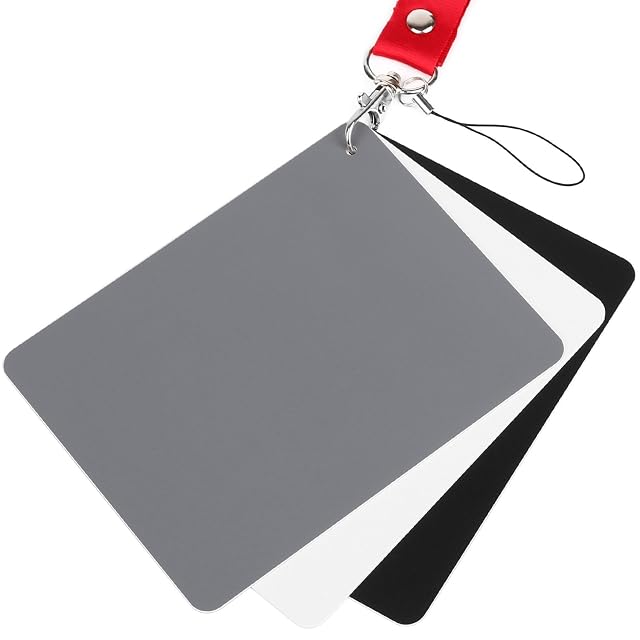
  1. ChromLives set of black, white and grey reference cards on their lanyard

    ChromLives Three cards, 12.7 by 10.2 cm, 18 per cent grey

    Eleven euros for three cards at 12.7 by 10.2 cm — grey at 18 per cent, plus white and black — from a page that says outright the white one barely works as a reflector.

    Reference type
    THREE CARDS, each with its job named in the first three bullets: an 18 per cent neutral GREY for metering exposure, a WHITE for setting white balance, and a BLACK for covering stray light. Three cards is the standard set, and this page is the only one on this shelf to explain each separately rather than as a bundle
    Stated reflectance
    18 PER CENT for the grey card, in the first bullet, which says it balances complex light to a neutral 18 per cent grey scene. No figure is given for the white or the black — where the 11 € JJC on this shelf publishes 90 per cent for its white card
    Patch count and published values
    Not applicable in the colorimetric sense: three cards, no patches, no published values. The 59 € Calibrite on this shelf is the only page here with numbered patches — which makes it a different instrument rather than a better card
    Surface finish
    NOT DESCRIBED. Neither matt nor gloss is claimed, and on a reference card the finish is what decides whether a light source appears as a highlight in the middle of the reading. The 11 € JJC publishes non-reflective and waterproof; the 11 € Lightdow publishes a density figure
    Size
    12.7 by 10.2 cm — 5 by 4 inches — in the fourth bullet, described as a medium card size and called compact, robust and light. It is the middle size on this shelf, between the 13 by 10 cm JJC and the 30 by 30 cm Lightdow
    Supplied case
    NO CASE, but a PREMIUM CLIP RELEASE LANYARD in the fifth bullet — a cord and a clip so the cards hang from a bag or a belt loop. For a card used once at the start of a session, being attached to something is more useful than being in a pouch
    Amazon reference
    B07318GYGP (same reference on 6 Amazon marketplaces)
    EAN
    0730060528342
    • Three cards with the purpose of each explained separately
    • Eighteen per cent published for the grey, and a clip lanyard supplied
    • No surface finish described, matt or otherwise

    Best for: A first reference set, where the three cards need explaining as much as supplying.

    ≈ $10 / £9 / 11 €
    Check price on Amazon
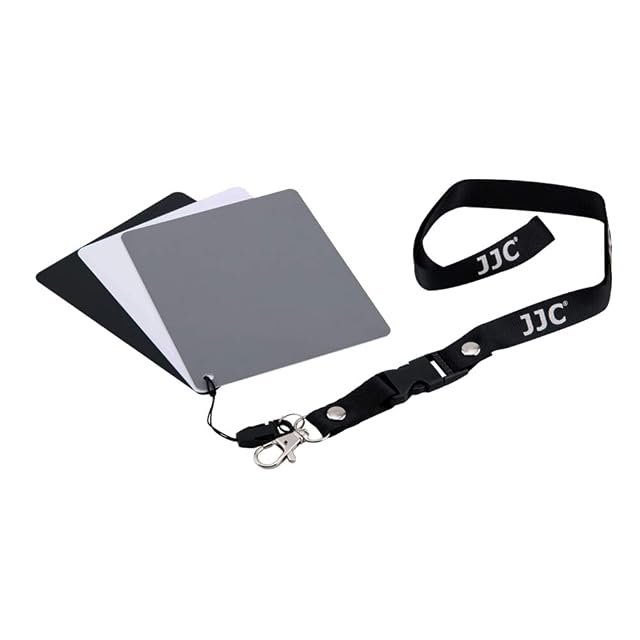
  2. JJC set of three PVC grey, white and black cards with their clip strap

    JJC Three PVC cards, 130 by 100 mm, 18 % and 90 %

    Eleven euros for three waterproof PVC cards publishing both 18 per cent grey and 90 per cent white — the only page here to give two reflectance figures.

    Reference type
    THREE CARDS in PVC — an 18 per cent neutral grey, a white and a black — in the second and fifth bullets, described as colour-calibrated reference cards and called a must for light balance and photographic exposure
    Stated reflectance
    TWO FIGURES, and this is what separates the page: 18 PER CENT for the neutral grey AND 90 PER CENT for the white card, both in the second bullet. Ninety per cent is what a white reference should reflect — a true 100 per cent surface does not exist — and publishing it means the white card can be used for exposure as well as for white balance. No other page on this shelf gives a second figure
    Patch count and published values
    Three cards, no patches. The 59 € Calibrite here is the only patch chart on this shelf
    Surface finish
    PUBLISHED IN FULL, in the third bullet: NON-REFLECTIVE, highly scratch-resistant and WATERPROOF, in durable PVC. Non-reflective is the property that matters — a glossy card throws a highlight into the middle of the reading — and waterproof is what lets a card be used in rain and wiped afterwards
    Size
    130 by 100 mm, in the first bullet, described as medium. Marginally larger than the 12.7 by 10.2 cm ChromLives here and a fraction of the 30 by 30 cm Lightdow
    Supplied case
    No case: a strap with a DETACHABLE CLIP, in the fourth bullet, described as compact, robust and light in pocket format, easy to carry on a wallet or a key ring. The same solution as the ChromLives — attachment rather than storage
    Amazon reference
    B07Z4N8Y19 (same reference on 6 Amazon marketplaces)
    EAN
    6972502073032
    • Both 18 per cent and 90 per cent published — two reflectance figures
    • Non-reflective, scratch-resistant and waterproof PVC, all stated
    • No case, and no colorimetric values

    Best for: Outdoor work where the card gets wet, and any shoot that needs a white reference as well as a grey one.

    ≈ £9 / 11 €
    Check price on Amazon
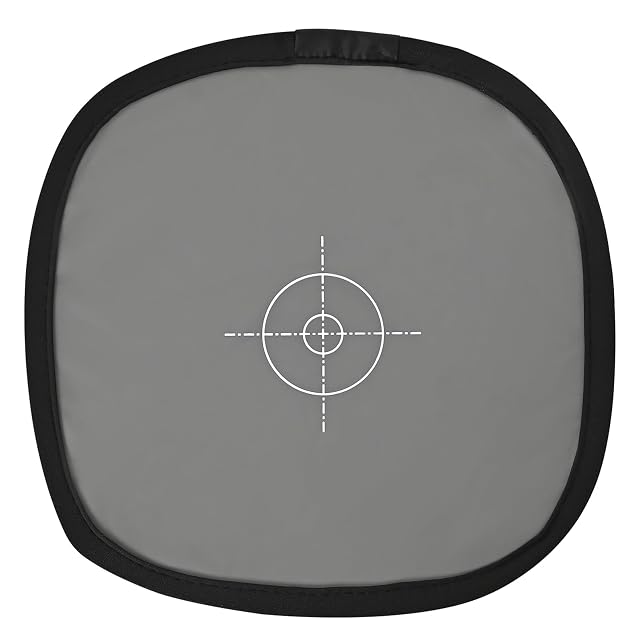
  3. Lightdow folding grey card opened to 30 by 30 cm beside its carry case

    Lightdow 30 by 30 cm folding, 17.8 % reflectance, density 0.74

    Eleven euros for a 30 by 30 cm pop-up card that publishes 17.8 per cent, a density of 0.74, a 2 per cent tolerance and an eighth of a stop of error — the only measured card here.

    Reference type
    A DOUBLE-SIDED POP-UP card — grey on one face, white on the other, in the fourth bullet, which says it simplifies the technical questions of exposure and colour correction under varying light and names weddings and fashion shows as where that matters. It springs open like a reflector rather than being a rigid card
    Stated reflectance
    17.8 PER CENT, in the first bullet — and the honesty of that figure is the point. "Eighteen per cent" is the nominal standard; 17.8 is what this surface actually measures, published alongside a DENSITY OF 0.74. Density is the logarithmic form of the same property, and giving both is how a manufacturer shows the figure came from an instrument rather than a catalogue
    Patch count and published values
    Two faces, no patches. What it publishes instead is unique on this shelf: a MAXIMUM DEVIATION OF 2 PER CENT in the second bullet, and a MAXIMUM METERING ERROR OF ONE EIGHTH OF A STOP in the third. A tolerance is what turns a claim into a specification
    Surface finish
    Not described — the one gap on an otherwise measured page. The 11 € JJC here publishes non-reflective, and on a 30 cm surface a sheen matters more rather than less
    Size
    30 by 30 cm, in the title — NEARLY SEVEN TIMES the area of the 130 by 100 mm cards on this shelf, and FOLDING, with a carry case supplied. A large target can be metered from further away and photographed in the frame for later correction; a folding one still fits in a bag
    Supplied case
    YES — a carry case, in the title and the fourth bullet, which is what a sprung folding card needs. The fifth bullet adds a 90-day return and replacement guarantee for quality-related problems
    Amazon reference
    B00HT9MA1W (same reference on 6 Amazon marketplaces)
    EAN
    0616983848487
    • Seventeen point eight per cent and a density of 0.74, both published
    • A 2 per cent deviation and an eighth of a stop of metering error — the only tolerances here
    • The surface finish is never described, on the largest card here

    Best for: Metering from a distance at a wedding or a show, where the card has to be large, fold away and be trusted to a fraction of a stop.

    ≈ $15 / £13 / 11 €
    Check price on Amazon
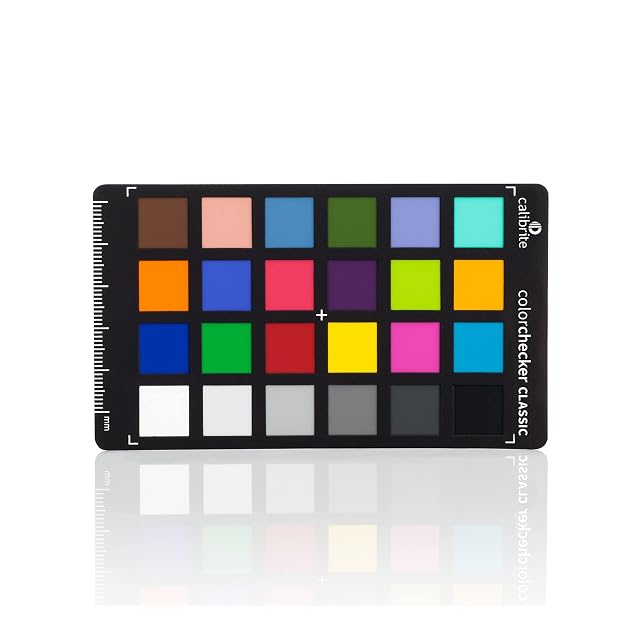
  4. Calibrite ColorChecker Classic Mini chart showing its twenty-four colour patches

    Calibrite ColorChecker Classic Mini, 24 patches, 6.35 by 10.9 cm

    Fifty-nine euros for a 24-patch chart that builds DNG and ICC camera profiles — six grey patches among them, on the smallest card here.

    Reference type
    A COLOUR CHART, and the distinction from the rest of this shelf is total. Three products here are grey cards — one tone, held in the light, read by a meter. This is 24 known colours photographed once so that software can compute how this camera sees colour and correct every frame afterwards. The first bullet calls it colour calibration and colour management, which is a different job from metering
    Stated reflectance
    NO SINGLE FIGURE, and correctly so: a chart has no one reflectance. What it has instead are six GREY PATCHES, in the third bullet, which do the grey card’s job as part of the set — so the neutral reference is there, spread across a range from white to black rather than fixed at 18 per cent
    Patch count and published values
    24 PATCHES, published in the first and third bullets: six greys, RGB and CMYK primaries, and a mixture of everyday colours. The colorimetric values themselves are not printed on the page — they live in the software, which is where a profile-building workflow needs them
    Surface finish
    Not described. On a chart the finish is critical — a gloss would put a reflection across a patch — and the page leaves it unstated, as three of the four pages on this shelf do
    Size
    6.35 by 10.9 cm, in the title — THE SMALLEST ON THIS SHELF, a third the area of the pocket grey cards and a twelfth of the 30 by 30 cm Lightdow. A chart is photographed in the frame rather than metered off, so small is sufficient; it does have to be large enough to fill a usable part of the frame
    Supplied case
    Not mentioned — on a 59 € chart whose patches are worthless once scratched or faded. The 11 € Lightdow on this shelf supplies a case
    Amazon reference
    B0973JNJCB (same reference on 6 Amazon marketplaces)
    EAN
    0850028833056
    • Twenty-four patches building real DNG and ICC camera profiles
    • Six grey patches, so the neutral reference is included across a range
    • No case mentioned, and a faded or scratched chart is a wrong chart

    Best for: Matching two cameras on the same shoot, or any work where colour has to be repeatable rather than merely correct.

    ≈ $74 / £44 / 59 €
    Check price on Amazon

Each amount in a write-up is what the listing showed when that page was written. The figure next to the product is pulled in as you read, and it is the one that counts.