Skip to content

The best remote shutter releases for 2026

A release fires the camera without a hand on it, which is the difference between a sharp long exposure and a blurred one. The connection divides the shelf. A cable release plugs into a socket that is proprietary to each maker and often to each tier within a range, so the connector name in the listing matters more than the brand on the box. Infrared is cheap and needs line of sight to a receiver window, which many bodies no longer have. Radio works around corners and through a bag, and is what longer distances need. Whatever the link, the useful releases support a half press as well as a full one, so focus and metering can be woken before the exposure. Beyond firing, the feature that decides the price is the intervalometer: a delay before the first frame, an exposure length for bulb work, an interval between frames and a total count — four settings that together cover time-lapse and star trails, and that some cameras now duplicate internally. Range is published for radio types and, as with any radio figure, describes open ground. Then power: a coin cell that lasts a season, or a rechargeable unit that is one more thing to charge. We compare connection type, sockets and bodies named, half-press support, intervalometer functions, stated range and power source.

The accessories that earn their place in the bag

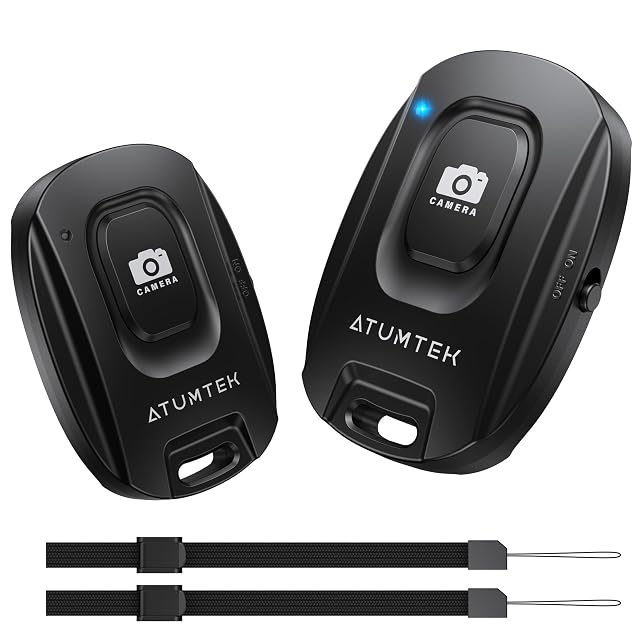
  1. Pair of ATUMTEK Bluetooth camera remotes with a wrist strap attached

    ATUMTEK Two Bluetooth 5.2 remotes, 10 m, CR2032

    Eight euros for two Bluetooth 5.2 phone remotes with a published 10 m range, 20,000 shots from one CR2032 and their dimensions on the page.

    Connection type
    BLUETOOTH 5.2, in the first bullet, claimed to give lag-free operation. It is the only wireless standard on this shelf that is not a proprietary radio or infrared — and it exists because this remote talks to a phone rather than to a camera
    Sockets and bodies named
    NO CAMERA. The second bullet claims compatibility with most Android and Apple smartphones on the market, and names nothing else. It sits on this shelf as the phone answer to the same job — and the hub above compares connection, range and power, all of which this page publishes
    Half-press support
    Not applicable. A phone has no two-stage shutter button, so there is nothing to half-press: focus is set by tapping the screen before the remote is used
    Intervalometer functions
    NONE. The 39 € Rollei on this shelf is the only intervalometer here
    Stated range
    UP TO 10 METRES, in the first bullet — the shortest published range on this shelf, against 50 m for two of the camera remotes. Ten metres is a group photograph or a self-portrait, which is what a phone remote is for
    Power source
    A CR2032 button cell of 210 mAh, in the third bullet, claimed to take OVER 20,000 PHOTOGRAPHS. Publishing a shot count rather than a battery life is the right unit for this product, and 20,000 means the cell outlasts the interest
    Amazon reference
    B0CHFCFW5C (same reference on 6 Amazon marketplaces)
    EAN
    6973383077799
    • Two remotes for 8 €, with a published 10 m range
    • Over 20,000 shots from one CR2032, and the cell is included
    • Phones only — no camera, no socket, no body named

    Best for: Group photographs and self-portraits taken on a phone on a tripod, where two remotes mean one lives in a coat pocket.

    ≈ $9 / £7 / 8 €
    Check price on Amazon
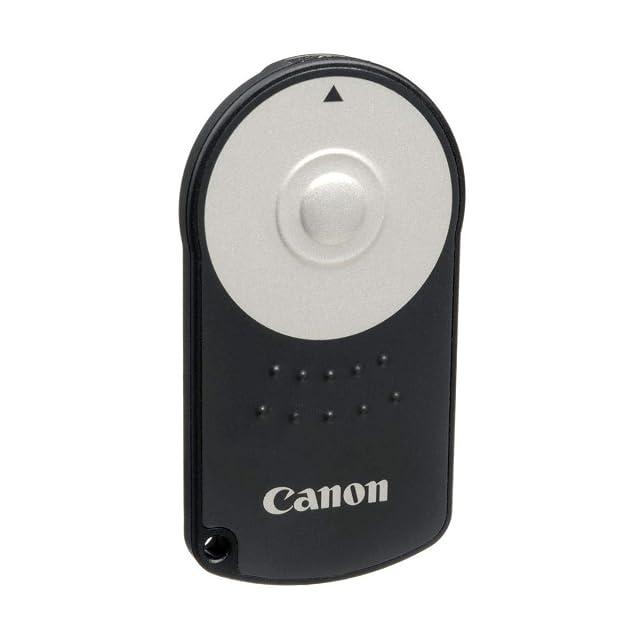
  2. Canon RC-6 infrared remote release, black, seen from the front

    Canon RC-6 infrared — three bullets, one body named "t1i"

    Sixteen euros for Canon’s own infrared remote, from a page of three bullets that names one camera in lower case and lists its contents twice.

    Connection type
    INFRARED — the only one on this shelf, and the constraint that defines it: an infrared remote needs LINE OF SIGHT to the sensor on the FRONT of the camera. It works from in front, where you are standing to be photographed, and not from behind. Every other remote here uses radio or Bluetooth and works through a wall
    Sockets and bodies named
    ONE, and written as "t1i" in lower case — the EOS Rebel T1i, a camera from 2009. The RC-6 in fact works with a long list of Canon bodies carrying an infrared receiver, and the page names a single one of them, in the wrong case
    Half-press support
    Not stated. The RC-6 has a two-position switch — immediate release and a two-second delay — and the page mentions neither
    Intervalometer functions
    None
    Stated range
    NOT PUBLISHED. Two remotes on this shelf publish 50 m and one publishes 10 m; the original publishes nothing, on a technology whose range is its main limitation
    Power source
    NOT PUBLISHED. The RC-6 uses a CR2032, and the page does not say so — where the 8 € ATUMTEK publishes the cell, its capacity and its shot count
    Amazon reference
    DE B0037NX6JY · US B07L8HTKDH · GB B07L8HTKDH · FR B07L8HTKDH · IT B07L8HTKDH · ES B07L8HTKDH
    EAN
    4960999669304
    • Canon’s own remote, so the infrared protocol is the correct one
    • The RC-6 part number identifies it unambiguously
    • Three bullets, and the contents are listed twice

    Best for: A Canon body with an infrared receiver, standing in front of the camera — bought by part number because the page says nothing else.

    ≈ $20 / £11 / 13 €
    Check price on Amazon
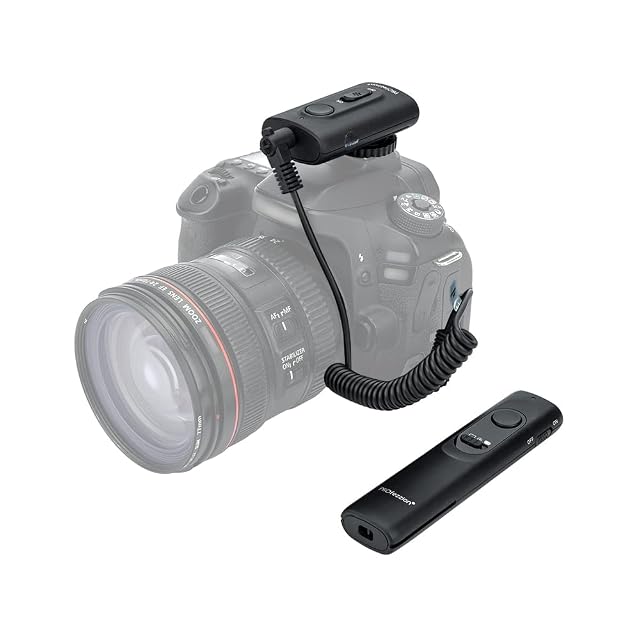
  3. PROfezzion wireless shutter release transmitter and receiver with its tripod clip

    PROfezzion 50 m radio, 16 channels, 5 modes, batteries included

    Thirty-five euros for a 50 metre radio release with sixteen channels and five modes including bulb — batteries included, and one transmitter fires several cameras.

    Connection type
    2.4 GHz RADIO, in the second bullet — a transmitter and a separate receiver that plugs into the camera. Radio needs no line of sight, which the first bullet names directly: the shutter fires at up to 50 metres without a clear view of the camera
    Sockets and bodies named
    MORE THAN FORTY, in the fifth bullet — the longest compatibility list on this shelf by a wide margin. It runs from the EOS R and RP through the R6 Mark III, R7, R8, R10, R100 and R50V to the 2000D, 1500D, 850D, 90D and 77D, the M6 Mark II and M5, and then leaves Canon entirely for Contax 645 and N1, Samsung NX, and Pentax K-3 II, 645D, K500 and K200D — bodies sharing the same release socket
    Half-press support
    Not named as half-press, but answered in a better way: the third bullet says the RECEIVER ITSELF FUNCTIONS AS A CABLE SWITCH. Unplugged from the transmitter’s control, it becomes a wired release on the camera — which is where a half-press lives
    Intervalometer functions
    NONE, and the page is explicit about a second limit in the same bullet: IT DOES NOT CONTROL VIDEO START AND STOP. What it does give is FIVE MODES — single shot, a 5-second delay, a 3-frame burst, unlimited burst, and BULB for long exposures
    Stated range
    50 METRES, published in the first and second bullets, over 16 CHANNELS. Channels matter where several photographers work together: sixteen means two people can fire their own cameras in the same room without triggering each other
    Power source
    AAA batteries for BOTH units, and the fourth bullet says they are INCLUDED — which on this shelf is rare enough to note. The same bullet adds a detachable clip for fixing the transmitter to a tripod leg
    Amazon reference
    B09HJQBBHM (same reference on 6 Amazon marketplaces)
    EAN
    6940202352160
    • Fifty metres over sixteen channels, with one transmitter able to fire several receivers
    • Five modes including bulb, and the receiver works alone as a cable switch
    • It does not control video start and stop, stated by the maker

    Best for: Wildlife or group work at a distance, and long exposures — where bulb mode and 50 metres matter more than a timer.

    ≈ $36 / £34 / 34 €
    Check price on Amazon
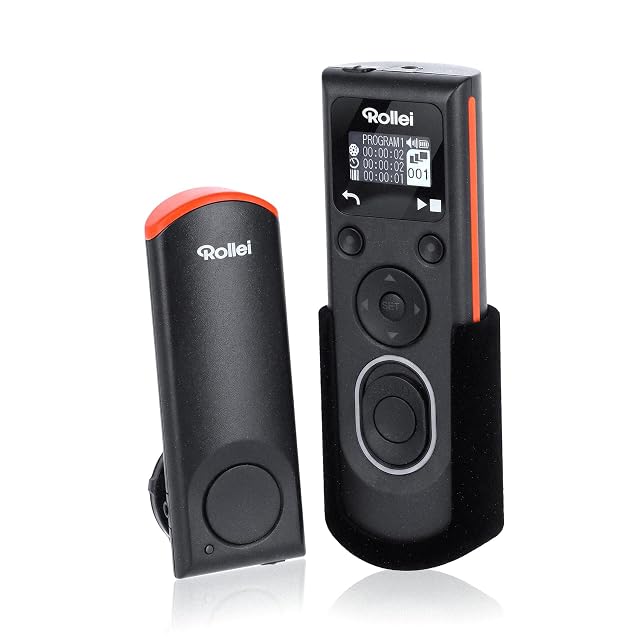
  4. Rollei wireless remote release with its illuminated OLED display lit

    Rollei Radio intervalometer, OLED, 50 m, to 99 h 59 min 59 s

    Thirty-nine euros for the only intervalometer here: an OLED display, 50 metres, exposures to 99 hours and two setups stored — for Nikon.

    Connection type
    RADIO, wireless, with an ILLUMINATED OLED DISPLAY and illuminated buttons, in the second bullet — which makes the point that matters for the work this does: a timer is programmed in the dark, at the start of a night exposure, and a lit screen is the difference between setting it correctly and guessing
    Sockets and bodies named
    NIKON DSLM AND DSLR, in the title, with no individual model named anywhere in nine bullets. It is the vaguest compatibility on this shelf — the 35 € PROfezzion names more than forty bodies — and Nikon uses several different release sockets, so the exact plug has to be confirmed elsewhere
    Half-press support
    Not stated
    Intervalometer functions
    THE ONLY ONE ON THIS SHELF, and the fullest specification here: INTERVAL SHOOTING for time-lapse sequences; a TIMED RELEASE PROGRAMMABLE UP TO 100 HOURS IN ADVANCE; UNLIMITED BURST; and MANUAL LONG EXPOSURE adjustable from ONE SECOND to 99 HOURS 59 MINUTES 59 SECONDS. Four functions, each in its own bullet
    Stated range
    50 METRES, in the third bullet, for both remote release and interval work — matching the 35 € PROfezzion and five times the 10 m of the 8 € phone remote
    Power source
    NOT PUBLISHED, in nine bullets — which on a device meant to run a hundred-hour timer is the specification most worth knowing. A remote whose cell dies at hour ninety has taken no photograph at all
    Amazon reference
    B097TQ3432 (same reference on 2 Amazon marketplaces)
    EAN
    4048805281190
    • The only intervalometer here: time-lapse, timer, bulb to 99 hours, unlimited burst
    • An illuminated OLED display and lit buttons, for programming in the dark
    • No power source published, on a device that runs hundred-hour programmes

    Best for: Star trails, time-lapse and any exposure measured in hours, on a Nikon body whose release socket has been confirmed.

    ≈ 39 €
    Check price on Amazon

Each amount in a write-up is what the listing showed when that page was written. The figure next to the product is pulled in as you read, and it is the one that counts.