Skip to content

The best polarising filters for 2026

A polariser removes reflections from non-metallic surfaces — water, glass, wet leaves, painted panels — and deepens a blue sky at right angles to the sun. It is the one filter whose effect cannot be reproduced afterwards in software, because it changes which light enters the lens rather than how it is processed. Nearly everything sold now is a circular polariser, and the word describes the internal construction rather than the shape: linear types interfere with the metering and autofocus systems of modern cameras, which is why they have all but vanished. The cost is light, normally between one and two stops, and makers publish the figure as a filter factor or in stops; that loss is permanent while the filter is fitted, which matters in a forest more than on a beach. Rotation is the whole interface, so the feel of the ring is a real criterion — a filter that rotates the lens' own focus ring while being adjusted is a filter that gets left behind. Two cautions belong on the same page: the effect is strongest at ninety degrees to the sun and nearly absent facing it, and on a very wide lens that variation appears across a single frame as an uneven sky. Then thread size, coatings and frame thickness, as with any filter. We compare thread size, type, light loss stated, coating description, frame thickness and rotation mechanism.

The accessories that earn their place in the bag

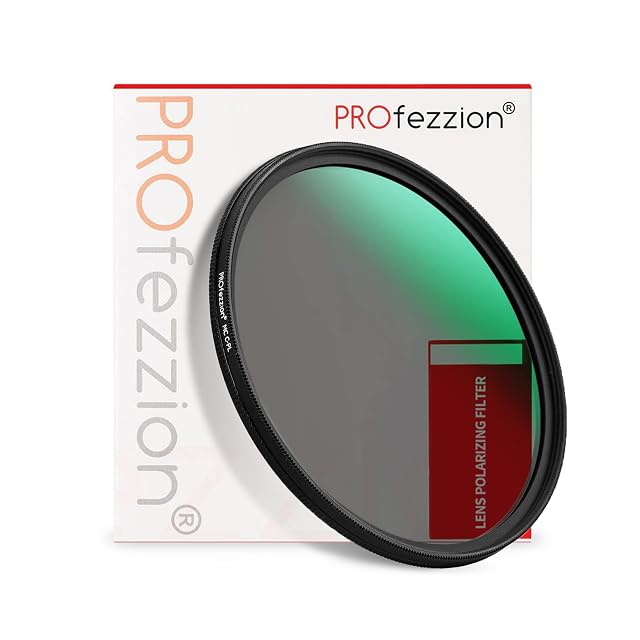
  1. PROfezzion 58 mm circular polariser with its rotating ring and case

    PROfezzion 58 mm CPL, twelve layers

    Twelve coating layers on a 58 mm circular polariser for 16 € — from a page whose fourth bullet gives the thread as 52 mm and explains where to check it.

    Thread size
    58 mm in the title — AND 52 mm in the fourth bullet, which says the filter fits any lens with a 52 mm thread. The same bullet then explains, usefully, that the correct size is printed on the lens after a ⌀ symbol. The title and the part number PF-58CPL agree on 58; the bullet is the odd one out, and the ⌀ on the lens settles it
    Type
    CIRCULAR, in the title and throughout. The hub above treats circular versus linear as the first question: a circular polariser keeps autofocus and metering working on a modern camera, and a linear one does not
    Light loss stated
    NOT STATED. A polariser costs light — commonly one and a half to two stops — and no page on this shelf publishes the figure. The hub above asks for it in stops, and four filters here leave it out
    Coating description
    TWELVE layers, multi-coated, in the third bullet, credited with reducing reflection and named for outdoor and landscape work over water, sky and plants. The same count as the maker’s UV filter on this site
    Frame thickness
    Not published — where the same maker publishes 3 mm on its UV filter. On a polariser the frame is necessarily thicker, because it has to rotate, and that makes the missing figure more significant rather than less
    Rotation mechanism
    Not described. A polariser is used by turning it, and how the ring turns — knurled, geared, stiff, smooth — is the whole ergonomics of the thing. The 28 € NEEWER on this shelf describes straight knurling and smooth rotation; this page is silent
    Amazon reference
    B093247YD6 (same reference on 6 Amazon marketplaces)
    EAN
    6940202350500
    • Twelve multi-coating layers, on named Japanese glass in an aviation-aluminium frame
    • A bullet that explains where the thread size is printed, after the ⌀ symbol
    • The title says 58 mm and the fourth bullet says 52 mm

    Best for: A 58 mm lens used over water and foliage, where twelve coating layers for 16 € matter more than a published stop figure.

    ≈ $16 / £13 / 16 €
    Check price on Amazon
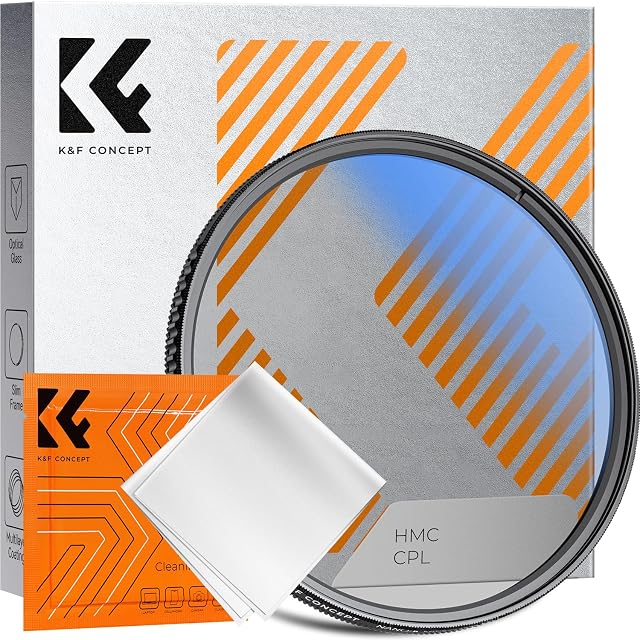
  2. K&F Concept 67 mm circular polariser held against a bright sky

    K&F CONCEPT 67 mm CPL, 18 layers, 5.3 mm frame

    Eighteen coating layers in a published 5.3 mm frame — the thinner of the two polariser frames on this shelf, for 18 €.

    Thread size
    67 mm, in the title, with the fifth bullet naming Canon, Nikon, Sony, Samsung and FUJIFILM lenses of that thread
    Type
    CIRCULAR — Zirkularer Polfilter — in the title and the third bullet. The hub above explains why that matters: a circular polariser leaves autofocus and metering intact on a modern body
    Light loss stated
    NOT STATED, as on all four polarisers here. Eighteen layers raise transmission; what the polarising element itself takes out is the figure the hub above asks for, and no page on this shelf gives it
    Coating description
    EIGHTEEN-fold coating on high-grade optical glass, in the third bullet, credited with reducing reflections and holding image quality in difficult light. The highest count on this shelf, matching the same maker’s UV filter
    Frame thickness
    PUBLISHED at 5.3 mm, in the fourth bullet, described as an ultra-slim aluminium frame that prevents vignetting even on wide-angle shots. It is the thinner of the two polariser frames published here — the 28 € NEEWER gives 5.9 mm — and the reason is stated rather than implied
    Rotation mechanism
    Not described. The frame thickness is published and how the ring turns is not
    Amazon reference
    B08HS3ZWYY (same reference on 6 Amazon marketplaces)
    EAN
    6942052508506
    • Five point three millimetres of frame, published with the reason: no vignetting on a wide lens
    • Eighteen coating layers, the highest count on this shelf
    • No light loss published

    Best for: A wide-angle or standard zoom at 67 mm where the frame has to stay out of the corners of the picture.

    ≈ £23 / 18 €
    Check price on Amazon
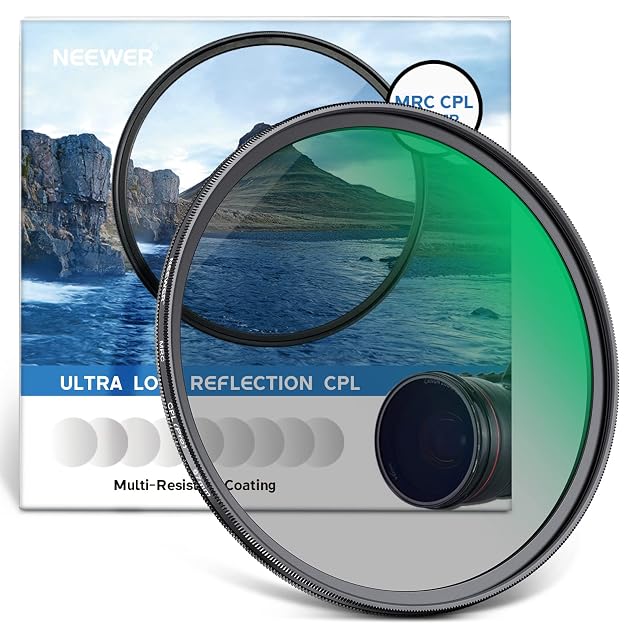
  3. NEEWER 67 mm CPL filter showing its knurled rotating ring and case

    NEEWER 67 mm CPL, 99.9 per cent, 30 layers, 5.9 mm

    Thirty coating layers, reflection under 0.1 per cent and a published 5.9 mm magnalium frame — the only polariser here that describes how its ring turns.

    Thread size
    67 mm, in the title and the fifth bullet, supplied with a protective case and a cleaning cloth
    Type
    CIRCULAR, in the title, built on what the first bullet calls an imported polarising film. Circular is what keeps autofocus and metering intact, as the hub above explains
    Light loss stated
    NOT STATED — no figure in stops, as on all four polarisers here. What this page does publish is the other side of the transaction: 99.9 per cent of reflections from non-metallic surfaces eliminated, and a minimum light reflection of under 0.1 per cent off the filter’s own surfaces. Both are real numbers; neither is the exposure penalty the hub above asks for
    Coating description
    THIRTY LAYERS of polarising film on both sides of the filter, in the second and third bullets — the highest count on this shelf — with four properties named: water-repellent, oil-repellent, antistatic and scratch-resistant. The same bullet claims ultraviolet blocking from 300 to 380 nm, which is a stated waveband rather than a vague claim
    Frame thickness
    PUBLISHED, and in two parts: an ultra-thin 5.9 mm frame in MAGNALIUM ALLOY, plus a 3.8 mm front bezel that the fourth bullet says effectively prevents vignetting on wide-angle lenses. The 18 € K&F here is thinner overall at 5.3 mm; this is the only page that separates the frame from the bezel
    Rotation mechanism
    DESCRIBED — alone on this shelf. The fourth bullet gives black anodised threads with precision machining for effortless installation, and straight wheels for smooth rotation. A polariser is operated by turning it, and this is the one page that treats the turning as a specification
    Amazon reference
    B09HGHKN2R (same reference on 6 Amazon marketplaces)
    EAN
    0191073121478
    • Thirty coating layers, with reflection under 0.1 per cent and a stated 300-380 nm UV band
    • The only description of a rotation mechanism on this shelf
    • No light loss in stops, as everywhere on this shelf

    Best for: A 67 mm lens whose polariser gets turned constantly — landscapes, water, glass — where a smooth ring and a wipeable coating earn the extra 10 €.

    ≈ $26 / £23 / 28 €
    Check price on Amazon
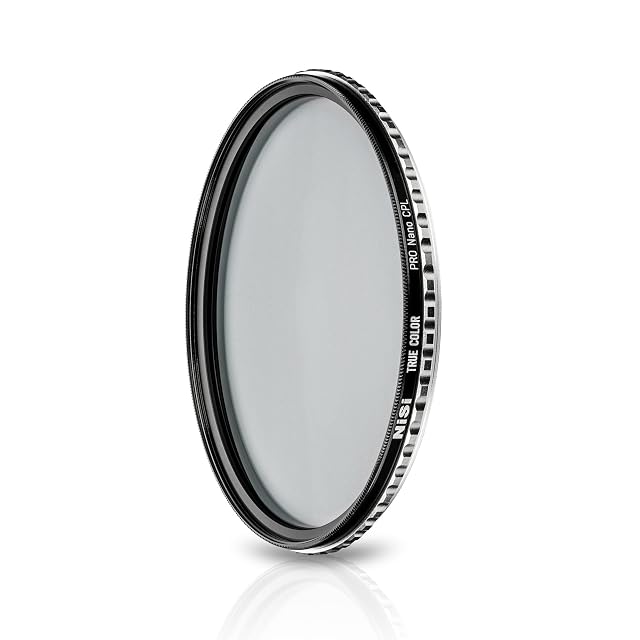
  4. NiSi True Color CPL filter with its knurled frame and blackened glass edge

    NiSi True Color CPL, 77 mm, 20 layers, Cine Sealed

    A hundred and two euros for a polariser whose coating is sold on colour neutrality and whose glass edges are blackened and sealed against condensation.

    Thread size
    77 mm, in the title — the largest on this shelf, and the size the buying advice above says to standardise on, since a step ring brings it down to everything smaller
    Type
    CIRCULAR, in the title. The hub above puts circular versus linear first for a reason: only the circular kind leaves autofocus and metering working
    Light loss stated
    NOT STATED in stops. The first bullet claims 99.9 per cent of light reflections eliminated — the same figure the 28 € NEEWER here publishes — and the exposure penalty a polariser imposes is absent from all four pages on this shelf
    Coating description
    TWENTY layers, in the third bullet, including an ULTRA-LOW-REFLECTION layer specified at 0.2 PER CENT, with double-sided water- and oil-repellent coatings for easy cleaning and scratch resistance. Fewer layers than the thirty of the NEEWER; the difference on this page is what the coating is claimed to preserve rather than how many there are
    Frame thickness
    NOT PUBLISHED — the one number this page omits, at 102 €. The fifth bullet claims no vignetting even on wide-angle lenses and gives no millimetres, where the 18 € K&F publishes 5.3 mm and the 28 € NEEWER 5.9 mm. What IS named is a matt black interior coating in the second bullet, to absorb stray light inside the frame
    Rotation mechanism
    A KNURLED frame — gerändelter Rahmen — in the fifth bullet, described as giving grip for quick mounting and removal. That is about fitting rather than turning; the 28 € NEEWER here is the page that describes the rotation itself
    Amazon reference
    B09XQXPG3C (same reference on 6 Amazon marketplaces)
    EAN
    6972949374020
    • A coating sold on colour neutrality, with the yellow cast of other filters named as the problem
    • Cine Sealed blackened glass edges, credited with preventing condensation
    • No frame thickness published, at 102 €

    Best for: Work where the polariser must not tint the image — video graded across shots, or landscape work in mixed light — and where condensation on a cold morning is a real risk.

    ≈ $129 / £95 / 102 €
    Check price on Amazon

Each amount in a write-up is what the listing showed when that page was written. The figure next to the product is pulled in as you read, and it is the one that counts.