Skip to content

The best lens adapters for 2026

An adapter joins a lens of one mount to a body of another, and whether it can exist at all is decided by a distance. Every mount publishes a flange focal distance — the gap between the mount face and the sensor — and an adapter can only add to it, never take it away. That is why lenses from longer-flanged systems adapt readily onto shorter-flanged mirrorless bodies, and why the reverse generally needs a corrective optical element that changes the image. The second question is electronics. A plain adapter is a metal tube: focus is manual, the aperture is whatever the lens can set by its own ring, and the body records nothing about the lens. An electronic adapter carries contacts and a processor, and the listing has to say what it passes — autofocus, aperture control, stabilisation communication, and the metadata that ends up in a file. Claims here are graded rather than binary, and makers usually publish a compatibility list rather than a promise. Then the physical things: whether the adapter includes a tripod foot, which matters as soon as the lens outweighs the body; whether it has an aperture ring for lenses that lack one; the internal finish, since a reflective tube raises flare; and the tolerance of the two lock mechanisms. We compare mounts joined, contacts present, functions claimed, optical elements if any, tripod foot, aperture ring and build.

The accessories that earn their place in the bag

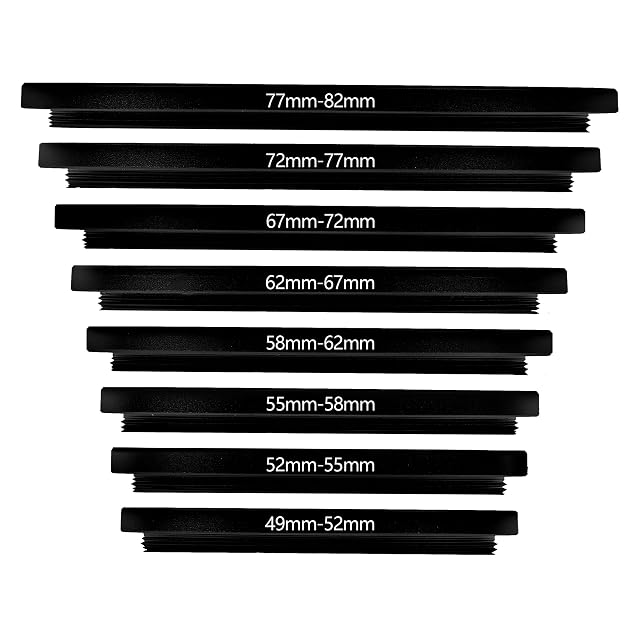
  1. Belmalia set of eight black anodised step-up rings laid out in order of size

    Belmalia Eight step-up rings, 49 to 82 mm

    Eight anodised rings from 49 to 82 mm for 11 €, each stepping up one size, and screwable into one another to reach the gaps between.

    Mounts joined
    NONE — and this is the distinction the word "adapter" hides on this shelf. These are filter-thread rings: they join a larger filter to a smaller lens thread, in eight steps from 49 to 82 mm. No camera mount is involved at any point. The 95 € Canon and the 185 € Nikon on this shelf are the mount adapters; three of the five pages here, this one included, are rings
    Contacts present
    None, and none is possible: a filter ring sits at the front of the lens, where there is nothing to communicate with
    Functions claimed
    One: fitting. The first bullet says larger filters or converters can be used on lenses of smaller diameter, and that is the whole claim. Nothing is passed, nothing is powered, nothing is lost
    Optical elements
    None. The rings are hollow metal, which is why they cost 11 € and change nothing about the image — the intro above reserves corrective elements for adapters working against the flange distance
    Tripod foot
    Not applicable
    Aperture ring
    Not applicable
    Build
    Anodised aluminium, in the third bullet, described as stable, dimensionally true and light. The fourth bullet claims precisely cut threads that neither tilt nor jam, and the second says the rings screw into one another to reach intermediate sizes — 49 to 58 through two rings, for instance
    Amazon reference
    B00OE7B0UE (same reference on 6 Amazon marketplaces)
    EAN
    4054438653150
    • Eight consecutive steps from 49 to 82 mm, with no gap left in the sequence
    • Anodised aluminium rather than plastic, at 11 € for the set
    • Steps UP only: a smaller filter cannot be put on a larger lens with these

    Best for: One set of large filters shared across several lenses, where every thread in the bag is 49 mm or more.

    ≈ £8 / 11 €
    Check price on Amazon
  2. CamKix nine step-up rings arranged from 37 mm to 82 mm

    CAMKIX Nine step-up rings, 37 to 82 mm

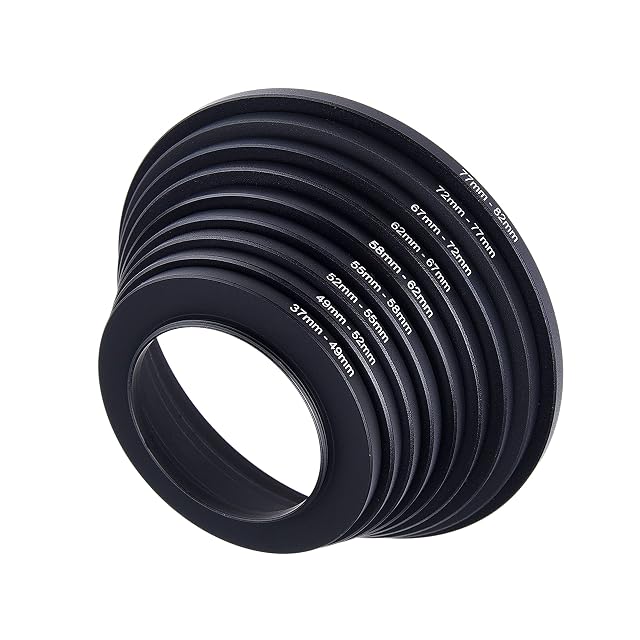
    Nine rings from 37 to 82 mm for 11 €, one more step than the Belmalia set at the same price, and the extra one is at the small end where kit lenses live.

    Mounts joined
    NONE. Like the 11 € Belmalia and the 23 € K&F on this shelf, this is a filter-thread set: nine rings that let a larger filter sit on a smaller lens. The mount adapters here are the 95 € Canon and the 185 € Nikon, and they do a different job entirely
    Contacts present
    None, and none is possible at the front of a lens
    Functions claimed
    One, and the first bullet puts it as an economy rather than a feature: a new lens of a different diameter does not require a second set of filters. The second bullet states the mechanism — a larger filter onto a smaller thread
    Optical elements
    None
    Tripod foot
    Not applicable
    Aperture ring
    Not applicable
    Build
    Resistant anodised aluminium, in the fourth bullet, with the claim that these last much longer than plastic adapter rings. No stacking is mentioned anywhere — the 11 € Belmalia set advertises screwing its rings together, and this page leaves the possibility unstated
    Amazon reference
    B077XGL35R (same reference on 6 Amazon marketplaces)
    EAN
    0711099326055
    • Nine steps from 37 mm, covering the small threads an eight-ring set misses
    • The same 11 € as the Belmalia set for one ring more
    • Steps up only, like every ring set that is not the 23 € K&F here

    Best for: A bag mixing a small prime or kit zoom with larger lenses, where the 37 mm end is the thread that actually needs adapting.

    ≈ $12 / £9 / 11 €
    Check price on Amazon
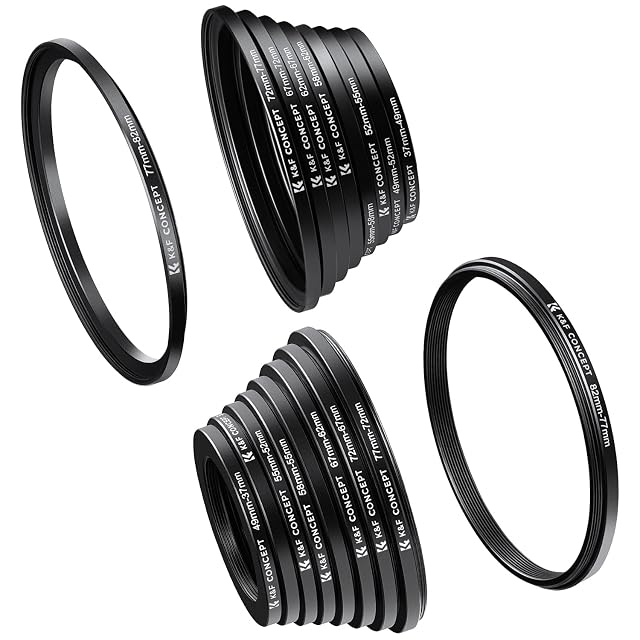
  3. K&F Concept eighteen-piece filter ring set in its two rows of nine

    K&F CONCEPT Eighteen rings, nine up and nine down

    Eighteen rings for 23 €, nine up and nine down — the only set on this shelf that can fit a smaller filter to a larger lens, with the vignetting that implies.

    Mounts joined
    NONE, again: filter threads. The first bullet says the set matches a lens thread to the thread of any other accessory, which is the clearest statement of the job on this shelf. The 95 € Canon and the 185 € Nikon here are the mount adapters
    Contacts present
    None
    Functions claimed
    Fitting, in both directions — and the second direction is what distinguishes this set. The second bullet lists nine step-up rings, the third nine step-down, and the fourth says the ring screws easily onto the front of any lens
    Optical elements
    None
    Tripod foot
    Not applicable
    Aperture ring
    Not applicable
    Build
    Described in the first bullet as extremely robust and light, with NO MATERIAL NAMED — where the 11 € Belmalia and the 11 € CAMKIX both say anodised aluminium. The fifth bullet promises a perfect, secure fit with no wobble and no thread wear
    Amazon reference
    B00JL4HGAI (same reference on 6 Amazon marketplaces)
    EAN
    0700424378524
    • Eighteen rings, and the only step-down set on this shelf
    • The step-up half matches the nine sizes of the 11 € CAMKIX set exactly
    • No material named, where both 11 € sets specify anodised aluminium

    Best for: A bag where a filter is sometimes larger than the lens and sometimes smaller — a compact lens borrowing a big filter one day, a big lens borrowing a small one the next.

    ≈ $28 / £22 / 23 €
    Check price on Amazon
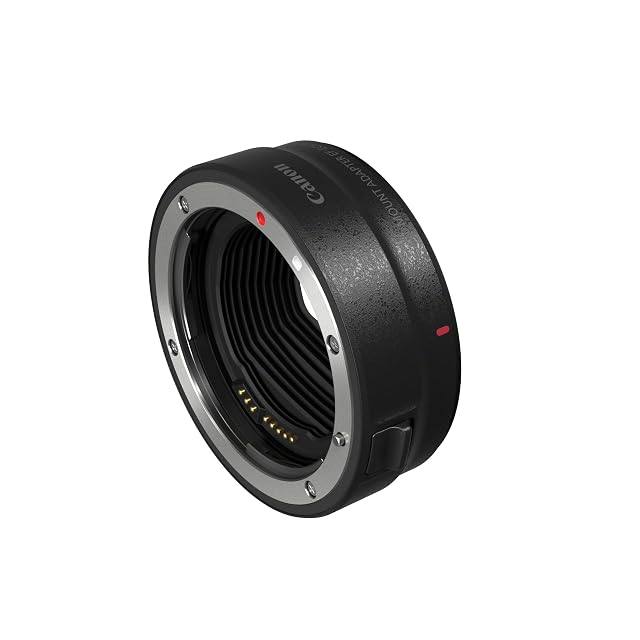
  4. Canon EF-EOS R mount adapter between an EF lens and an RF body

    Canon EF and EF-S lenses onto RF bodies

    Ninety-five euros to put EF and EF-S lenses on an RF body, with ten cameras named, a sealed metal mount, and two caps and a pouch in the box.

    Mounts joined
    EF and EF-S to RF — a real mount adapter, unlike the three ring sets on this shelf, which join filter threads. The intro above explains why this direction works at all: an adapter can only add to the distance between mount face and sensor, and EF is the longer-flanged system, so the gap is filled by an empty tube rather than corrected by glass
    Contacts present
    Not itemised, and that is the gap on this page. The first bullet claims existing EF and EF-S lenses work with performance unchanged and in parts better, and the fourth says the body generates a crop for EF-S lenses — both of which require the body to know what is attached. The contacts are implied throughout and never listed
    Functions claimed
    Performance "unchanged and in parts better", in the first bullet. The intro above asks for functions one at a time — autofocus, aperture control, stabilisation communication, metadata — and this page names none of them individually, which is the pattern that tip warns about
    Optical elements
    None named, and none is needed here. EF sits further from the sensor than RF, so the adapter is a spacer; the corrective element the intro above describes belongs to adapters working the other way, against the flange distance
    Tripod foot
    Not mentioned. The intro above says a foot matters as soon as the lens outweighs the body, which on a mirrorless body with a long EF telephoto is most of the time
    Aperture ring
    Not on this version. The page describes one adapter and names no control ring and no filter slot
    Build
    A metal mount, dust- and splash-protected, in the third bullet. The fifth lists what comes with it: the adapter, an R-F-3 body cap, an RF rear lens cap, a pouch and a manual — two caps, because an adapter left on the body means the lens cap and the body cap no longer fit what they were bought for
    Amazon reference
    B07H5SL6W3 (same reference on 6 Amazon marketplaces)
    EAN
    4549292115703
    • Ten RF bodies named on the page, rather than a mount specification alone
    • A dust- and splash-protected metal mount, at 95 €
    • No function list: "performance unchanged and in parts better" stands in for autofocus and aperture claims

    Best for: A bag of EF glass moving onto an RF body, where the lenses are to keep working exactly as they did.

    ≈ $121 / £98 / 95 €
    Check price on Amazon
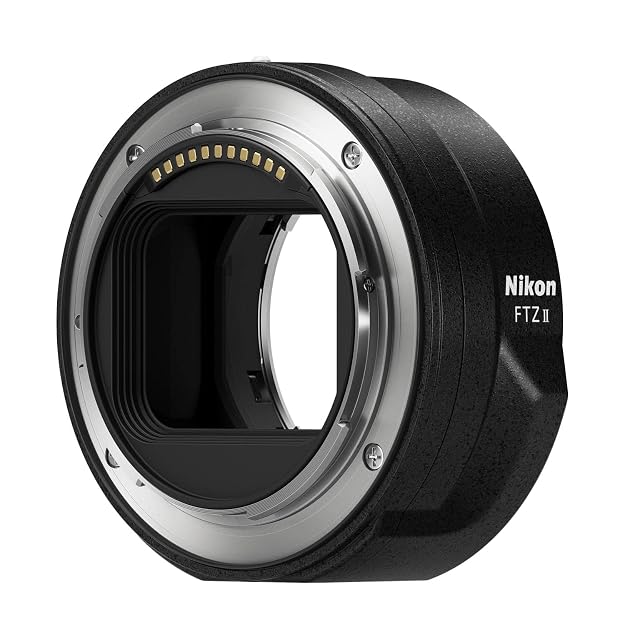
  5. Nikon FTZ II adapter mounted between an F-mount lens and a Z-mount body

    Nikon FTZ II — F lenses onto Z bodies

    One hundred and eighty-five euros to put F-mount lenses on a Z body, with full autofocus and auto exposure claimed for "numerous" of them — and four bullets that name none.

    Mounts joined
    F to Z — the second true mount adapter on this shelf, beside the 95 € Canon. The intro above explains the direction: F sits far from the sensor because it was built around a mirror, Z sits close, so the adapter restores a distance rather than correcting an optical error
    Contacts present
    Not itemised, but necessarily there: the second bullet claims full autofocus and automatic exposure, and neither is possible through a passive tube. The page never says how many contacts or what else passes — stabilisation communication and metadata are not mentioned
    Functions claimed
    Two, and separately, which is more than any other adapter page here manages: FULL AUTOFOCUS and AUTOMATIC EXPOSURE, for "numerous" F lenses. The intro above warns that claims of this kind are graded rather than binary and that makers usually publish a compatibility list; the word "numerous" is doing the work of that list
    Optical elements
    None named, and none is required in this direction
    Tripod foot
    Not mentioned anywhere in four bullets. The intro above calls a foot important as soon as the lens outweighs the body, which describes most F-mount telephotos on a Z body
    Aperture ring
    Not mentioned. Older F lenses with no electronic aperture depend on how the adapter drives the mechanical lever, and the page says nothing about that at all
    Build
    Robust and protected against dust and splashes, in the fourth bullet, with good ergonomics claimed in the first. The third bullet — "a new level of sharpness" — is a claim about image quality on a device this page never says contains an optical element
    Amazon reference
    B09KKTQSQ9 (same reference on 6 Amazon marketplaces)
    EAN
    4960759909121
    • Autofocus and automatic exposure claimed as two separate functions, not as one word
    • Dust and splash protection on a 185 € adapter, matching the 95 € Canon here
    • Four bullets, and not one names a lens or a body

    Best for: F-mount glass moving onto a Z body, for a buyer who will check their own lenses against the maker’s published list elsewhere.

    ≈ $226 / £148 / 185 €
    Check price on Amazon

Each amount in a write-up is what the listing showed when that page was written. The figure next to the product is pulled in as you read, and it is the one that counts.