Skip to content

The best camera hard cases for 2026

A hard case is bought for transport rather than for carrying, and its specification is unusually honest because most of it is standardised. Internal dimensions decide everything and are always published, since the case is a box first. The ingress rating is an IP code where the maker gives one, and it describes dust and water separately; a case can be dust-tight and only splash-resistant, and the two digits say so. A pressure equalisation valve is what lets a sealed case be opened after a flight or a change of altitude, and its absence is felt exactly once. The interior is a choice between cubed foam that is torn to shape and cannot be undone, custom-cut foam ordered for a known kit, and padded dividers that can be rearranged; the first is cheap and final. Then the hardware that gets used every day: latches that can be worked with cold hands, provision for padlocks or a seal, hinges that are stainless rather than moulded, and whether wheels and a pull handle are fitted — a large case without them is a two-person object. Published empty weight is the figure that decides whether it can go as hold luggage at all. We compare internal dimensions, ingress rating, interior type, pressure valve, latch and lock provision, wheels and handles, and empty weight.

The accessories that earn their place in the bag

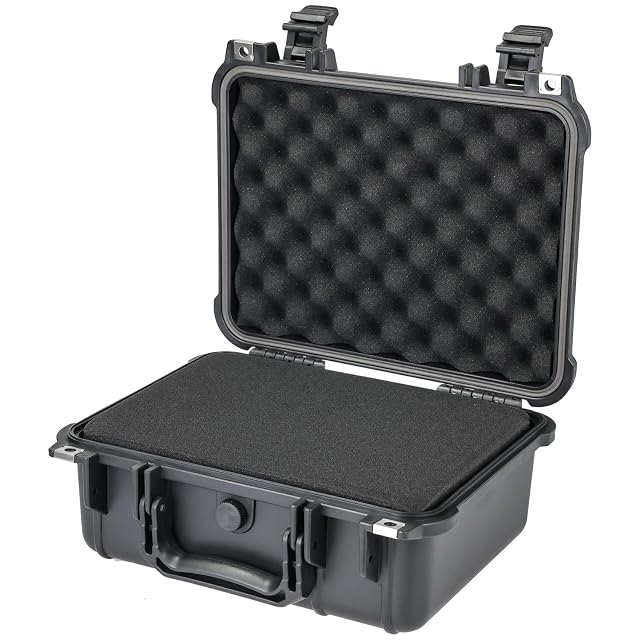
  1. HMF ODK100 hard case open showing its pick-and-pluck grid foam

    HMF ODK100, 30.5 by 23 by 14 cm inside, IP67, 1.82 kg

    Forty euros for an IP67 case that publishes everything: 30.5 by 23 by 14 cm inside, split 10.5 and 3.5 between base and lid, three foam layers, 1.82 kg.

    Internal dimensions
    THE MOST COMPLETE FIGURES IN THIS CATALOGUE: 30.5 by 23 by 14 cm inside, and the fifth bullet goes further by splitting the depth — 10.5 cm in the base, 3.5 cm in the lid — inside an exterior of 34 by 29.5 by 15.5 cm measured INCLUDING the handle and catches. The split is what tells you whether a body with a lens fitted stands up in the base
    Ingress rating
    IP67, in the second bullet: dust-tight, and protected against immersion in water to one metre for thirty minutes. It is a standard rather than an adjective, and both cases on this shelf publish it
    Interior type
    THREE LAYERS, itemised in the third bullet: 95 mm of pre-cut grid foam — the pick-and-pluck kind, plucked cube by cube to the shape of the equipment — a 10 mm foam floor beneath it, and CONVOLUTED egg-crate foam in the lid to press down on whatever is below
    Pressure valve
    YES, a pressure-equalisation valve in the fourth bullet. A sealed case carried up a mountain or flown in a hold arrives at a different air pressure from the one it was closed at, and without a valve the lid either jams shut or strains its seal
    Latch and lock provision
    A folding carry handle and EYES FOR PADLOCKS, in the fourth bullet. Padlock eyes are what let a case be checked into a hold or left in a vehicle
    Wheels and handles
    A folding handle, no wheels — correct at this size. Thirty-four centimetres and 1.82 kg is a case that is carried
    Empty weight
    1.82 kg, PUBLISHED in the fifth bullet — the only empty weight on this shelf, and the figure that decides what an airline allowance leaves for the equipment
    Amazon reference
    B08K3JBWP7 (same reference on 5 Amazon marketplaces)
    EAN
    4010537103422
    • Internal dimensions published with the base and lid depths split out
    • Three foam layers named — pick-and-pluck, floor and convoluted lid
    • No wheels, though at 34 cm none is needed

    Best for: A body, two lenses and a drone taken somewhere wet, dusty or airborne, where the case has to be locked and its weight declared.

    ≈ £34 / 40 €
    Check price on Amazon
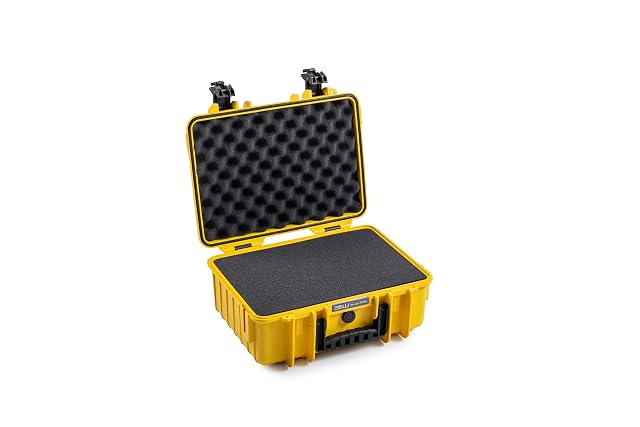
  2. B&W International yellow Type 4000 case open with its cubed foam layers

    B&W International Type 4000, IP67, −30 to +80 °C, stackable

    A hundred euros for an IP67 polypropylene case rated from −30 to +80 °C, stackable, with three layers of cubed foam and two 7 mm padlock eyes.

    Internal dimensions
    NOT PUBLISHED, and it is the one specification this page owes. The 40 € HMF on this shelf publishes its interior, its exterior AND the split between base and lid; this page describes the foam that fills a space it never measures
    Ingress rating
    IP67, in the third bullet — dust-tight and protected against immersion to one metre for thirty minutes, the same standard as the HMF here
    Interior type
    THREE LAYERS of pre-cut CUBED foam, in the first bullet, plucked cube by cube to fit a camera, a drone, tools, electronics or measuring equipment, with lid and base foam completing the protection. Three layers is more material to work with than the single 95 mm block of the 40 € HMF
    Pressure valve
    YES, and AUTOMATIC, in the third bullet — paired there with the temperature range, which is the right pairing: air expands and contracts with heat as well as altitude, and a valve is what keeps the seal from doing the work
    Latch and lock provision
    TWO sturdy front catches holding the case closed, and TWO EYES OF 7 mm DIAMETER for padlocks, in the fifth bullet. Publishing the eye diameter is unusual and useful: it says which padlock will actually pass through
    Wheels and handles
    A RUBBERISED carry handle, in the fourth bullet, and a STACKABLE construction that saves space in a vehicle, a store or on a shelf. No wheels. Stackability is a working feature — cases that stack are cases that travel in a van without sliding
    Empty weight
    Not published, where the 40 € HMF gives 1.82 kg
    Amazon reference
    B00H3R5Z5S (same reference on 6 Amazon marketplaces)
    EAN
    0013039312914
    • Rated from −30 to +80 °C, the only temperature range in this catalogue
    • Three layers of cubed foam, with lid and base foam as well
    • No internal dimensions published, at 100 €

    Best for: Equipment that travels in a vehicle through real cold or real heat, stacked with other cases and padlocked.

    ≈ £117 / 100 €
    Check price on Amazon

Each amount in a write-up is what the listing showed when that page was written. The figure next to the product is pulled in as you read, and it is the one that counts.