Skip to content

The best tripod heads for 2026

A head is bought separately from the legs it sits on, and the two publish their own load ratings — the lower of the pair is the one that governs, whatever the more flattering number on the box says. The type settles how it moves: a ball head swings freely and locks in one action, a three-way head separates the axes so one can be adjusted without disturbing the others, a gimbal carries a long lens balanced over its pivot, and a fluid head is built for panning under video. Then the declared load, which is a static figure: it describes what the head holds without slipping, and it says nothing about vibration at the moment of release or the torque it keeps once tilted well away from level. The plate is the part that decides what else in a bag still fits — the dovetail profile named after Arca is the one most third parties cut to, while proprietary profiles tie a head to its own maker. Under the head, the thread is either 3/8-16 or 1/4-20, and adapters between the two are cheap and easy to lose. Look also for a separate panning base with degree markings, a bubble level, and whether the friction control is a separate knob or shares the main lock. We compare head type, declared load, plate standard, mounting thread, panning base and markings, locking and friction controls, and published weight.

The accessories that earn their place in the bag

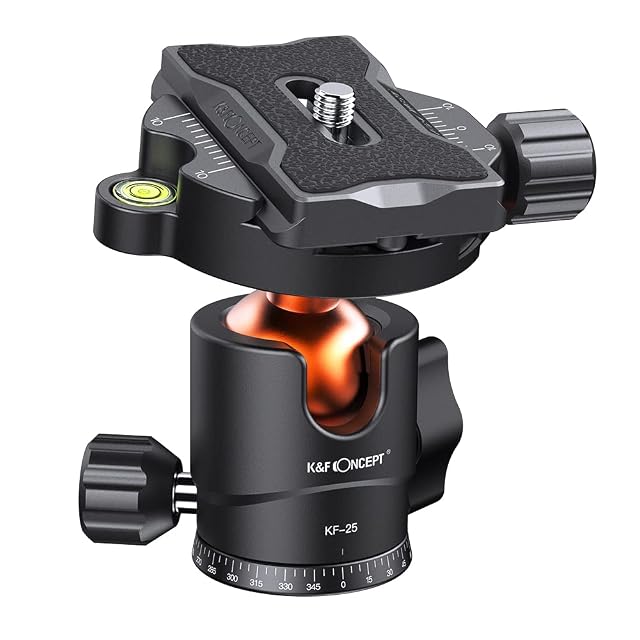
  1. K&F Concept KF-25 ball head in black with its three control knobs and bubble level

    K&F CONCEPT KF-25 ball head, 10 kg, 205 g

    Ten kilograms declared from 205 g of aluminium at 26 €, with a graduated ball, a bubble level and three knobs — and a plate whose profile the page never names.

    Head type
    A ball head, in the title and throughout. The hub above describes the type as swinging freely and locking in one action — faster than a three-way head and less precise when only one axis should move. The third bullet adds a scale on the ball itself, which is unusual at this price and lets an angle be returned to
    Declared load
    10 kg, in the first bullet, credited to a high-grade aluminium alloy. Read it against the shelf next door: the tripods in this catalogue top out at 6.35 kg, and the hub above says the lower of the two ratings governs. A 10 kg head does not make a 6 kg tripod carry more
    Plate standard
    Not named. The fourth bullet gives a removable quick-release plate with a 1/4 inch thread for all reflex cameras, and never says whether the dovetail follows the Arca profile or the maker’s own. The hub above calls the plate the part that decides what else in a bag still fits, and this page leaves that unanswerable
    Mounting thread
    Both, in the fourth bullet: a 1/4 inch thread above for the camera, and 3/8 inch screw holes below so the head mounts on a tripod, a monopod or a camera slider. Naming all three destinations is more than most heads bother with
    Panning base and markings
    A scale on the ball, in the third bullet, with three knobs controlling the ball and the panorama. The page does not describe a separate panning base under the head — so whether the horizontal movement is independent of the ball cannot be read, and on a ball head that is the difference between a level pan and a drifting one
    Locking and friction controls
    Three knobs, in the third bullet, for the ball and the panning movement. The second bullet claims strong locking force and names the bubble level as what brings the camera to level. No separate friction control is described — so the knob either holds or releases
    Published weight
    205 g, in the fifth bullet, with a height of 80 mm. At 205 g it is a sixth of the Manfrotto’s mass, and the page pairs both figures with portability
    Amazon reference
    B08VW91D74 (same reference on 6 Amazon marketplaces)
    EAN
    6942052556729
    • Two hundred and five grams and 80 mm tall, with both figures published
    • A scale on the ball and a bubble level, so an angle can be levelled and returned to
    • The plate profile is never named, so what else it fits is unknown

    Best for: A light tripod or monopod that needs a head which locks in one action and weighs almost nothing.

    ≈ $25 / £21 / 26 €
    Check price on Amazon
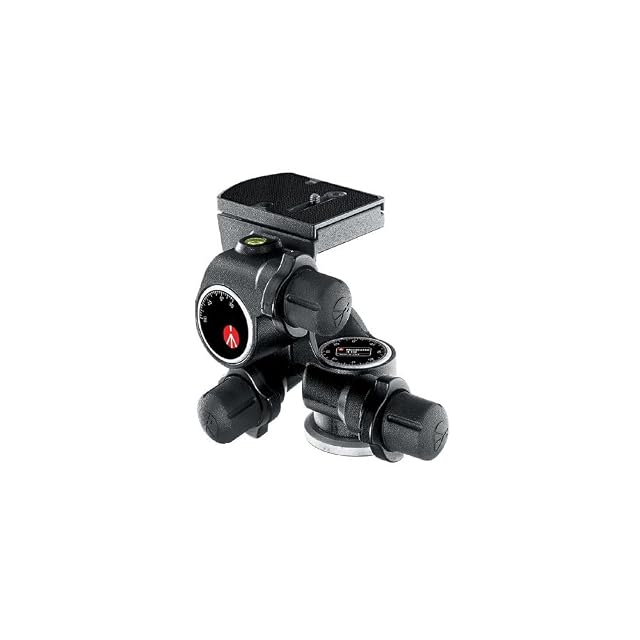
  2. Manfrotto 410 Junior geared head with its three adjustment knobs and levelling bubble

    Manfrotto 410 Junior geared head, 5 kg, 1.22 kg

    A geared head at 229 € — the only one here adjusted by turning knobs rather than releasing a ball — carrying 5 kg and weighing 1.22 kg, six times the 205 g K&F beside it.

    Head type
    A geared head, and it is the only one in this catalogue. The first bullet claims extreme precision control in three directions from the gearing and the bubble level. The hub above describes a three-way head as separating the axes so one can be adjusted without disturbing the others; a geared head goes further — each axis is driven by a worm gear, so it moves by fractions of a degree and cannot slump when released
    Declared load
    5 kg, in the fifth bullet, alongside the weight of 1.22 kg. It is the smallest rating of the three heads here — a third of the NEEWER’s 15 kg — and it is the one figure that sits within reach of the tripods next door, which top out at 6.35 kg
    Plate standard
    The Manfrotto 410 plate, named in the third bullet as supplied. It is a proprietary profile, which the hub above warns commits every future clamp to the same maker. That is the cost of this head: the plates are not the dovetail most third-party gear is cut for
    Mounting thread
    Not published. Five bullets describe the gearing, the locking, the plate, the format range and the weight, and no thread size appears — so whether it takes 3/8 inch alone or both is unknown before it arrives
    Panning base and markings
    Not described as a separate base. The first bullet claims precision in three directions and the gearing implies markings on each axis, but no scale and no independent panning foot is named. On a head sold for precision that is a surprising silence
    Locking and friction controls
    A locking system named in the second bullet as allowing fast and secure movement between shots. On a geared head the gear itself is the friction — nothing is released and re-caught, which is precisely why architectural and product photographers buy them
    Published weight
    1.22 kg, in the fifth bullet. It is six times the K&F on this shelf and nearly four times the NEEWER, and it is the honest price of gearing: three worm drives and their housings weigh what they weigh
    Amazon reference
    B000JLI4Q2 (same reference on 6 Amazon marketplaces)
    EAN
    0719821156376
    • Geared adjustment on three axes, the only head in this catalogue that moves by fractions of a degree
    • Nothing slumps when a control is released, which is what makes a framing repeatable
    • A proprietary plate profile, which ties every future clamp to one maker

    Best for: Architecture, product and copy work on a solid tripod, where a framing has to be adjusted by millimetres and held exactly.

    ≈ $219 / £229 / 229 €
    Check price on Amazon
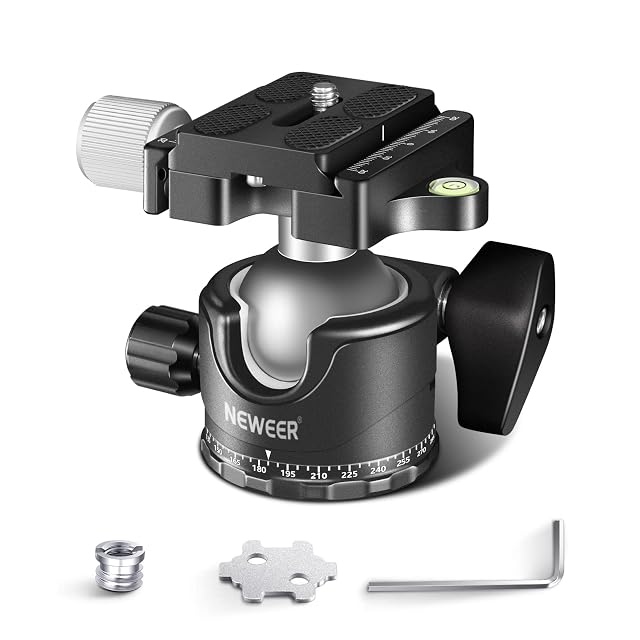
  3. NEEWER GM36 low-profile ball head with its Arca plate and panning scale

    NEEWER GM36 low-profile ball head, 15 kg, Arca 38 mm

    Fifteen kilograms declared and the only Arca-compatible plate named on this shelf, on a low-profile ball head weighing 310 g at 43 €.

    Head type
    A low-profile ball head with a 36 mm ball, in the title and the first bullet, which gives the reason for the shape: a lower centre of gravity makes the head more stable. The third bullet adds 360 degrees of pan and 90 of tilt in a U-shaped notch — the cutout that lets a camera drop into portrait orientation
    Declared load
    33 lb, 15 kg, in the first bullet — the largest figure on this shelf and more than twice what any tripod in this catalogue declares. The hub above says the lower of the head and legs governs, so this head will never be the limiting part of any assembly built from these pages
    Plate standard
    Arca-compatible, 38 mm, named explicitly in the second bullet with a 1/4 inch fixing screw and rubber pads to protect the camera. It is the ONLY page of the three here to name a profile, and the hub above says to read the plate before the load figure precisely because an Arca dovetail joins what most bags already contain
    Mounting thread
    A 3/8 inch thread below with a 3/8 to 1/4 inch screw adapter supplied, in the first bullet, said to fit most tripods, monopods and sliders. Supplying the adapter matters: it is the small brass ring that otherwise lives at the bottom of a bag until it is lost
    Panning base and markings
    A separate panning foot with a 360 degree scale, in the third bullet, credited with precise and smooth panoramic work, plus a bubble level for keeping the horizon straight. A panning base independent of the ball is what lets a level pan stay level — the K&F below it describes no such base
    Locking and friction controls
    Three locking knobs, in the fifth bullet: release them to set the ball freely, turn the camera gently for a panorama, release the plate. No separate friction adjustment is named, so the ball either holds or moves
    Published weight
    310 g, in the fourth bullet, with CNC-milled aluminium alloy named as the material. Half again the weight of the K&F, for half again the declared load
    Amazon reference
    B0B8CKD3TN (same reference on 6 Amazon marketplaces)
    EAN
    0191073122574
    • A 38 mm Arca-compatible plate, the only named profile on this shelf
    • Fifteen kilograms declared, more than twice what any tripod in this catalogue carries
    • No friction control, so the ball holds or releases with nothing in between

    Best for: Any tripod, monopod or slider in this catalogue, for a photographer who already owns Arca-profile plates and wants the head to stop being the limit.

    ≈ $36 / £38 / 43 €
    Check price on Amazon

Each amount in a write-up is what the listing showed when that page was written. The figure next to the product is pulled in as you read, and it is the one that counts.