Skip to content

The best close-up lenses for 2026

A close-up lens screws into the filter thread and lets a lens focus nearer than it was built to, which is the cheapest route into close work and the one with the fewest side effects on exposure. Strength is quoted in dioptres: a +2 brings the focus closer than a +1, the numbers add when two are stacked, and the practical result depends on the focal length of the lens underneath, so the same +4 behaves very differently on a wide lens and on a short telephoto. The critical number to match is the filter thread in millimetres, printed on the lens barrel beside the ⌀ symbol; a step ring joins a larger accessory to a smaller thread, never the other way round without vignetting. Construction is what separates the shelf: a single-element dioptre is a magnifying glass and shows it at the edges, while an achromatic doublet corrects colour fringing and costs several times as much for a visible reason. Unlike extension tubes, a close-up lens costs no light, keeps every electronic function of the lens intact, and needs no communication with the body at all. What it does reduce is working distance, which matters when the subject is alive. We compare dioptre strength, filter thread, element count and whether the set is achromatic, coating described, and what a multi-piece set contains.

The accessories that earn their place in the bag

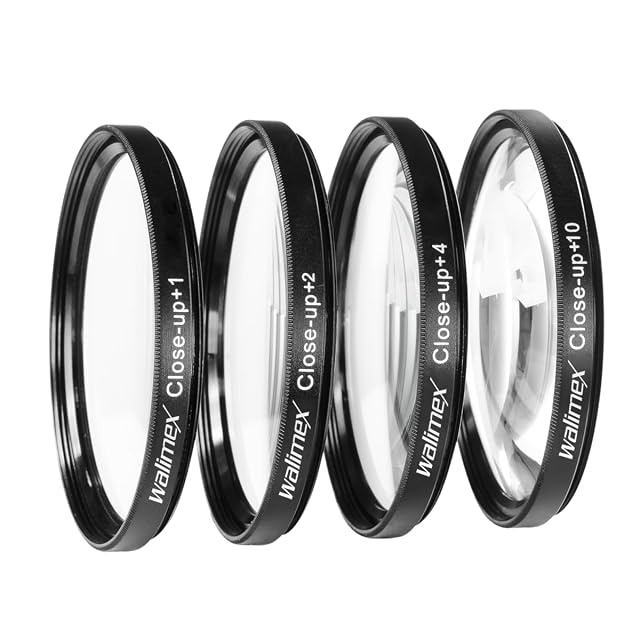
  1. Walimex pro close-up lens set of four filters in its protective case

    Walimex pro Four dioptres, +1 +2 +4 +10, 72 mm

    Twenty euros for the full +1 to +10 ladder in 72 mm, in a case, keeping every electronic function — from a page whose first bullet describes its own effect backwards.

    Dioptre strength
    Four: +1, +2, +4 and +10, in the first bullet. That is the complete ladder, and the intro above explains that the numbers add when two are stacked — so +1 and +2 together give +3, and the four supplied here reach seventeen combinations before the set is exhausted
    Filter thread
    72 mm, in the title and the third bullet, which says they screw onto any lens with a 72 mm thread quickly and need no other accessory. The buying advice above says to buy for the largest thread in the bag and step down, and 72 mm is the largest on this shelf beside the two 77 mm sets
    Element count
    NOT PUBLISHED. The second bullet says high-quality glass elements and nothing more: no count, no doublet, no achromatic claim. The intro above makes that the dividing line on this shelf — a single element is a magnifying glass and shows it at the edges, and only the 139 € NiSi here claims a corrected pair
    Whether the set is achromatic
    NO — nothing on the page claims it. The second bullet says high-quality glass elements and stops there: no doublet, no apochromatic design, no correction of colour fringing. The intro above makes that the dividing line on this shelf, so single elements should be assumed, with the softness at the edges that implies. Only the 139 € NiSi here claims a corrected pair. What this page does claim, in the same bullet, is that no light is lost and no exposure extended — which is true of every dioptre, corrected or not
    Coating described
    Not described at all. The 53 € K&F set on this shelf names a multi-layer AR nano coating and the 139 € NiSi a multilayer nano coating; this page names none
    What a multi-piece set contains
    Four lenses and a robust protective case, in the fifth bullet, credited with keeping the glass safe from scratches, dust and dirt
    Amazon reference
    B0073AMWO2 (same reference on 6 Amazon marketplaces)
    EAN
    4250234578608
    • The complete +1 to +10 ladder for 20 €, in a 72 mm thread
    • Autofocus and metering explicitly stated to remain unaffected
    • No element count and no achromatic claim, so single elements should be assumed

    Best for: A 72 mm lens and a first look at close-up work, where four strengths for 20 € matter more than corrected colour at the edges.

    ≈ 20 €
    Check price on Amazon
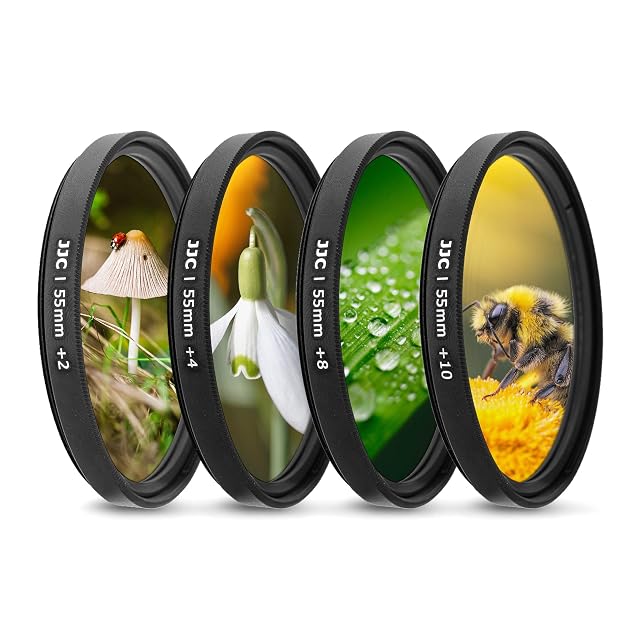
  2. JJC close-up filter set of four in 55 mm with its soft pouch

    JJC Four dioptres, +2 +4 +8 +10, 55 mm

    Twenty-two euros for +2, +4, +8 and +10 in 55 mm — the only close-up set on this shelf that names the lenses it was made for, and the only one with a +8.

    Dioptre strength
    Four: +2, +4, +8 and +10, in the fifth bullet. The ladder is unlike every other on this shelf — it has no +1 and it is the only one with a +8 — which means the gentlest strength here is twice the gentlest elsewhere, and the useful middle of the range is better covered
    Filter thread
    55 mm, in the title and the third bullet, which is the smallest on this shelf. The buying advice above prefers the largest thread in the bag with step rings below it, so a 55 mm set is bought for a specific lens rather than for a system
    Element count
    Not published. The second bullet gives high-grade optical glass in an aluminium-alloy frame, credited with magnifying the image while keeping resolution and clarity. No doublet, no achromatic claim
    Whether the set is achromatic
    NO, and no claim is made either way. The second bullet gives high-grade optical glass in an aluminium-alloy frame and credits it with keeping resolution and clarity while the image is magnified — a claim about the frame and the glass quality, not about colour correction. No doublet and no apochromatic design are mentioned, so single elements should be assumed. The 139 € NiSi on this shelf is the only corrected one
    Coating described
    No coating is named. What the second bullet does claim belongs to the frame rather than the glass: it is said to prevent stray light entering at the edge of the filter, which is a matter of blackened metal and thread depth
    What a multi-piece set contains
    Four filters of different dioptres and a protective filter pouch, in the fourth and fifth bullets. A pouch rather than the hard case of the 20 € Walimex pro or the EVA box of the 53 € K&F
    Amazon reference
    B08Q3HTYB4 (same reference on 5 Amazon marketplaces)
    EAN
    6941586676774
    • Four lenses named on the page, which no other close-up set here does
    • A +8 in the ladder, filling the gap between +4 and +10
    • Fifty-five millimetres is the smallest thread here, so it fits fewer lenses

    Best for: One of the four lenses named on the page, or any other 55 mm lens, where the middle of the dioptre range matters more than the gentlest step.

    ≈ £20 / 22 €
    Check price on Amazon
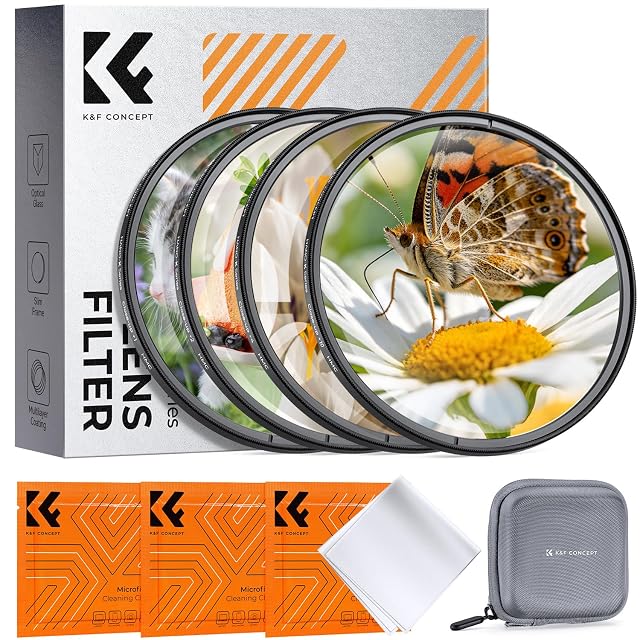
  3. K&F Concept close-up filter set in its four-compartment EVA case

    K&F CONCEPT Four dioptres, +1 +2 +4 +10, 77 mm, nano coating

    Fifty-three euros for +1 to +10 in 77 mm with a nano coating, an EVA case — and the only page here that names the aperture and the focal length to use.

    Dioptre strength
    Four: +1, +2, +4 and +10, in the first bullet, which also says several filters can be combined to increase magnification and that the higher the dioptre the shorter the close range. That last clause is the working-distance answer the other pages leave out
    Filter thread
    77 mm, in the title — the size the buying advice above recommends buying for, because a step ring brings a large filter down to a small lens and costs 11 € on this same shelf
    Element count
    Not published. The second bullet describes highly transparent optical glass with a coating; it claims no doublet and no apochromatic correction, which is what separates it from the 139 € NiSi. The first bullet is candid about the trade: this is macro at a fraction of the cost of a macro lens
    Whether the set is achromatic
    NO — and this page is the one that says so between the lines. Its first bullet calls the set macro at a fraction of the cost of a macro lens, and its answer to edge softness is advice rather than glass: stop down to F5.6–F11, stay at 35 mm or longer. The coating is multi-layer and described at length; the CORRECTION is never claimed, and a coating suppresses reflections rather than colour fringing. The 139 € NiSi here is where the doublet begins
    Coating described
    FULLY, and it is the best coating description on this shelf: a multi-layer AR nano coating on highly transparent optical glass, credited with markedly increased transmission, stray-light-free imaging, effective suppression of flare and ghosting, and an image with no darkening and no colour cast
    What a multi-piece set contains
    A high-density EVA case with four separate compartments, described as shock-, break- and pressure-resistant, plus THREE dust-free vacuum-packed cleaning cloths, in the fourth bullet. The fifth adds a precision-machined metal filter ring and scratch-resistant glass
    Amazon reference
    B0H86QPKBH (same reference on 6 Amazon marketplaces)
    EAN
    6942610305493
    • The only page here that names an aperture range: F5.6 to F11 for best sharpness
    • The only one that names a focal length floor: 35 mm and up, to avoid vignetting
    • No element count and no achromatic claim, at 53 €

    Best for: A 77 mm lens used carefully — stopped down, at 35 mm or longer — where the coating and the advice are worth more than the extra 33 €.

    ≈ $44 / £52 / 53 €
    Check price on Amazon
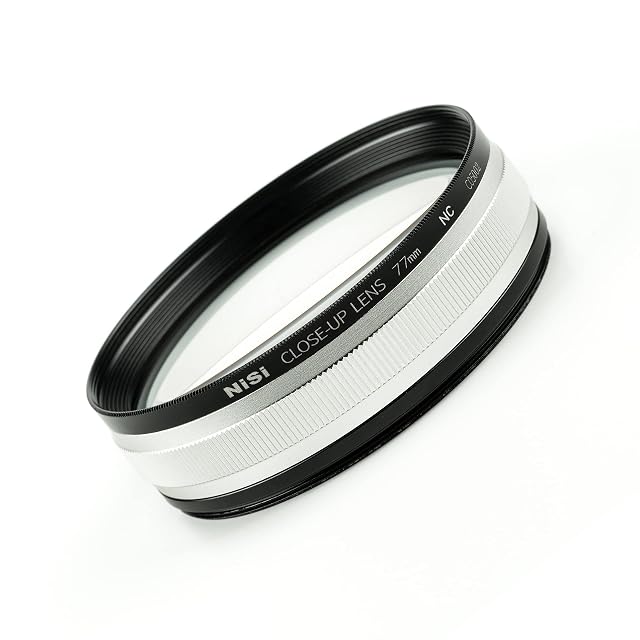
  4. NiSi 77 mm close-up lens with its two step-up rings and caps

    NiSi ONE achromatic doublet, 77 mm, about 1:1 at 200 mm

    One corrected doublet rather than four single elements — apochromatic, coated, with two step-up rings, quoted at about 1:1 at 200 mm, for 139 €.

    Dioptre strength
    NOT GIVEN IN DIOPTRES — and that is deliberate. The second bullet quotes a reproduction ratio instead: about 1:1 when used at 200 mm, on a zoom or prime in the 70 to 300 mm range. A ratio says what fills the frame; a dioptre only says where the glass focuses, and the intro above explains that the same dioptre behaves differently on every focal length
    Filter thread
    77 mm, with TWO STEP-UP RINGS in the box — 67-77 and 72-77 mm, in the fifth bullet. That is the buying advice above followed by the maker: buy for the largest thread and step down, and two of the rings that the 11 € Belmalia set on this shelf sells eight of arrive with the lens
    Element count
    TWO, cemented as a DOUBLET, with an apochromatic design, in the first bullet. It is the only corrected close-up lens on this shelf, and the intro above names that as the line that separates the shelf: a single element is a magnifying glass and shows it at the edges, while a doublet corrects colour fringing and costs several times as much for a visible reason
    Whether the set is achromatic
    YES, and it is the only one on this shelf. The first bullet gives two doubled optical glasses in an apochromatic design; the third gives the consequence, a special design against colour shift said to reduce purple and green borders considerably. The intro above explains the price of that: an achromatic doublet corrects colour fringing and costs several times as much for a visible reason — here 139 € against 20 to 53 € for uncorrected sets. It is also one lens rather than four
    Coating described
    A NiSi multilayer nano coating, in the first and fourth bullets, credited with improved resolution, natural colour, optimal clarity, easy cleaning and water- and grease-repellency. Named twice, which on this shelf only the 53 € K&F otherwise manages
    What a multi-piece set contains
    One 77 mm close-up lens, one 67-77 mm adapter ring, one 72-77 mm adapter ring, two lens caps and a pouch, in the fifth bullet. Two caps because a lens of this kind stays on the front of a lens that still needs covering
    Amazon reference
    B07V68MQ5H (same reference on 6 Amazon marketplaces)
    EAN
    6971634248776
    • A two-element apochromatic doublet — the only corrected close-up lens on this shelf
    • Strength quoted as a reproduction ratio, about 1:1 at 200 mm, not as a dioptre
    • One lens, where 20 € to 53 € buys four strengths on this shelf

    Best for: A 70-300 mm telephoto used for close work where purple and green fringing at the edges is the problem to be solved.

    ≈ $155 / 139 €
    Check price on Amazon

Each amount in a write-up is what the listing showed when that page was written. The figure next to the product is pulled in as you read, and it is the one that counts.