Skip to content

The best field monitors for 2026

A field monitor exists because the screen on the back of a camera is small, dim and often facing the wrong way. The specification that decides whether it solves the problem is brightness, published in nits: a panel intended for indoor use disappears in daylight, and the units sold for outdoor work state a figure several times higher and cost accordingly. Size and resolution are read together — a larger panel is easier to judge focus on, and a higher resolution shows detail the camera is actually recording rather than a scaled approximation. Inputs and outputs are the compatibility question: HDMI in its several connector sizes on most units, SDI on those intended for professional cameras, and a loop-through output for feeding a recorder or a second screen. What justifies the purchase beyond size is the tool set: focus peaking that outlines what is sharp, zebra patterns and false colour that show where the exposure is clipping, a waveform, and the ability to load a lookup table so a flat recording profile can be viewed as it will be graded. Power is by camera battery plate — and the plate type ties it to a battery system — or mains. Then mounting: threads and cold shoes on several faces, and whether an articulating arm is included. We compare size and resolution, brightness in nits, inputs and outputs, exposure and focus tools, lookup table support, power and mounting.

The bodies and lenses we compare here

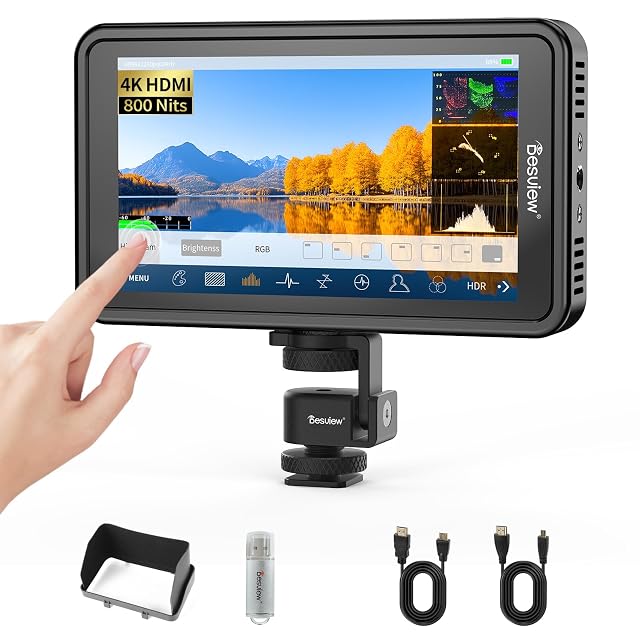
  1. Desview R5II, 5.5 inches, 800 nits, 3D LUT by USB stick

    5.5 inches, touchscreen · 1920 by 1080, 401 PPI, 1000:1, 16:9, 178° viewing, Rec.709 · 800 nits · 4K HDMI IN AND OUT at 30 Hz, 3.5 mm headphone socket · full-screen waveform, histogram, vectorscope, false colour, peaking focus assist and zoom · 3D LUT files imported over USB with a SUPPLIED U-DISK · NP-F550/750/970 or E6 batteries, 7-24 V DC in, 8 V DC OUT to power the camera through a dummy battery · sun hood included · one-year warranty stated

    A 5.5-inch 800-nit touchscreen at 401 PPI that imports lookup tables from a supplied USB stick and can feed 8 volts back into the camera.

    Best for: Log footage that has to be judged through a lookup table on a small, light monitor, on a rig where one battery should run both camera and screen.

    ≈ £139 / 149 €
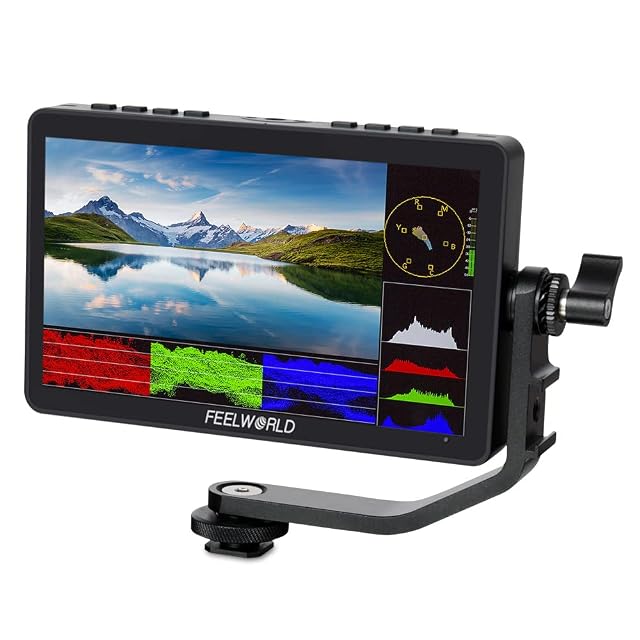
  2. FEELWORLD F5 Pro V4, 5.2 inches, 500 nits, F970 power kit

    5.2 inches — 15.2 cm — touchscreen with pinch-to-zoom · 1920 by 1080 native · 500 nits · 4K HDMI IN AND LOOP-OUT · histogram, false colour, focus assist, embedded audio, pixel-to-pixel, frame guides and a nine-field grid · 3D LUT support with REC-709 calibration · Type-C input, an F970 battery plate, an external POWER KIT for wireless transmitters and LED lights, and an 8.4 V DC output · supplied with micro-HDMI cable, sun hood, tilt arm and removal key · battery and 12 V 1.5 A adapter NOT included

    A 5.2-inch monitor whose back carries a Sony F970 power kit for a wireless transmitter or an LED light — one battery for the whole accessory stack, for 170 €.

    Best for: A rig that already carries a wireless transmitter or a small LED, where one Sony battery should power the lot.

    ≈ $140 / £140 / 159 €

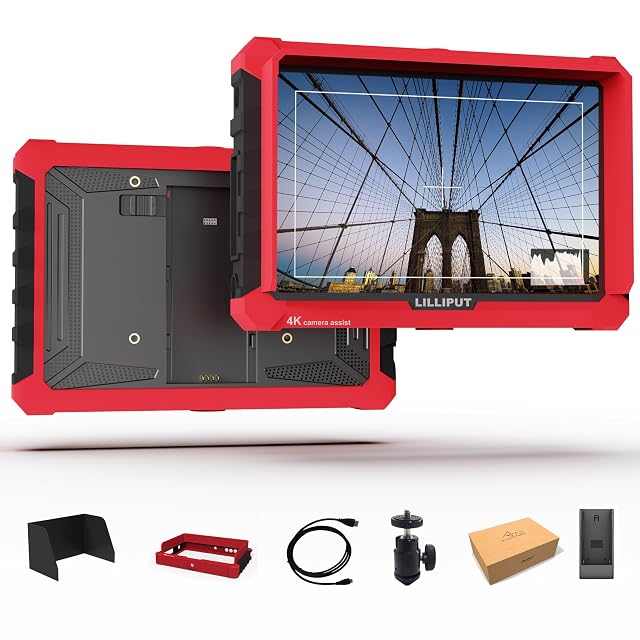
  3. LILLIPUT A7S, 7 inches, 1920 by 1200, 3G-SDI

    7 inches · 1920 by 1200 native — the only monitor here above 1080 — on an 8-BIT panel, 1000:1, 170° wide viewing angle, full lamination · 500 cd/m² · 4K HDMI in and LOOP-OUT plus 3G-SDI, named in the title · full waveform, oscillogram in RGB/YUV/Y, vectorscope, luminance histogram, peaking focus in ten steps and five colours, audio bars, zebra, single colour, false colour, nine fields, de-squeeze, magnification, auto flip, point-to-point, centre marker, safety marker and crop marker · firmware updates from a SUPPLIED U-DISK · F1 and F2 assignable buttons with a dial · silicone rubber case and integrated sun hood · one-year warranty · batteries NOT included

    The only 1920 by 1200 panel on this shelf, with 3G-SDI alongside 4K HDMI and the longest list of monitoring tools here — in a silicone rubber case, for 181 €.

    Best for: A set where an SDI cable runs from the camera to the monitor, and where the extra 120 lines and a published bit depth matter more than brightness.

    ≈ 181 €

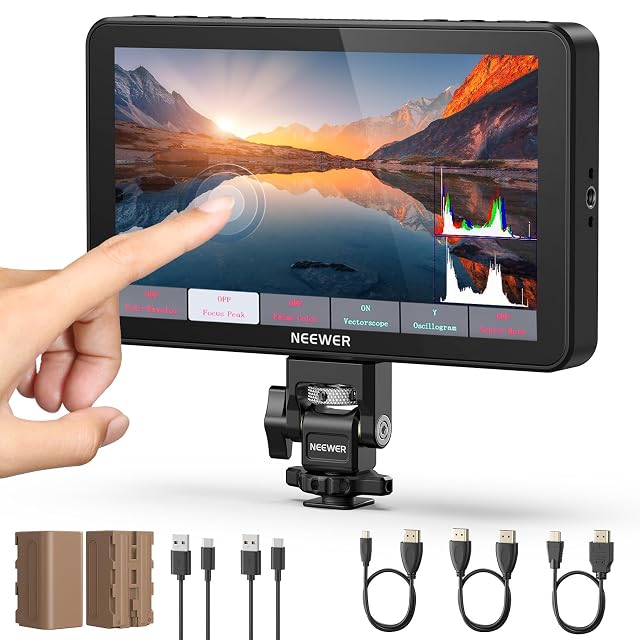
  4. NEEWER F700, 7 inches, 2000 nits, 175 by 107 by 25 mm, 445 g

    7 inches, IPS touchscreen, buttons AND touch (touch disableable) · 1920 by 1080, 1000:1, 16:9, 160° · 2000 NITS, with manual and AUTOMATIC backlight adjustment from 1 to 100 · 4K HDMI loop in and out, with the full format list published, plus a 3.5 mm headphone socket · false colour, zebras, histogram, oscillogram, full waveform, vectorscope, HDR, single colour, peak focus, audio bar, with F1, F2 and F3 shortcut keys · FIFTEEN preinstalled 3D LUTs and up to SIXTY custom ones by SD card · NP-F550/750/970, DC input, Type-C charging, and an 8 V 1.5 A DC OUTPUT as a dummy battery; two NP-F750 cells give 2.4 h each, 4.8 h together · quarter-inch threads on the base AND the side, a cold shoe, 180° adjustment, BUILT-IN FANS · 175 by 107 by 25 mm · 445 g bare, 857 g with two batteries

    Two thousand nits with automatic backlight, fifteen lookup tables preinstalled, built-in cooling fans — and the only monitor here that publishes its dimensions and two weights.

    Best for: Long days in changing light on a camera or a rig that can carry 857 g, where log footage has to look right without any setup.

    ≈ $270 / £255 / 297 €

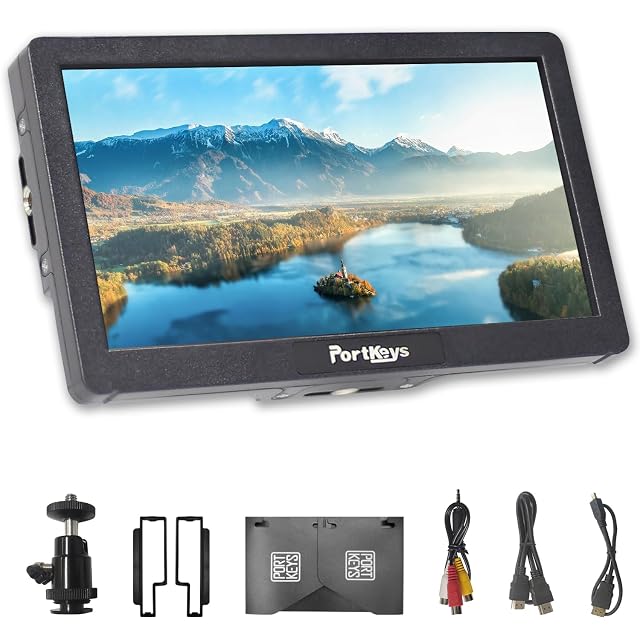
  5. Portkeys HD7H, 7 inches, 1000 nits, 278 g

    7 inches · 1000:1 contrast, resolution not stated as pixels · 1000 nits, on a matte anti-reflective surface · 4K HDMI in at 30p, a NATIVE AV/RCA input, 3.5 mm headphone out and a built-in speaker · focus peaking, false colour, luma histogram, check field and anamorphic de-squeeze to 4.0× · lookup tables NOT mentioned · a single Sony NP-F battery (F970/F750/F550) or 7-24 V DC, 10 W draw · THREE quarter-inch threads and a swivel bracket · 278 g · sun hood included · battery not included

    Seventy-eight euros buys a 1000-nit matte 7-inch monitor with focus peaking, false colour and — alone on this shelf — a native AV input for a Hi8 or MiniDV camcorder.

    Best for: A handheld or gimbal rig where the screen has to survive direct sun, and for anyone still feeding a tape camcorder into a modern setup.

    ≈ $79 / £75 / 88 €

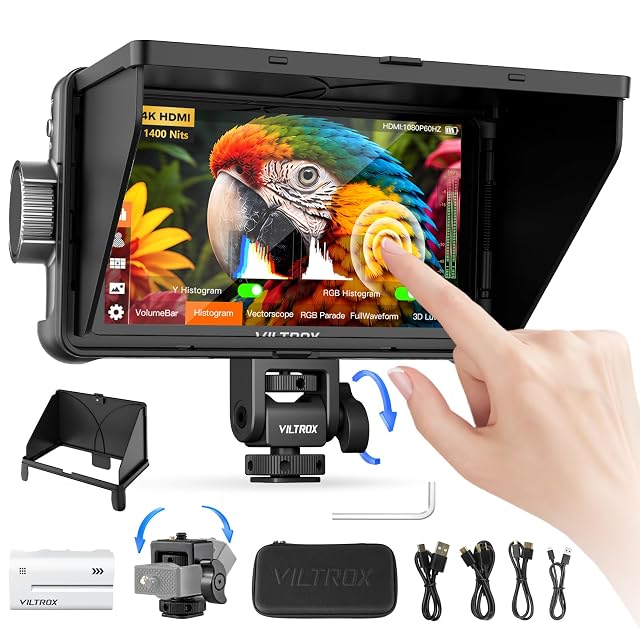
  6. VILTROX DC-550 Pro II, 5.5 inches, 1400 nits, camera control

    5.5 inches, touchscreen · 1920 by 1080, 1000:1, Rec.709 · 1400 nits · 4K HDMI in with loop-through, low latency · parade waveform, vectorscope, luminance histogram, focus assist, audio meter, image flip and false colour · CUSTOM 3D LUTs imported by SD CARD, with a note that export through the colour ring is not supported · CAMERA CONTROL over USB-C for shooting modes, plus an ONION-SKIN function for stop-motion · supplied WITH a VILTROX NP-F550 battery, a carrying case, a hot-shoe adapter, a detachable hood and three cables · diagonal markers and a centre point

    Fourteen hundred nits, camera control over USB-C and an onion-skin mode for stop-motion — and the only monitor here that arrives with a battery in the box.

    Best for: Stop-motion and animation work, and any shoot where the camera should be driven from the monitor rather than from its own buttons.

    ≈ $238 / 278 €

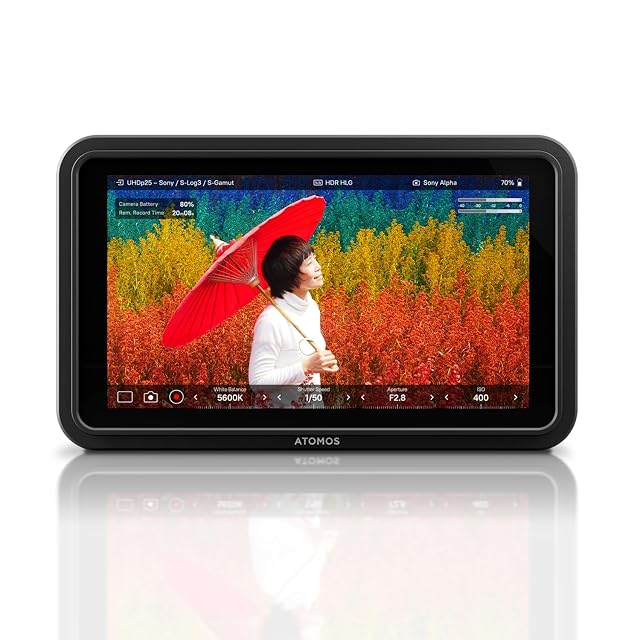
  7. Atomos Shinobi II, 5.2 inches, 1500 nits, HDR

    5.2 inches, IPS · 1920 by 1080 Full HD, HDR · 1500 nits · 4K HDMI input · waveform, histogram, RGB parade, vectorscope, false colour, zebra, focus peaking, zoom and frame guides · LUT SUPPORT stated · CAMERA CONTROL over USB-C for Canon, Sony, Panasonic and Z CAM, including record start and stop and selected parameters · NP-F L-series battery or USB-C Power Delivery · slim body named for gimbals and rigs · no loop-out mentioned · no weight or dimensions published

    Fifteen hundred nits of HDR on 5.2 inches, with camera control for four named systems and power over USB-C Power Delivery — the dearest monitor on this shelf at 395 €.

    Best for: A gimbal or travel rig where HDR monitoring and a power bank matter more than feeding a second screen.

    ≈ $375 / £329 / 395 €

Each amount in a write-up is what the listing showed when that page was written. The figure next to the product is pulled in as you read, and it is the one that counts.