Skip to content

The best camera sliders for 2026

A slider moves the camera in a straight line, which is the difference between a static shot and one with parallax in it. The first thing to read is the gap between two numbers: the rail length and the actual travel, which is always shorter because the carriage itself occupies part of the rail. A listing giving only the rail length is describing what you carry rather than what you get. Declared load is a static figure and has a second condition here that flat supports do not: a slider used vertically or on an incline has to hold the rig against gravity along the rail, and makers state a lower figure for that case when they state one at all. The bearing is what separates a smooth move from a shot that has to be discarded — ball bearings on a rail are the common arrangement, flywheels and adjustable drag add controllable resistance. Motorisation turns the slider into a time-lapse device and brings its own specifications: speed range, whether it can be programmed for shoot-move-shoot, and what powers it. Mounting is the practical part: threads at both ends for two tripods, a single central thread for one, and levelling feet for a table. Then published weight, because a slider is the heaviest thing in most bags. We compare rail length and actual travel, declared load, bearing type, drag control, motorisation, mounting points and weight.

The bodies and lenses we compare here

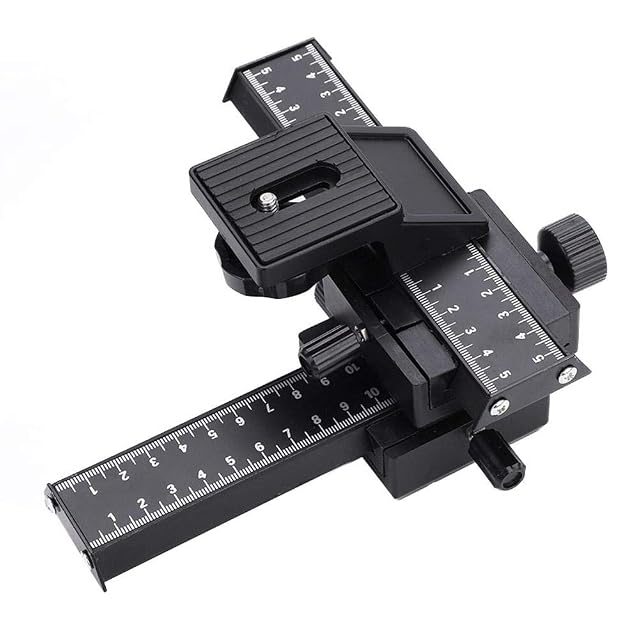
  1. Wakects Dual-axis 4-way macro focusing rail

    A focusing rail rather than a travelling slider · movement in four directions, left, right, forward and back · rack-and-pinion drive with a precision scale · 1/4 inch mounting screw · aluminium alloy · no rail length published · no travel published · no declared load published · no motorisation · no weight published

    A 28 € two-axis macro focusing rail, not a travelling slider: rack and pinion, a precision scale, four directions of movement — and not one dimension published.

    Best for: Macro work on a tripod, where focus is set by moving the camera rather than the lens and the position has to be repeatable.

    ≈ 28 €
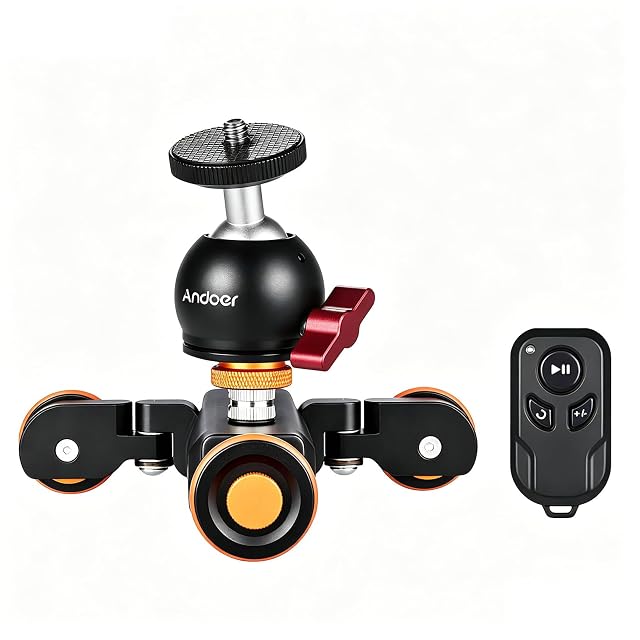
  2. Andoer L4 PRO motorised dolly, three speeds, 3 kg

    A motorised wheeled dolly rather than a rail · three speeds, 2.4, 2.6 and 2.8 cm per second · reversible direction · wheel angle adjustable through 180 degrees for straight or circular paths · declared load 3 kg · wireless remote effective to 6 m · 1/4 to 3/8 inch convertible screw with a ball head supplied · 1800 mAh cell giving up to 6 hours · plastic body · no weight published

    Three published speeds in centimetres per second, a 3 kg load and six hours of battery for 108 € — a motorised dolly whose every figure is stated except its own weight.

    Best for: Time-lapse and slow product moves on a smooth floor or table, where a hands-off motorised drift matters more than a guided rail.

    ≈ £84 / 106 €

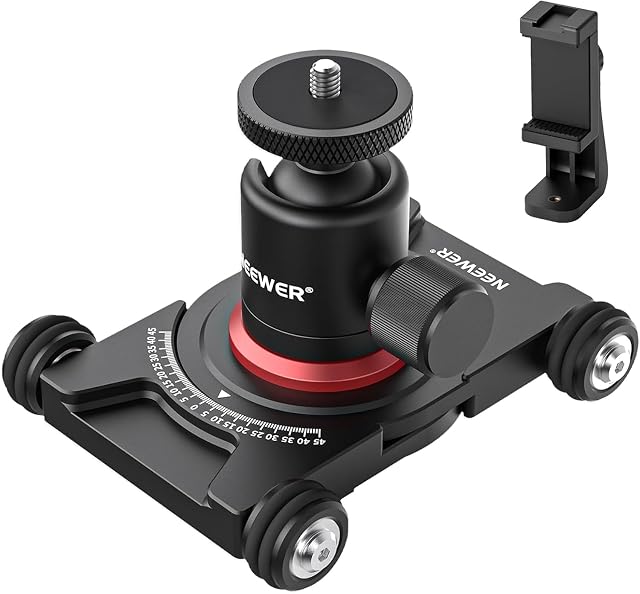
  3. NEEWER SD001 dolly, 200 g, wheels set from -45 to +45 degrees

    A wheeled dolly rather than a rail · straight-line or circular movement with wheels set between minus 45 and plus 45 degrees · rubber-padded wheels for quiet running · ball head with 360 degrees of pan and 90 of tilt on a 1/4 inch screw · phone holder and a cold shoe · 100 by 84 by 20 mm · 200 g · aluminium · not for telephoto lenses · no declared load published

    A 200 g pocket dolly at 37 €, running on rubber wheels that turn through 90 degrees to trace a circle — with a ball head in the box and a warning against telephoto lenses.

    Best for: Table-top product and food video where a small camera or a phone has to drift or circle, and the surface is already smooth.

    ≈ $42 / £35 / 29 €

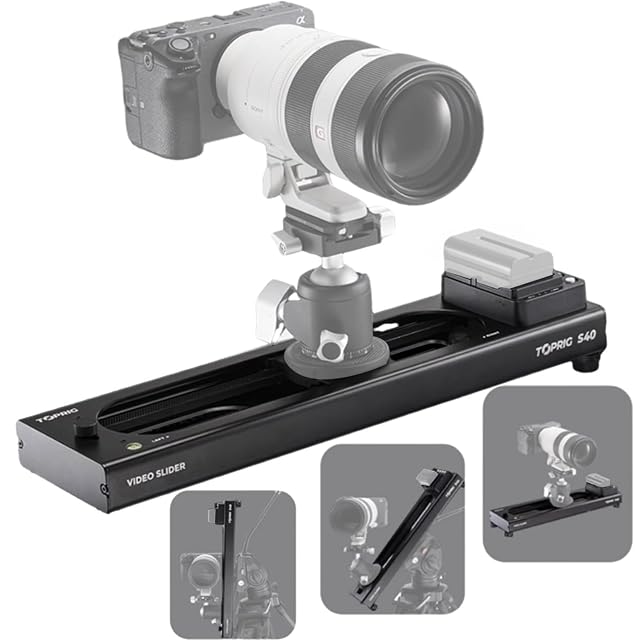
  4. Accsoon TOPRIG-S40, 4 kg horizontal and 2.5 kg vertical

    A motorised rail slider · stepless speed from 0.1 to 5 cm per second · declared load 4 kg horizontally and 2.5 kg vertically — the only page here to publish both · brushless motor described as near-silent · full button control without an app · custom motion paths set by Dot AB, manually or through the app · no rail length published in the bullets · no travel published · no weight published · no mounting points published

    The only support here that publishes a horizontal AND a vertical load — 4 kg and 2.5 kg — with stepless speed from 0.1 to 5 cm per second, at 319 €.

    Best for: Interview and product work where the move has to be repeatable, silent and usable on an incline with a camera worth protecting.

    ≈ £259 / 319 €

Each amount in a write-up is what the listing showed when that page was written. The figure next to the product is pulled in as you read, and it is the one that counts.