Skip to content

The best on-camera flashes for 2026

A flashgun sits in the shoe and is rated by a guide number — a figure that only means something alongside the two conditions behind it: the sensitivity it was quoted at, and the coverage the head was zoomed to. A maker quoting a guide number at a long zoom setting and a high sensitivity produces a larger number for the same flash, so two units are comparable only once both sets of conditions are read. The number also cannot be compared with a watt-second rating from a studio head, which measures something else entirely. The feature that changes pictures most is head movement: a head that tilts up bounces light off a ceiling and a head that also swivels bounces off a wall, and bounced light is the whole reason to own one of these rather than use the flash built into the camera. Zoom narrows the beam to match a lens and is quoted as a focal range. Metering support means the flash talks to the camera to set its own power, and the protocol is specific to each camera system. Recycle time is stated at full power and with a named cell type. Then power: disposable cells, a proprietary lithium pack, or a socket for an external battery, and whether a radio receiver is built in. We compare guide number with its stated conditions, head tilt and swivel, zoom range, metering support, recycle time, power source and built-in radio.

The bodies and lenses we compare here

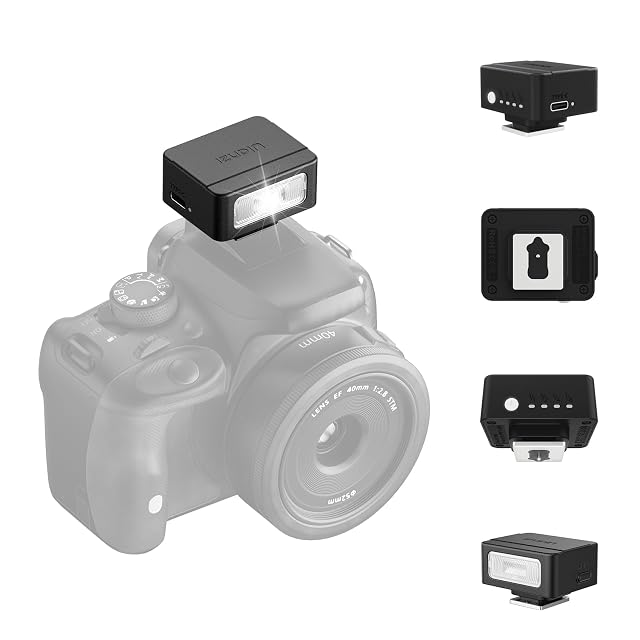
  1. ULANZI SL01 mini flash, GN8, four power levels

    Single-contact hot shoe · GN8, no sensitivity or coverage stated · 6500K · four manual levels from 1/8 to 1/1 · about 375 flashes at full power · no head movement published · no zoom · no metering support, manual only · 250 mAh internal cell, charged in about an hour over USB-C · no radio

    The cheapest flash of the five here at 23 €, with four power levels and a cell that charges over USB-C — and a guide number of 8 published without either of the two conditions that would make it comparable.

    Best for: A little fill light on a mirrorless body where the flash has to be pocketable, and the photographer sets the power by hand.

    ≈ £23 / 21 €
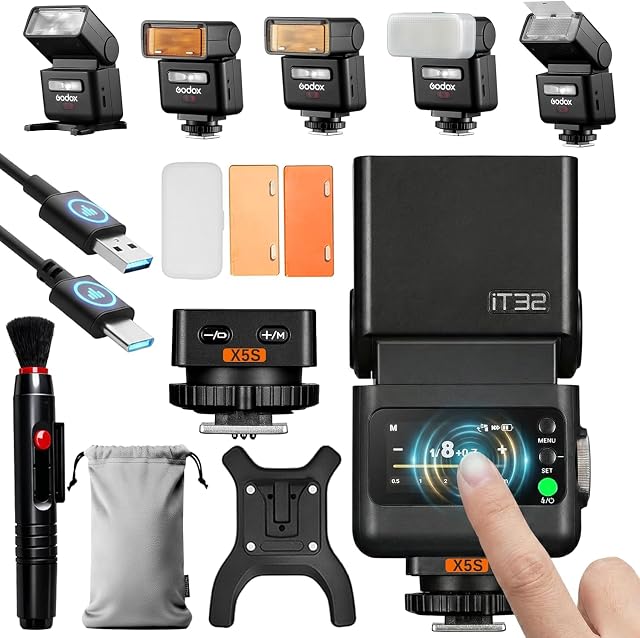
  2. Godox iT32 TTL with X5-S trigger for Sony, HSS 1/8000 s

    Sony fit · TTL, manual and stroboscopic modes · high-speed sync to 1/8000 s · first and second curtain sync · flash exposure compensation · Godox 2.4G X system, X5S detachable and controlling the flash from up to 20 m · touchscreen · 7.2 V 900 mAh cell, about 70 minutes at full power, recharged in about 70 minutes over USB-C · 10-step LED modelling light · magnetic diffuser, colour filters and a mini stand supplied · no guide number published

    A TTL flash sold with its own radio trigger for 107 €, with high-speed sync to 1/8000 and a touchscreen — and no guide number anywhere on the page, which is the one figure this shelf is ranked by.

    Best for: A Sony body that needs one small flash working both on and off the camera, inside a system that can grow to studio heads later.

    ≈ $104 / £93 / 107 €

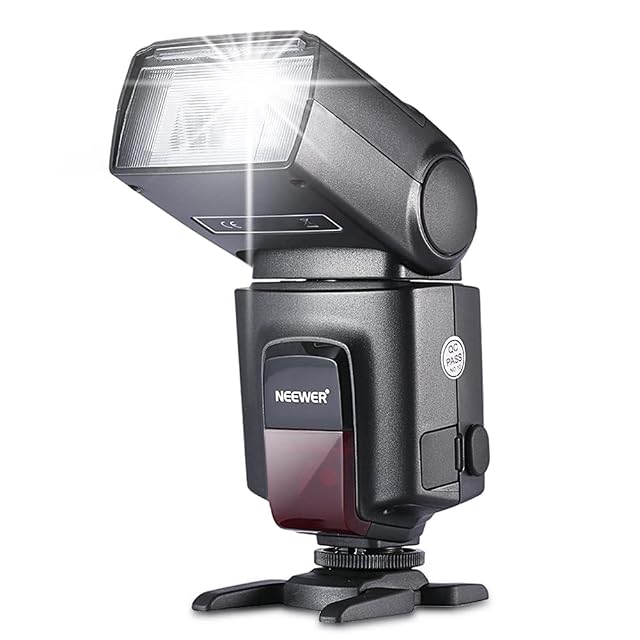
  3. NEEWER TT560, GN38 at ISO 100, head tilts 90 and swivels 270

    Universal single-contact hot shoe · GN38 at ISO 100 · 8 manual levels from 1/128 to 1/1, seven stops · 5600K plus or minus 200K · recycle 0.1 to 5 s · flash duration 1/300 to 1/20,000 s · head tilts 0 to 90 degrees and swivels 0 to 270 · S1 and S2 optical slave modes and PC sync · 4 AA cells, not supplied, with a socket for a CP-E4 external pack · no TTL, no high-speed sync, no camera-menu control

    The only flash here that publishes its guide number with the sensitivity behind it — GN38 at ISO 100 — and a head that tilts through 90 degrees and swivels through 270, for 51 €, with a first bullet that is four warnings.

    Best for: Bounced flash on a budget, on almost any camera with a centre-contact shoe, for someone who sets the power by hand and owns rechargeable AA cells.

    ≈ $47 / £42 / 51 €

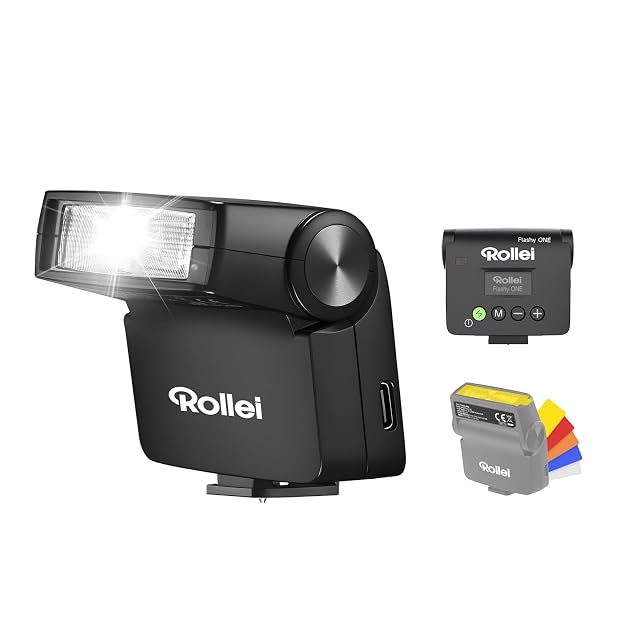
  4. Rollei Flashy ONE, GN16 and 16.8 Ws, recycle 0.01 to 2.5 s

    Single-pin hot shoe · GN16, no sensitivity or coverage stated · 16.8 Ws published · 1/128 to 1/1 in third-stop steps, seven stops · recycle 0.01 to 2.5 s · flash duration to 1/50,000 s · up to 500 flashes at full power · 1250 mAh cell · LCD display · no head movement published · no zoom · no metering support · no radio

    The only flash of the five here to publish watt-seconds as well as a guide number — 16.8 Ws and GN16 — with seven stops in third-stop steps and a recycle time from 0.01 to 2.5 seconds, for 43 €.

    Best for: Manual flash on any camera with a standard shoe, where third-stop control and a published flash duration matter more than automation.

    ≈ $69 / £57 / 43 €

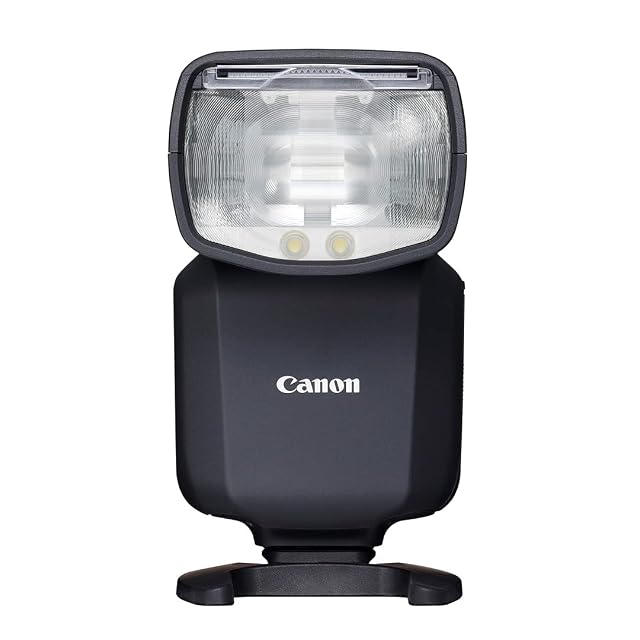
  5. Canon Speedlite EL-5, guide number 60, weather-sealed

    Canon system flash · guide number 60, no sensitivity or coverage stated · recycle 0.1 to 1.2 s · about 85 flashes at full power in a burst · manual levels from 1/1 to 1/1024, eleven stops · LP-EL lithium pack, up to 350 shots at full power · FP high-speed sync named in the title · improved passive cooling · weather-resistant seals · a compatibility list that excludes several current bodies

    The dearest flash of the five here at 325 €, with weather seals, eleven stops of manual control and 350 full-power shots from its own lithium pack — and a compatibility list that rules out every reflex and several mirrorless bodies.

    Best for: A recent EOS R body used in weather, where fast recycling, deep manual control and sealed construction justify the price.

    ≈ £357 / 325 €

Each amount in a write-up is what the listing showed when that page was written. The figure next to the product is pulled in as you read, and it is the one that counts.