A guide number depends on the sensitivity and coverage behind it · review
NEEWER TT560, GN38 at ISO 100, head tilts 90 and swivels 270 review
The only flash here that publishes its guide number with the sensitivity behind it — GN38 at ISO 100 — and a head that tilts through 90 degrees and swivels through 270, for 51 €, with a first bullet that is four warnings.
The bottom line A qualified guide number, a head that tilts and swivels, optical slave modes and a socket for an external pack make this the most capable flash here under a hundred euros. It is manual-only, it takes AA cells that are not included, and at full power it needs five seconds.
On the listing
Six long bullets, and the first is a list of absences. Read before ordering: no TTL, no high-speed sync, no camera-menu control, no automatic flash exposure, a universal single-contact shoe with a central firing contact only, power set by hand, and a list of incompatible bodies; a long compatibility list running through Fuji, Sony, Canon, Nikon, Panasonic, Olympus and Pentax; a note that on mirrorless cameras with both shutter types the flash works only in mechanical shutter mode; GN38 at ISO 100 with eight manual levels from 1/128 to 1/1, 5600K plus or minus 200K, a recycle time of 0.1 to 5 seconds, flash durations of 1/300 to 1/20,000 second, a head tilting 0 to 90 degrees and swivelling 0 to 270, and S1 and S2 optical slave modes with PC sync; sync advice to keep the shutter at 1/200 second or slower; and four AA cells, not supplied, with a CP-E4 socket, a low-battery indicator, power saving and overheat protection.
GN38 at ISO 100, which is how it should be written
The only qualified guide number of the five here. The hub above says two conditions are needed and this page gives one of them — the sensitivity — which is the one that most inflates an unqualified figure. Set against the GN60 published with no conditions two places up, or the GN8 at the bottom of the shelf, this is the number that can actually be used.
Ninety degrees up, two hundred and seventy round
The reason to put a flash on the shoe instead of using the camera’s own. Up for a ceiling, round for a wall, and between them almost any room can be made to supply soft light from a direction that is not the lens axis.
The first bullet is four warnings
No TTL. No high-speed sync. No camera-menu control. No automatic exposure. All of it before a single feature is named, with the incompatible bodies listed by model. It is the most candid opening bullet in this catalogue, and it tells a buyer exactly what 51 € does not include.
Five seconds, and the socket that shortens them
Nought point one at minimum power, five seconds at full: the slowest recycle on this shelf. The sixth bullet names the CP-E4 external pack as the remedy, which is an extra purchase and the standard answer for a flash that runs on four AA cells.
Availability
Between 51 € and 65 € on the German, French, Italian and Spanish Amazon stores when this page was last checked.
The American and British Amazon stores carry it too, priced in local currency. Those amounts are deliberately absent from the range above, which reads euro stores only.
Everything in this section is the figure Keepa carried on the day of the last update to this page. Availability and prices shift without notice.
Prices quoted in this text were read on 13 September 2026. The live price is at the top of the page.
What it does well, and what it gives up
Strengths
GN38 quoted at ISO 100, the only guide number of the five here published with its sensitivity
A head that tilts through 90 degrees and swivels through 270, so light can be bounced off a ceiling or a wall
S1 and S2 optical slave modes and PC sync, plus a socket for an external pack that speeds recycling
Compromises
No TTL, no high-speed sync and no camera-menu control — the first bullet is four warnings
Five seconds to recycle at full power, the slowest on this shelf
Four AA cells, not supplied, and no radio receiver of any kind
Specifications
Guide number with its stated conditions
GN38 at ISO 100, in the fourth bullet. It is the only guide number of the five here published with its sensitivity, which is exactly what the hub above says to demand — and it is why this figure can be compared with other flashes while GN8, GN16 and GN60 elsewhere on this shelf cannot. The coverage it was measured at is still not given
Head tilt and swivel
Tilts 0 to 90 degrees and swivels 0 to 270, published in the fourth bullet. This is the specification the hub above calls the one that changes pictures most: a head that tilts bounces off a ceiling, a head that swivels bounces off a wall. Two of the five flashes here publish nothing about head movement at all
Zoom range
None published. No focal range appears, so the beam is fixed — worth noting beside the guide number, since a zooming head concentrates the same energy into a narrower angle and reports a larger figure
Metering support
None, and the first bullet says so four times over before anything else: no TTL, no high-speed sync, no camera-menu control, no automatic flash exposure. The power is set on the flash by hand. The same bullet lists bodies it will not work with, and the second lists dozens it will
Recycle time
0.1 to 5 seconds, in the fourth bullet, across the power range. Five seconds at full power is the slowest figure on this shelf, and the fifth bullet adds that the CP-E4 external pack shortens it
Power source
Four AA cells, not supplied, with 1.5 V alkaline or Ni-MH recommended in the sixth bullet, plus a socket for a CP-E4 external power pack for faster recycling. A low-battery indicator, power saving and overheat protection are named in the same bullet
Built-in radio
None. S1 and S2 optical slave modes and PC sync are listed in the fourth bullet, which lets the flash be fired off-camera by another flash or a cable — not by radio
Amazon reference
B004LEAYXY (same reference on 6 Amazon marketplaces)
EAN
0808018111622
What people ask before they commit
Why does GN38 at ISO 100 matter more than a bigger number elsewhere?
Because it can be checked. The hub above explains that a guide number rises with the sensitivity and the zoom setting it was quoted at, so an unqualified figure may describe a weaker flash measured generously. This page states ISO 100, which is the standard reference. Against the GN60 two places up — published with no conditions at all — the smaller, qualified figure is the more trustworthy one.
What does swivelling 270 degrees add to tilting 90?
A wall. Tilting the head up sends light to the ceiling, which falls softly from above and is flattering for most subjects. Swivelling lets the head point sideways so the light comes off a wall instead, which gives directional shaping rather than overhead. Together they mean the flash can use whatever surface the room offers, which is the reason to own a flash with a moving head.
Is the warning bullet a bad sign?
It is an honest one. Four absences stated before any feature — no TTL, no high-speed sync, no menu control, no automatic exposure — save a buyer from discovering them afterwards, and the following bullets list compatible and incompatible bodies in detail. A page that leads with its limits is easier to trust than one that lists them nowhere.
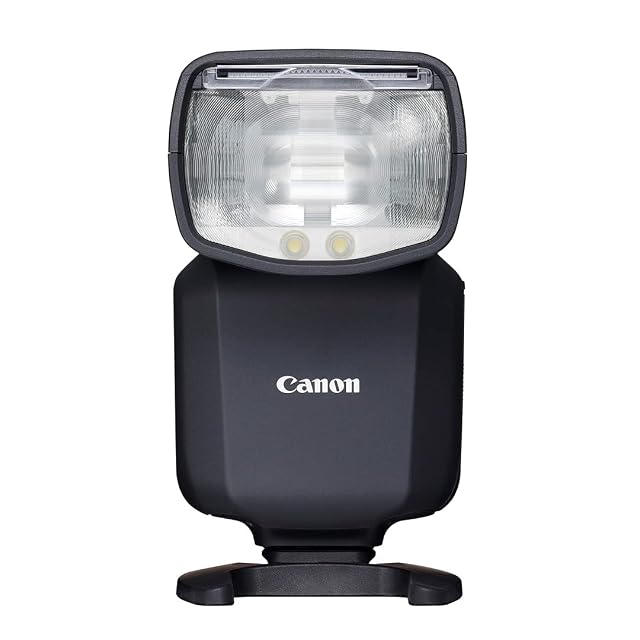
Canon system flash · guide number 60, no sensitivity or coverage stated · recycle 0.1 to 1.2 s · about 85 flashes at full power in a burst · manual levels from 1/1 to 1/1024, eleven stops · LP-EL lithium pack, up to 350 shots at full power · FP high-speed sync named in the title · improved passive cooling · weather-resistant seals · a compatibility list that excludes several current bodies
The dearest flash of the five here at 325 €, with weather seals, eleven stops of manual control and 350 full-power shots from its own lithium pack — and a compatibility list that rules out every reflex and several mirrorless bodies.
Best for: A recent EOS R body used in weather, where fast recycling, deep manual control and sealed construction justify the price.
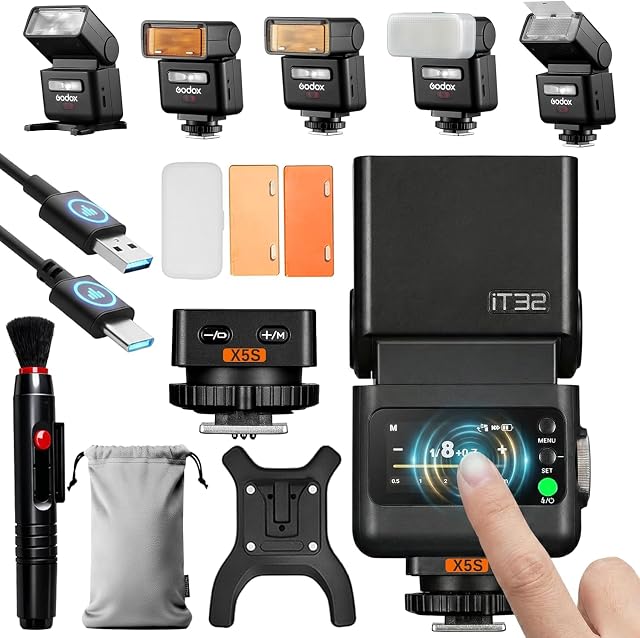
Sony fit · TTL, manual and stroboscopic modes · high-speed sync to 1/8000 s · first and second curtain sync · flash exposure compensation · Godox 2.4G X system, X5S detachable and controlling the flash from up to 20 m · touchscreen · 7.2 V 900 mAh cell, about 70 minutes at full power, recharged in about 70 minutes over USB-C · 10-step LED modelling light · magnetic diffuser, colour filters and a mini stand supplied · no guide number published
A TTL flash sold with its own radio trigger for 107 €, with high-speed sync to 1/8000 and a touchscreen — and no guide number anywhere on the page, which is the one figure this shelf is ranked by.
Best for: A Sony body that needs one small flash working both on and off the camera, inside a system that can grow to studio heads later.
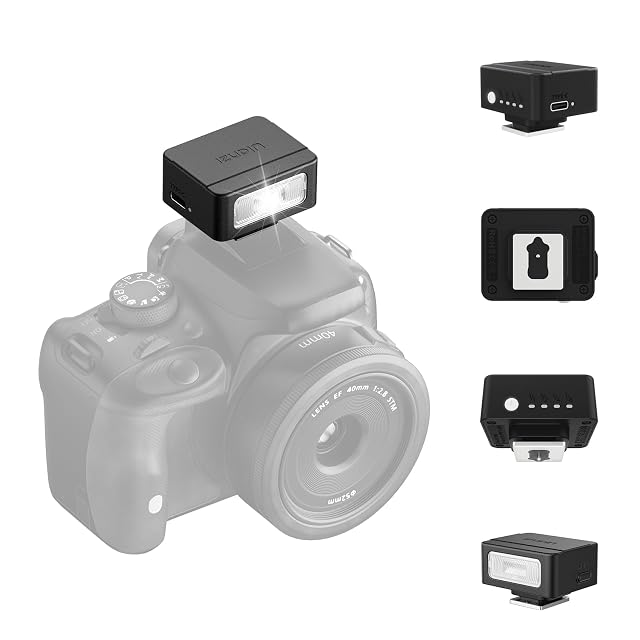
Single-contact hot shoe · GN8, no sensitivity or coverage stated · 6500K · four manual levels from 1/8 to 1/1 · about 375 flashes at full power · no head movement published · no zoom · no metering support, manual only · 250 mAh internal cell, charged in about an hour over USB-C · no radio
The cheapest flash of the five here at 23 €, with four power levels and a cell that charges over USB-C — and a guide number of 8 published without either of the two conditions that would make it comparable.
Best for: A little fill light on a mirrorless body where the flash has to be pocketable, and the photographer sets the power by hand.