A guide number depends on the sensitivity and coverage behind it · review
ULANZI SL01 mini flash, GN8, four power levels review
The cheapest flash of the five here at 23 €, with four power levels and a cell that charges over USB-C — and a guide number of 8 published without either of the two conditions that would make it comparable.
The bottom line At 23 € with four levels and USB-C charging it is a sensible little fill light, and the listing is unusually honest about what it cannot do. GN8 without conditions, no head movement and no recycle time mean three of the seven lines this shelf compares are unanswerable.
On the listing
Six bullets, two of which are warnings. A universal single-contact hot shoe said to fit most cameras without an adapter, naming Canon, Fuji, Sony, Nikon, Panasonic, Olympus and Pentax, and excluding the Sony ZV-1F; a note that only cameras with a single-contact shoe are compatible and what to check if the flash does not fire; a Fuji-specific note explaining how to set flash synchronisation to M and to switch from an electronic to a mechanical shutter; GN8 output described as a stable and efficient light source; four power levels from 1/8 to 1/1 set by a dial, with about 375 flashes at 1/1; and a built-in 250 mAh cell charged in about an hour over USB-C, with power-bank operation for continuous outdoor use.
GN8, and nothing behind the number
The hub above asks for two conditions and this page gives neither. A guide number depends on the sensitivity it was quoted at and the coverage the head was set to, and without both the figure is a marketing number rather than a specification. GN8 is small — that much is clear from the price and the size — but how small, against the GN16 and GN38 on this shelf, cannot be established from this page.
One contact, and what it costs
No metering, no camera-menu control, no high-speed sync: a single central contact carries the fire signal and nothing else. The listing is straightforward about it and even explains how to coax reluctant bodies into manual mode, which is more candour than most pages at any price.
Three hundred and seventy-five flashes, then USB-C
A count at full power, and a cell that refills in about an hour from anything with a USB socket. For a unit meant to live in a bag that is the right arrangement — no spare batteries to buy, and a power bank extends the day.
What this shelf exists for, and what is missing
A flash on the shoe earns its place by bouncing light off a ceiling or a wall, and that needs a head that tilts and swivels. Nothing on this page describes one. The light this unit gives is frontal, which is softer than the camera’s own flash and still frontal.
Availability
Between 21 € and 23 € on the German, French, Italian and Spanish Amazon stores when this page was last checked.
The British Amazon store carry it too, priced in local currency. Those amounts are deliberately absent from the range above, which reads euro stores only.
Nothing came back from the American Amazon store at all, so the button for that country runs a search instead of opening an entry that is not there.
Everything in this section is the figure Keepa carried on the day of the last update to this page. Availability and prices shift without notice.
Prices quoted in this text were read on 13 September 2026. The live price is at the top of the page.
What it does well, and what it gives up
Strengths
Twenty-three euros, and a cell that charges over USB-C from a power bank rather than taking batteries
Four power levels on a dial, from 1/8 to 1/1, on a flash this small
About 375 flashes at full power, published as a count
Compromises
GN8 with neither a sensitivity nor a coverage figure, so it cannot be compared with anything on this shelf
No head movement of any kind, which is the feature this shelf exists for
A single-contact shoe means no metering, and two of the six bullets are compatibility warnings
Specifications
Guide number with its stated conditions
GN8, in the title and the fourth bullet, and neither the sensitivity nor the coverage is given. The hub above is explicit that a guide number means nothing without both: a maker quoting at a high sensitivity and a long zoom setting produces a larger number for the same flash. GN8 is the smallest figure on this shelf and it cannot be compared with the GN38 two places up, which does carry its ISO
Head tilt and swivel
Not published on the listing, and the design does not suggest any. The hub above calls head movement the feature that changes pictures most, because bouncing light off a ceiling or a wall is the whole reason to use a flash on the shoe rather than the one in the camera. Nothing on this page describes a head that moves
Zoom range
None published. No focal range appears, so the beam is whatever the fixed optic gives — which is consistent with a unit this small and is also why the guide number cannot be read against a zooming flash
Metering support
None. The first bullet describes a universal single-contact hot shoe, which carries only the fire signal and no data, and the title calls it a manual flash. The second and third bullets go further and explain how to force Fuji and other bodies into manual flash mode, and warn it is incompatible with the Sony ZV-1F
Recycle time
Not published on the listing. The fifth bullet gives about 375 flashes at 1/1 power, which is a count rather than an interval — the page says how many, never how soon
Power source
A built-in 250 mAh cell, fully charged in about an hour over USB-C, in the sixth bullet, which adds that a power bank can keep it running outdoors. No disposable cells, and no separate charger
Built-in radio
None. No radio system is named and no optical slave mode appears either, so the flash fires when the shoe tells it to and in no other way
Amazon reference
B0DRP8R9D6 (same reference on 5 Amazon marketplaces)
EAN
6975357307505
What people ask before they commit
What is a single-contact hot shoe?
A shoe that carries only the central firing contact and none of the data pins around it. The first bullet presents it as universal compatibility, which it is — almost any camera with a standard shoe will fire the flash. What it cannot do is talk: no metering, no power set from the camera menu, no high-speed sync. The trade is deliberate at this price.
Why does the listing explain Fuji shutter settings?
Because an electronic shutter cannot fire a manual flash of this kind, and the third bullet spells out the fix: switch the shutter type from electronic to mechanical, then set the flash setting from off to M. It is unusual for a listing to publish a workaround this specific, and it is genuinely useful — the same limitation applies to several mirrorless bodies.
Is 375 flashes a useful figure?
It is useful for planning an afternoon, and it is not a recycle time. The fifth bullet gives the count at full power, so at lower settings there are more. What the page never says is how long the flash takes to be ready again, which is the figure that decides whether a second frame can be taken straight away.
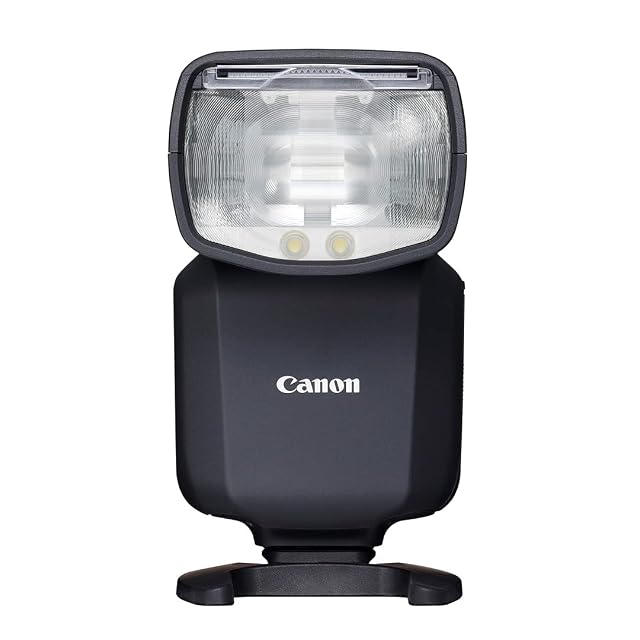
Canon system flash · guide number 60, no sensitivity or coverage stated · recycle 0.1 to 1.2 s · about 85 flashes at full power in a burst · manual levels from 1/1 to 1/1024, eleven stops · LP-EL lithium pack, up to 350 shots at full power · FP high-speed sync named in the title · improved passive cooling · weather-resistant seals · a compatibility list that excludes several current bodies
The dearest flash of the five here at 325 €, with weather seals, eleven stops of manual control and 350 full-power shots from its own lithium pack — and a compatibility list that rules out every reflex and several mirrorless bodies.
Best for: A recent EOS R body used in weather, where fast recycling, deep manual control and sealed construction justify the price.
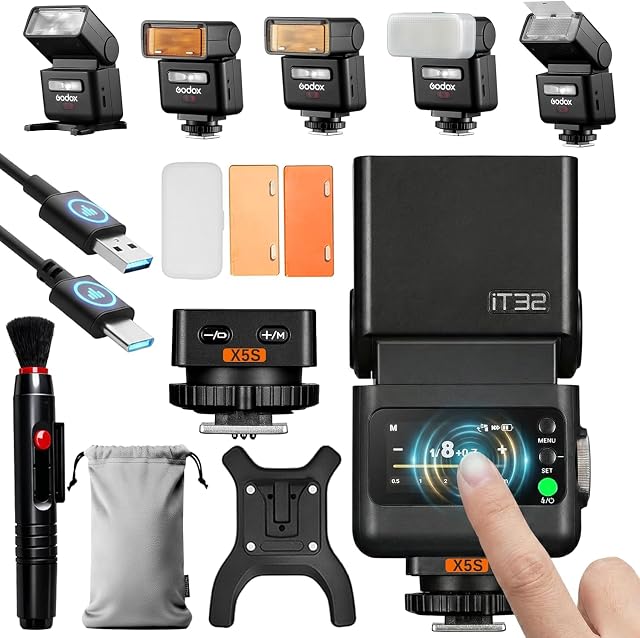
Sony fit · TTL, manual and stroboscopic modes · high-speed sync to 1/8000 s · first and second curtain sync · flash exposure compensation · Godox 2.4G X system, X5S detachable and controlling the flash from up to 20 m · touchscreen · 7.2 V 900 mAh cell, about 70 minutes at full power, recharged in about 70 minutes over USB-C · 10-step LED modelling light · magnetic diffuser, colour filters and a mini stand supplied · no guide number published
A TTL flash sold with its own radio trigger for 107 €, with high-speed sync to 1/8000 and a touchscreen — and no guide number anywhere on the page, which is the one figure this shelf is ranked by.
Best for: A Sony body that needs one small flash working both on and off the camera, inside a system that can grow to studio heads later.
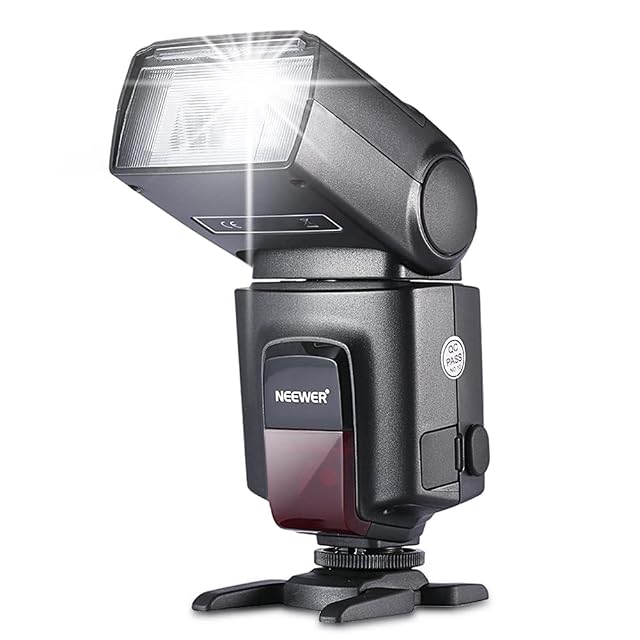
Universal single-contact hot shoe · GN38 at ISO 100 · 8 manual levels from 1/128 to 1/1, seven stops · 5600K plus or minus 200K · recycle 0.1 to 5 s · flash duration 1/300 to 1/20,000 s · head tilts 0 to 90 degrees and swivels 0 to 270 · S1 and S2 optical slave modes and PC sync · 4 AA cells, not supplied, with a socket for a CP-E4 external pack · no TTL, no high-speed sync, no camera-menu control
The only flash here that publishes its guide number with the sensitivity behind it — GN38 at ISO 100 — and a head that tilts through 90 degrees and swivels through 270, for 51 €, with a first bullet that is four warnings.
Best for: Bounced flash on a budget, on almost any camera with a centre-contact shoe, for someone who sets the power by hand and owns rechargeable AA cells.