A guide number depends on the sensitivity and coverage behind it · review
Godox iT32 TTL with X5-S trigger for Sony, HSS 1/8000 s review
A TTL flash sold with its own radio trigger for 107 €, with high-speed sync to 1/8000 and a touchscreen — and no guide number anywhere on the page, which is the one figure this shelf is ranked by.
The bottom line As a kit it is well judged: a trigger in the box, TTL, sync to 1/8000, a diffuser, filters and a stand for 107 €. As a specification it has a hole where the output should be — no guide number at all — and the head movement is never described either.
On the listing
Six bullets. A lens-cleaning pen included alongside the iT32 and X5S; an all-in-one TTL kit for Sony with automatic TTL, manual and stroboscopic modes on the Godox 2.4 GHz X radio system, the trigger recognised automatically when aligned under the flash; an extended wireless section explaining that the X5S can be detached and shoe-mounted to control the iT32 from up to 20 m, and used as a transmitter for other Godox X-system units, with the AD100Pro II, AD200Pro II, AD600Pro II, AD600BM II, iT30Pro, V100 and V480 named; high-speed sync to 1/8000 s with first and second curtain sync and flash exposure compensation, and TTL balancing subject against background; a compact design with a touchscreen, a 7.2 V 900 mAh cell giving about 70 minutes at full power and recharging in about 70 minutes over USB-C, a 10-step LED modelling light, a magnetic diffuser, colour filters and a mini stand; and a closing warning that the X5S has no power switch, shows status by coloured LEDs, charges only when magnetically attached to the iT32, takes about 3 hours to fill its 3.8 V 100 mAh cell and holds up to 16 hours of standby.
A flash that never states its guide number
Every other flash on this shelf publishes one. GN8, GN16, GN38 at ISO 100, 60. This page describes how the flash is controlled, how far the radio reaches, what it syncs to and what is in the box, and never says how much light it makes. The hub above calls the guide number the rating for this shelf, and here there is nothing to rate.
The trigger is the product
Most flashes at this price fire when the shoe tells them to. This one arrives with a transmitter that detaches, sits on the camera, and drives the flash from twenty metres — and can fire a row of studio heads from the same system. That is what 107 € buys over the manual units below it.
Seventy minutes, and seventy to charge
A runtime rather than a recycle time. At full power the cell lasts about seventy minutes and refills in about the same, over USB-C. What the page never gives is the interval between two frames, which is the figure a photographer actually waits on.
Read the closing bullet about the trigger
No on-off switch. Status by coloured LED only. It charges solely when magnetically attached to the flash, taking about three hours. None of that is a fault, and all of it is worth knowing before the trigger is in a bag separately from the flash that feeds it.
Availability
About 107 € on the German, French, Italian and Spanish Amazon stores when this page was last checked.
The American and British Amazon stores carry it too, priced in local currency. Those amounts are deliberately absent from the range above, which reads euro stores only.
Everything in this section is the figure Keepa carried on the day of the last update to this page. Availability and prices shift without notice.
Prices quoted in this text were read on 13 September 2026. The live price is at the top of the page.
What it does well, and what it gives up
Strengths
A radio transmitter included, so the flash can be taken off the camera out of the box
TTL metering, high-speed sync to 1/8000 s, and first and second curtain sync
A magnetic diffuser, colour filters, a mini stand and a 10-step modelling light, all supplied
Compromises
No guide number published anywhere, so the output cannot be compared with anything on this shelf
The Sony fitting ties the kit to one camera system
The X5S has no on-off switch and charges only when attached to the flash
Specifications
Guide number with its stated conditions
Not published at all. Six bullets cover the kit contents, the TTL system, the radio range, the sync modes, the touchscreen, the cell and the trigger, and no guide number appears — with or without conditions. It is the figure the hub above says this shelf is rated by, and this is the only page here that omits it entirely
Head tilt and swivel
Not published on the listing. The fifth bullet describes a compact design with a touchscreen, a modelling light, a magnetic diffuser, filters and a mini stand, and never describes a head that moves. The supplied mini stand suggests off-camera use, which is a different way to move the light
Zoom range
None published. No focal range appears on the page
Metering support
TTL, for Sony, named in the title and the second bullet, which also lists manual and stroboscopic modes. The fourth bullet adds what TTL does here: the flash sets its own power to balance subject and background. This is the only through-the-lens metering on this shelf, and it is tied to one camera system
Recycle time
Not published on the listing. The fifth bullet gives about 70 minutes of operation at full power and a recharge of about 70 minutes over USB-C, which are runtimes rather than intervals between flashes
Power source
A 7.2 V 900 mAh lithium cell, about 70 minutes at full power, recharged in about 70 minutes over USB-C. The X5S trigger has its own 3.8 V 100 mAh cell, charged only when attached to the flash, full in about 3 hours and good for up to 16 hours of standby — stated in the closing bullet along with the fact that it has no on-off switch
Built-in radio
Yes, and it is the point of the kit: the Godox 2.4G X system. The X5S detaches from the flash and mounts on the camera shoe to control the iT32 wirelessly from up to 20 m, and as a transmitter it can also fire other Godox X-system units — the AD100Pro II, AD200Pro II, AD600Pro II, AD600BM II, iT30Pro, V100 and V480 are named. Off-camera, it can adjust only the iT32’s power, not the other lights’
Amazon reference
B0G1GZ46V8 (same reference on 6 Amazon marketplaces)
EAN
0767637542968
What people ask before they commit
How much does a missing guide number matter?
It removes the only figure that ranks this shelf. The hub above treats the guide number, read with its conditions, as the rating for a flashgun; without it there is no way to say whether this unit is stronger or weaker than the 51 € flash two places down that publishes GN38 at ISO 100. Everything else here — TTL, sync speed, the radio — describes control rather than output.
What does the X5S actually control off-camera?
The closing part of the third bullet is precise about this, and the limitation is easy to miss: used off-camera the X5S can adjust the power of the iT32 only. It can fire other Godox X-system lights, but not change their power levels. So it is a full controller for this flash and a remote release for everything else.
Why does high-speed sync go to 1/8000?
Because a camera shutter above its sync speed is never fully open, so an ordinary flash burst lights only part of the frame. High-speed sync replaces the single burst with a rapid series that covers the whole travel of the shutter, which allows 1/8000 second — typically used to keep a wide aperture in bright sunlight. It costs a great deal of the flash output, which no listing mentions.
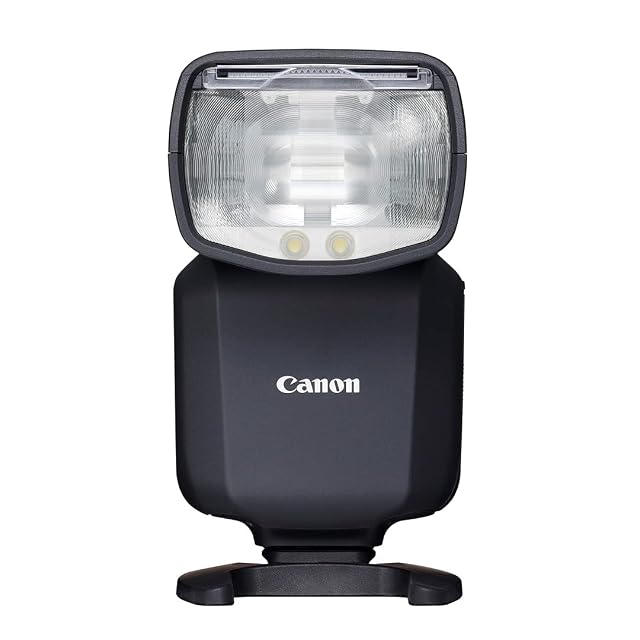
Canon system flash · guide number 60, no sensitivity or coverage stated · recycle 0.1 to 1.2 s · about 85 flashes at full power in a burst · manual levels from 1/1 to 1/1024, eleven stops · LP-EL lithium pack, up to 350 shots at full power · FP high-speed sync named in the title · improved passive cooling · weather-resistant seals · a compatibility list that excludes several current bodies
The dearest flash of the five here at 325 €, with weather seals, eleven stops of manual control and 350 full-power shots from its own lithium pack — and a compatibility list that rules out every reflex and several mirrorless bodies.
Best for: A recent EOS R body used in weather, where fast recycling, deep manual control and sealed construction justify the price.
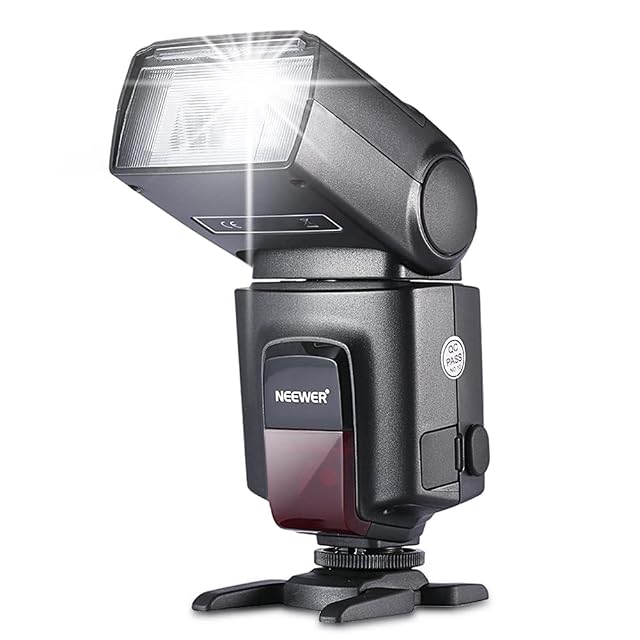
Universal single-contact hot shoe · GN38 at ISO 100 · 8 manual levels from 1/128 to 1/1, seven stops · 5600K plus or minus 200K · recycle 0.1 to 5 s · flash duration 1/300 to 1/20,000 s · head tilts 0 to 90 degrees and swivels 0 to 270 · S1 and S2 optical slave modes and PC sync · 4 AA cells, not supplied, with a socket for a CP-E4 external pack · no TTL, no high-speed sync, no camera-menu control
The only flash here that publishes its guide number with the sensitivity behind it — GN38 at ISO 100 — and a head that tilts through 90 degrees and swivels through 270, for 51 €, with a first bullet that is four warnings.
Best for: Bounced flash on a budget, on almost any camera with a centre-contact shoe, for someone who sets the power by hand and owns rechargeable AA cells.
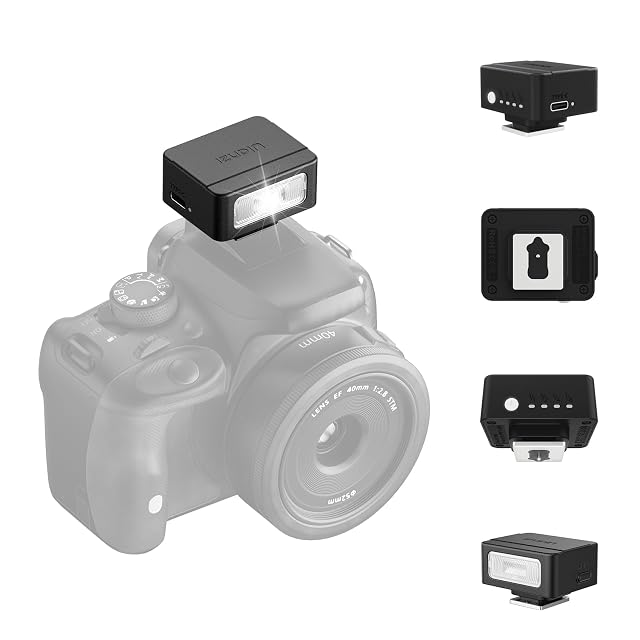
Single-contact hot shoe · GN8, no sensitivity or coverage stated · 6500K · four manual levels from 1/8 to 1/1 · about 375 flashes at full power · no head movement published · no zoom · no metering support, manual only · 250 mAh internal cell, charged in about an hour over USB-C · no radio
The cheapest flash of the five here at 23 €, with four power levels and a cell that charges over USB-C — and a guide number of 8 published without either of the two conditions that would make it comparable.
Best for: A little fill light on a mirrorless body where the flash has to be pocketable, and the photographer sets the power by hand.