Skip to content

The best camcorders for 2026

A camcorder exists for the jobs where a stills body is awkward: an event that runs for an hour without a break, a lecture, a performance. Its advantages are structural. Recording length is limited by card and battery rather than by the thermal and format limits that stop many hybrid cameras, and where a limit exists the maker states it. The zoom is an integrated optical range operated by a rocker, so the framing changes smoothly with one thumb — and the figure to read is the optical range, since digital zoom is a crop by another name. Audio is the second structural advantage: inputs that a small body does not have, sometimes on XLR connectors with their own level controls, and a listing that names the connector type is naming the microphones that can be used. Sensor size is generally smaller than on a stills camera, which buys depth of field and reach at the cost of low-light performance, and the recording format is described by codec, container and bit rate — three published facts that decide whether the files edit easily. Then the body: a screen that flips out and rotates, optical or hybrid stabilisation, dual card slots for relay recording, and whether the unit runs from mains power indefinitely. We compare sensor size, optical zoom range, recording formats and stated limits, audio inputs, stabilisation, screen articulation and power options.
The bodies and lenses we compare here

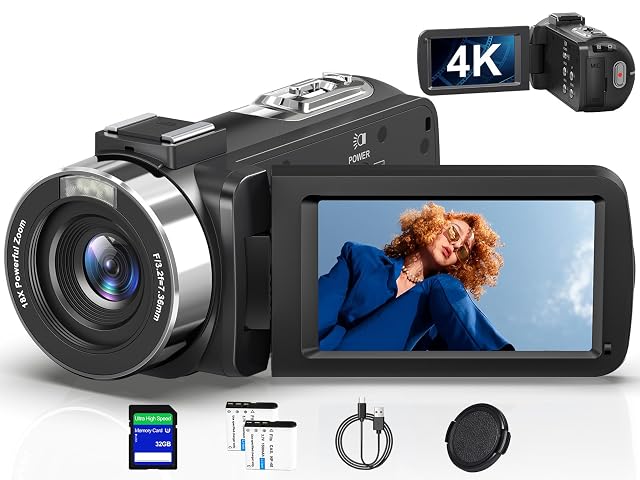
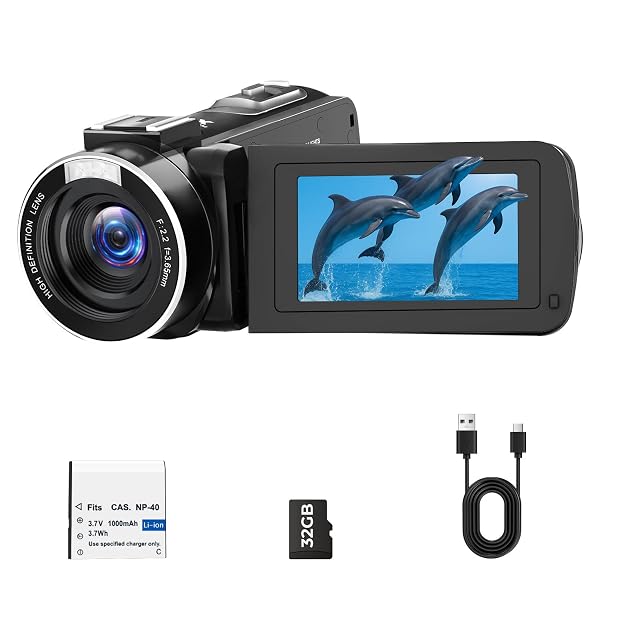
  1. CAMWORLD AC25, 2.7K, 18× digital zoom, 32 GB card supplied

    No sensor size published · no optical zoom: 18× digital, stated by the maker as NO optical zoom · 2.7K video · 48 MP stills · no recording limit published · stabilisation named without a type · 3 inch screen turning 270 degrees · LED fill light · 32 GB card and battery included

    The cheapest camcorder here at 66 €, whose own second bullet writes that its 18× zoom is not optical — and which, like all six on this shelf, never states how long it will record.

    Best for: A first camcorder for family events, plugged into a power bank, where the 270 degree screen and the card in the box are the specification that counts.

    ≈ 61 €

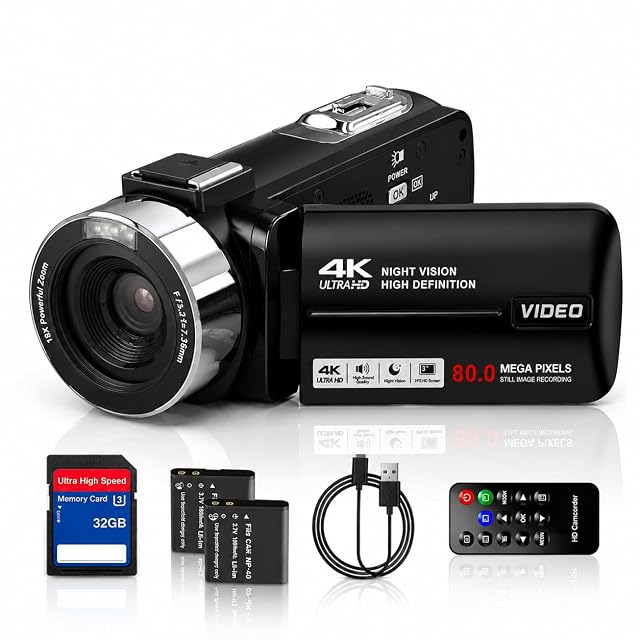
  2. Aroeally HDV03, 4K 30 fps, infrared night vision, two 1500 mAh cells

    No sensor size published · no optical zoom: 18× digital · 4K at 30 fps · 80 MP stills · infrared night vision · no recording limit published · 3 inch IPS screen turning 270 degrees · remote supplied · two 1500 mAh batteries · webcam mode

    A 4K camcorder with infrared night vision and two batteries at 89 €, whose 80 megapixel figure has no sensor published behind it and whose recording limit, like the whole shelf, never appears.

    Best for: Filming indoors and after dark on a tripod, where the infrared mode and the remote do work the cheaper camera cannot.

    ≈ 89 €

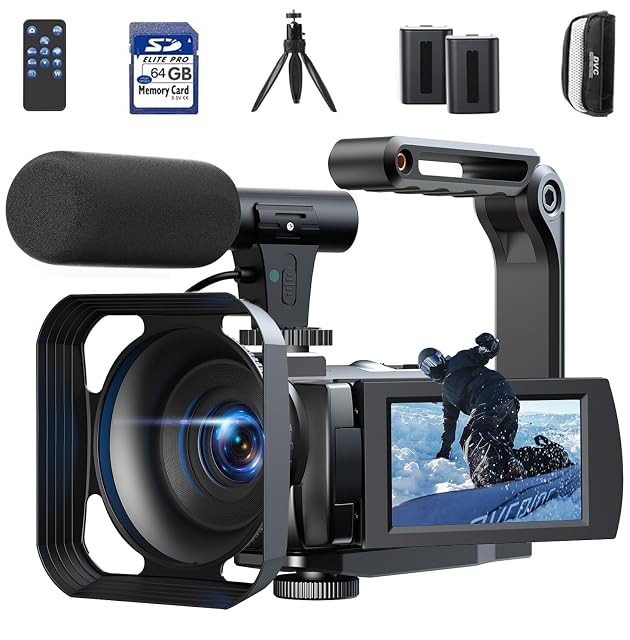
  3. PITIKI V112, 4K, 80 MP, night vision, external microphone supported

    No sensor size published · no optical zoom: 18× digital · 4K · 80 MP stills · infrared night vision · external microphone supported · no recording limit published · 32 GB card supplied, expandable to 128 GB · two 1500 mAh cells · German store only

    The only camcorder under 140 € here that supports an external microphone — the audio input this whole shelf is compared on — and the only one no store outside Germany was offering.

    Best for: Interviews and talking heads on a budget, where a real microphone socket matters more than a screen that turns.

    ≈ 104 €

  4. FIREFOTO AC12C, 5K at 25 fps, 56 MP, HDMI out, two 2400 mAh cells

    No sensor size published · no optical zoom published · 5K at 25 fps · 56 MP stills · infrared night vision · external microphone and HDMI output · handheld stabiliser supplied · no recording limit published · 3 inch touchscreen turning 270 degrees · two 2400 mAh cells, about 150 minutes each

    The only camcorder here to publish a runtime per battery — about 150 minutes — and the only one with an HDMI output, a folding handheld stabiliser and a microphone in the box.

    Best for: Vlogging and interviews where the supplied microphone, the grip and two long batteries do the work of three separate purchases.

    ≈ 133 €

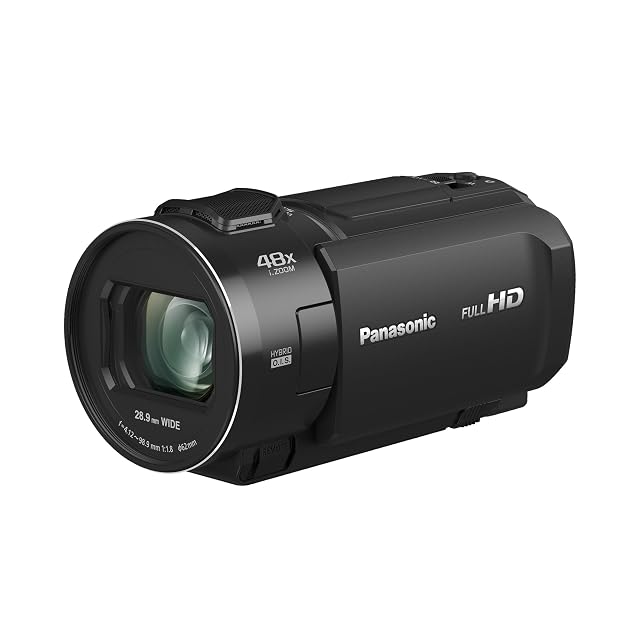
  5. Panasonic HC-V900, 1/2.5 inch sensor, 25-600 mm, 24× optical, f/1.8

    1/2.5 inch sensor, the only one published here · 24× OPTICAL zoom, 25 to 600 mm · f/1.8 wide end · Full HD · five-axis Hybrid OIS+ · HDR movie · Full HD slow motion at 240 fps · zoom microphone with wind shield · 7.6 cm touchscreen, 1.56 million dots · no recording limit published

    The only camcorder of the six here to publish a sensor size, a real optical range in millimetres and an aperture — and it stops at Full HD while cameras a fifth of the price claim 5K.

    Best for: Events where a real 600 mm reach and stabilisation that works at it matter more than a resolution badge.

    ≈ £529 / 492 €

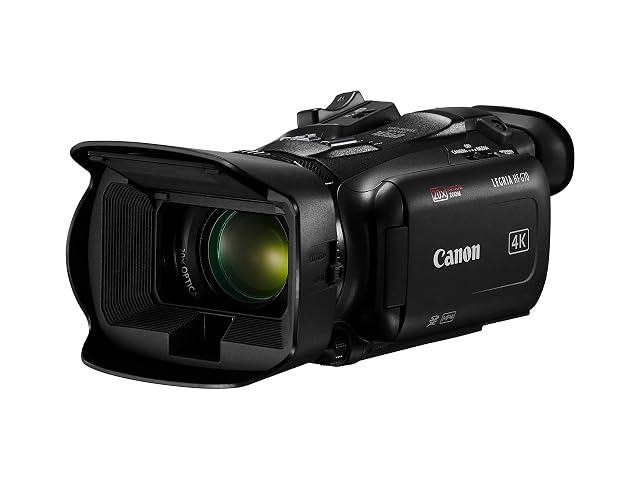
  6. Canon LEGRIA HF G70, 4K sensor, 20× optical, 4K UHD at 150 Mbit/s

    4K sensor stated, size not published · 20× OPTICAL zoom · DIGIC DV6 processor · eight-blade iris · five-axis stabilisation · 4K UHD at 150 Mbit/s and 25p · 0.5× Full HD slow motion · time lapse to 1200× · MP4 · lens hood with integrated cap supplied · no recording limit published

    The dearest camcorder here at 992 €, and the only one to publish a bit rate — 150 Mbit/s at 4K — an eight-blade iris and a genuine 20× optical zoom.

    Best for: Long-form recording where the bit rate and the iris matter, by someone who will check the audio arrangement in the maker’s own documentation.

    ≈ £1040 / 922 €

Each amount in a write-up is what the listing showed when that page was written. The figure next to the product is pulled in as you read, and it is the one that counts.