Long recording, a real zoom rocker, and audio inputs a body lacks · review
Panasonic HC-V900, 1/2.5 inch sensor, 25-600 mm, 24× optical, f/1.8 review
The only camcorder of the six here to publish a sensor size, a real optical range in millimetres and an aperture — and it stops at Full HD while cameras a fifth of the price claim 5K.
The bottom line The only camcorder here with a specification that can be compared to anything: sensor, aperture, a genuine 25-600 mm range and five-axis hybrid stabilisation. It buys those with Full HD and with complete silence about its battery.
On the listing
Full HD video from a light-sensitive 1/2.5 inch sensor behind an f/1.8 lens; a 24× optical zoom covering 25 mm wide to 600 mm telephoto for sharp distant detail; a bright 7.6 cm electrostatic touchscreen with 1.56 million dots; five-axis Hybrid OIS+ for stable footage on the move and at high zoom; Full HD slow motion at 240 frames a second and an HDR movie mode for a wider dynamic range; and a built-in zoom microphone with a wind shield to reduce distortion and wind noise outdoors.
Three numbers that exist nowhere else on this shelf
A sensor size. An aperture. An optical range in millimetres.
Four camcorders here publish a digital zoom factor and no sensor at all; one publishes no zoom whatsoever. This page gives 1/2.5 inch, f/1.8, and 25 to 600 mm — which means it can be compared with something, and they cannot.
Why the resolution is the wrong way to read this page
It stops at Full HD while cameras a fifth of the price claim 5K. Pixels are the cheapest specification to print: the file format decides them. What decides a picture is the sensor collecting light and the glass in front of it, and this is the only camcorder on the shelf that describes either.
Stabilisation that matches the zoom
Five-axis Hybrid OIS+, named in the fourth bullet for exactly the situation the second bullet creates: 600 mm magnifies hand movement as much as the subject. Optical and electronic correction working together is the right pairing for that reach, and no stop figure is published for it.
The one place it is thinner than the cheap cameras
Nothing about the battery. No capacity, no runtime, no charging note, where the 66 € camera below publishes recording while charging and the 140 € one gives 150 minutes a cell. On a camera for events, that omission is the real complaint.
Availability
Between 492 € and 600 € on the German, French, Italian and Spanish Amazon stores when this page was last checked.
The American and British Amazon stores carry it too, priced in local currency. Those amounts are deliberately absent from the range above, which reads euro stores only.
Everything in this section is the figure Keepa carried on the day of the last update to this page. Availability and prices shift without notice.
Prices quoted in this text were read on 13 September 2026. The live price is at the top of the page.
What it does well, and what it gives up
Strengths
Publishes a sensor size, an optical range in millimetres and an aperture — three figures no other camcorder here gives
Five-axis Hybrid OIS+, named as combining optical and electronic correction, where the cheap cameras name nothing or a grip
A zoom microphone with a wind shield, and a screen specified in dots rather than inches alone
Compromises
Full HD only, where four camcorders at a fifth of the price claim 4K or 5K
Nothing about the battery — no capacity, no runtime, no charging note
No external microphone input, and no recording limit
Specifications
Sensor size
1/2.5 inch, stated in the first bullet as a light-sensitive sensor paired with an f/1.8 lens. It is the only sensor size published by any camcorder on this shelf, and the figure that explains why this camera costs what it does
Optical zoom range
24× optical, covering 25 mm wide to 600 mm telephoto — stated in the second bullet with both ends in millimetres. Four camcorders here publish a digital factor and one publishes nothing; this publishes a range that can be compared
Recording formats
Full HD, stated in the title and the first bullet, with HDR movie in the fifth for a wider dynamic range. Full HD slow motion at 240 frames a second is named in the same bullet. No container or codec appears
Stated recording limits
Not published on the listing — six bullets cover the sensor and lens, the zoom, the screen, the stabilisation, the creative modes and the microphone, without a clip length or file ceiling. Even the most complete camcorder here leaves the figure the hub asks for first unstated
Audio inputs
Not published as a socket — the sixth bullet describes a built-in zoom microphone with a wind shield, which narrows its pickup as the lens zooms, and no external input is named. A wind shield on the built-in microphone is nevertheless more than the other five camcorders publish
Stabilisation
Five-axis Hybrid OIS+, stated in the fourth bullet as giving stable footage on the move and at high zoom. Hybrid means optical correction in the lens working with electronic correction; no stop figure or protocol is published
Screen articulation
A 7.6 cm electrostatic touchscreen with 1.56 million dots, stated in the third bullet. It is the only screen on this shelf given a dot count rather than a diagonal alone
Power options
Not published on the listing — no battery capacity, runtime or charging arrangement appears in the six bullets, which is the one place this page is thinner than the cheap cameras below it
Amazon reference
B0DLJHBNGW (same reference on 6 Amazon marketplaces)
EAN
5025232969395
What people ask before they commit
How can Full HD cost more than 5K on this shelf?
Because resolution is the cheapest thing to print on a box. This camera publishes a 1/2.5 inch sensor, an f/1.8 lens and a 24× optical range from 25 to 600 mm; the 5K camera above publishes no sensor, no aperture and no zoom at all. Pixels come from the file format, detail comes from the sensor and the glass, and only one of these two pages tells you anything about either.
What does 25 to 600 mm actually give me?
A room from the back wall at the wide end, and a face across a church at the long end, without moving. That span in one lens is what a camcorder is for, and it is optical throughout — real reach rather than a crop. The aperture is published only at the wide end, f/1.8, so how much light survives at 600 mm is not stated.
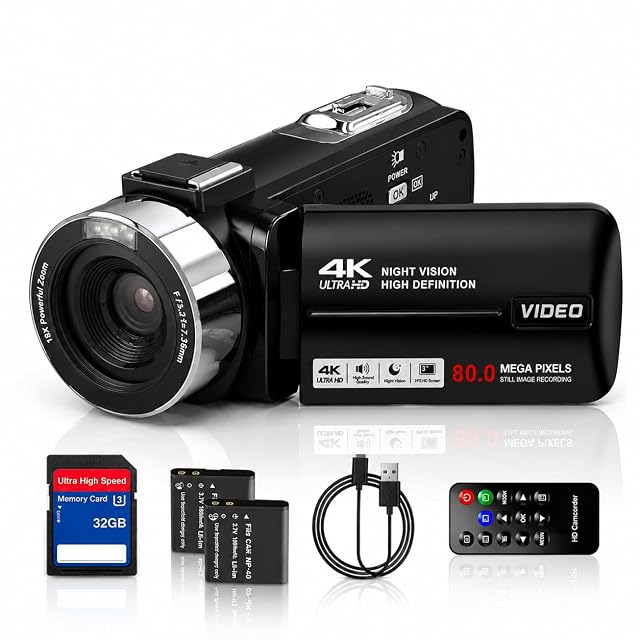
No sensor size published · no optical zoom: 18× digital · 4K at 30 fps · 80 MP stills · infrared night vision · no recording limit published · 3 inch IPS screen turning 270 degrees · remote supplied · two 1500 mAh batteries · webcam mode
A 4K camcorder with infrared night vision and two batteries at 89 €, whose 80 megapixel figure has no sensor published behind it and whose recording limit, like the whole shelf, never appears.
Best for: Filming indoors and after dark on a tripod, where the infrared mode and the remote do work the cheaper camera cannot.
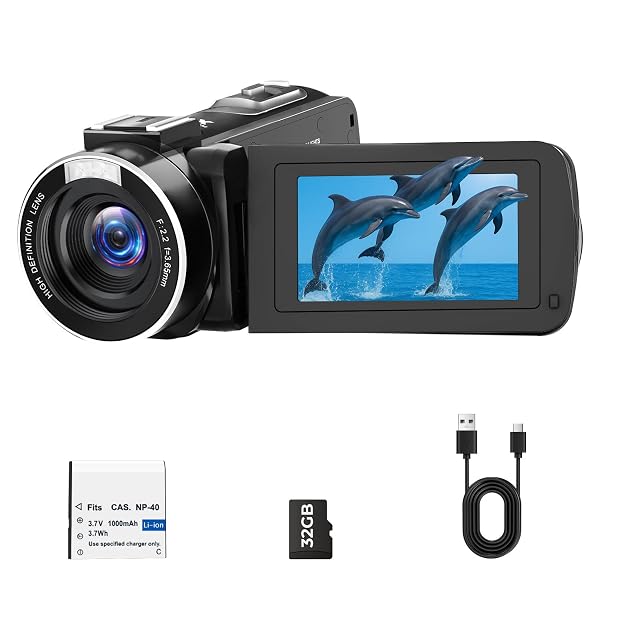
No sensor size published · no optical zoom: 18× digital, stated by the maker as NO optical zoom · 2.7K video · 48 MP stills · no recording limit published · stabilisation named without a type · 3 inch screen turning 270 degrees · LED fill light · 32 GB card and battery included
The cheapest camcorder here at 66 €, whose own second bullet writes that its 18× zoom is not optical — and which, like all six on this shelf, never states how long it will record.
Best for: A first camcorder for family events, plugged into a power bank, where the 270 degree screen and the card in the box are the specification that counts.
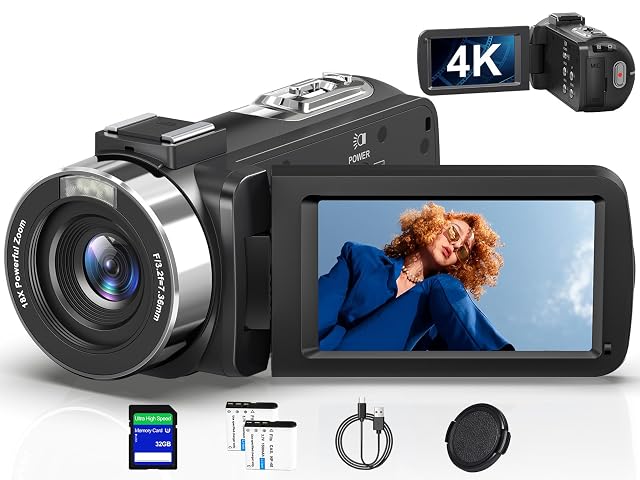
No sensor size published · no optical zoom: 18× digital · 4K · 80 MP stills · infrared night vision · external microphone supported · no recording limit published · 32 GB card supplied, expandable to 128 GB · two 1500 mAh cells · German store only
The only camcorder under 140 € here that supports an external microphone — the audio input this whole shelf is compared on — and the only one no store outside Germany was offering.
Best for: Interviews and talking heads on a budget, where a real microphone socket matters more than a screen that turns.