The bottom line A bit rate, an iris and real optical reach put this in a different class from the rest of the shelf, and at 992 € it needs to be. What no buyer should have to guess at this price is the audio input and the screen, and this page states neither.
On the listing
A 4K sensor with a DIGIC DV6 processor for sharp UHD images, and an eight-blade iris credited with attractive background blur; a 20× optical zoom with advanced five-axis stabilisation for wide-angle and close-up work; output and recording options including 0.5× Full HD slow motion and time lapse in 4K or Full HD to 1200×; MP4 support for playback on a compatible television, with 4K UHD at 150 Mbit/s and 25p; and a box holding the camcorder, a PD-E1 USB mains adapter, a BP-820 battery and a lens hood with integrated lens protection.
The number that separates this from every other camcorder here
One hundred and fifty megabits a second.
Five other pages on this shelf print a resolution — 2.7K, 4K, 5K — and not one of them says how much data is written behind it. At a low bit rate a 5K file holds less real detail than a well-compressed Full HD one, particularly on movement. This is the only page that publishes the figure, and it is a professional one.
An iris with blades, which is a lens specification
Eight of them, named in the first bullet. It describes the shape of the aperture and therefore how out-of-focus highlights render — round rather than angular. No other camcorder of the six here publishes anything about its iris at all.
Two silences that are hard to forgive at this price
No audio input. Not a socket, not a shoe, not a line level — nothing in five bullets. Two camcorders at a seventh of the price publish support for an external microphone, and on a camera sold for serious recording this is the omission that would send me to the maker’s own documentation before ordering.
No screen. Not a size, not a rotation. Four cheaper camcorders here publish both.
What is in the box
A mains adapter, a battery, and a lens hood with integrated protection. The hood matters more than it sounds on a 20× lens: flare at the long end is what it exists to stop.
Availability
Between 922 € and 1009 € on the German, French, Italian and Spanish Amazon stores when this page was last checked.
The British Amazon store carry it too, priced in local currency. Those amounts are deliberately absent from the range above, which reads euro stores only.
Listed in the American Amazon catalogue with nothing on sale against the entry: the camera has a page there and no seller behind it.
Everything in this section is the figure Keepa carried on the day of the last update to this page. Availability and prices shift without notice.
Prices quoted in this text were read on 13 September 2026. The live price is at the top of the page.
What it does well, and what it gives up
Strengths
Publishes a bit rate, 150 Mbit/s at 4K 25p, which decides detail after compression and which no other camcorder here states
An eight-blade iris, named in the first bullet for background blur — a lens detail no rival publishes
Time lapse to 1200× and 0.5× Full HD slow motion, both stated as recording options rather than implied
Compromises
No audio input of any kind published, on the most expensive camcorder of the six here
No screen size or articulation stated anywhere
The 20× zoom has no focal lengths attached, so its reach cannot be compared with the 25-600 mm below it
Specifications
Sensor size
Not published as a measurement — the first bullet names a 4K sensor with a DIGIC DV6 processor behind it, and gives no dimension. That is a resolution class rather than a size, so the Panasonic below it remains the only camcorder here with a published sensor size
Optical zoom range
20× optical, stated in the title and the second bullet. No focal lengths in millimetres are given, so the range cannot be placed against the 25-600 mm published one shelf down
Recording formats
4K UHD at 150 Mbit/s and 25p, stated in the fourth bullet, with MP4 named for playback on a compatible television. It is the only camcorder here to publish a bit rate, which is what actually decides how much detail survives compression
Stated recording limits
Not published on the listing — five bullets cover the sensor and iris, the zoom and stabilisation, the output options, the formats and the box contents, without a clip length or file ceiling. The most expensive camcorder on this shelf leaves the figure unstated like the other five
Audio inputs
Not published on the listing — no microphone socket, shoe or audio input appears anywhere in the five bullets, which on a camcorder at this price is the most surprising omission of the shelf
Stabilisation
Advanced five-axis stabilisation, stated in the second bullet alongside the 20× zoom for wide-angle and close-up work. No stop figure and no protocol is published
Screen articulation
Not published on the listing — no screen size, type or rotation is stated, where four of the five other camcorders here publish both a diagonal and an articulation
Power options
A PD-E1 USB mains adapter and a BP-820 battery are supplied, named in the fifth bullet with a lens hood and integrated lens protection. No capacity or runtime is given
Amazon reference
B0BGLGKF21 (same reference on 6 Amazon marketplaces)
EAN
4549292202274
What people ask before they commit
Why does a bit rate matter more than a resolution?
Because it decides how much of the detail survives being compressed into a file. Two cameras can both write 4K and differ enormously: at a low bit rate, fast movement and fine texture turn to mush. 150 Mbit/s at 25p is a professional figure and this is the only page on the shelf that publishes one — every other camcorder here gives a resolution and says nothing about the data behind it.
What does an eight-blade iris change?
The shape of the out-of-focus areas, and how smoothly they fall away. More blades give a rounder opening, so points of light behind the subject render as circles rather than polygons. The first bullet names it as the reason for attractive background blur, which is the correct claim: it is about the look of the blur rather than the amount, and the amount comes from the sensor and the aperture.
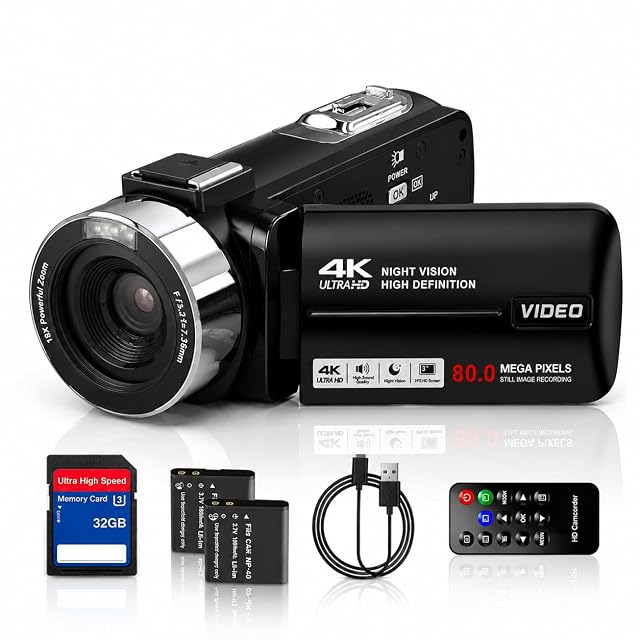
No sensor size published · no optical zoom: 18× digital · 4K at 30 fps · 80 MP stills · infrared night vision · no recording limit published · 3 inch IPS screen turning 270 degrees · remote supplied · two 1500 mAh batteries · webcam mode
A 4K camcorder with infrared night vision and two batteries at 89 €, whose 80 megapixel figure has no sensor published behind it and whose recording limit, like the whole shelf, never appears.
Best for: Filming indoors and after dark on a tripod, where the infrared mode and the remote do work the cheaper camera cannot.
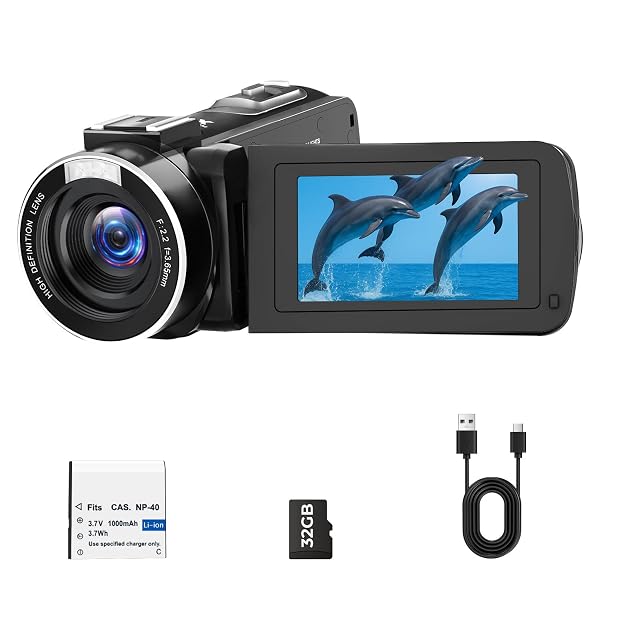
No sensor size published · no optical zoom: 18× digital, stated by the maker as NO optical zoom · 2.7K video · 48 MP stills · no recording limit published · stabilisation named without a type · 3 inch screen turning 270 degrees · LED fill light · 32 GB card and battery included
The cheapest camcorder here at 66 €, whose own second bullet writes that its 18× zoom is not optical — and which, like all six on this shelf, never states how long it will record.
Best for: A first camcorder for family events, plugged into a power bank, where the 270 degree screen and the card in the box are the specification that counts.
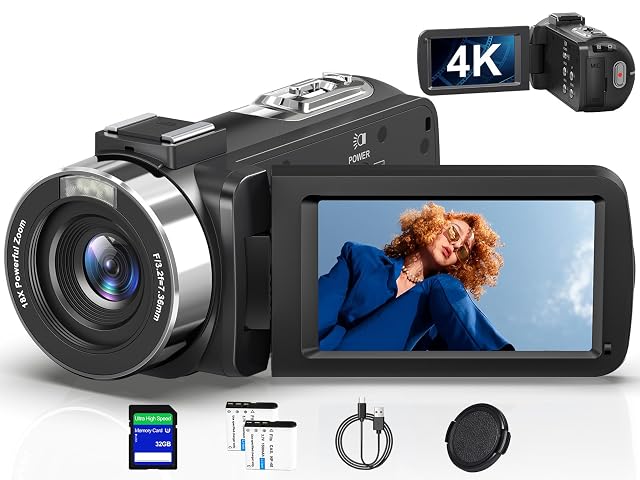
No sensor size published · no optical zoom: 18× digital · 4K · 80 MP stills · infrared night vision · external microphone supported · no recording limit published · 32 GB card supplied, expandable to 128 GB · two 1500 mAh cells · German store only
The only camcorder under 140 € here that supports an external microphone — the audio input this whole shelf is compared on — and the only one no store outside Germany was offering.
Best for: Interviews and talking heads on a budget, where a real microphone socket matters more than a screen that turns.