A guide number depends on the sensitivity and coverage behind it · review
Rollei Flashy ONE, GN16 and 16.8 Ws, recycle 0.01 to 2.5 s review
The only flash of the five here to publish watt-seconds as well as a guide number — 16.8 Ws and GN16 — with seven stops in third-stop steps and a recycle time from 0.01 to 2.5 seconds, for 43 €.
The bottom line Seven stops in third-stop steps, a published recycle range, 500 flashes and an energy figure in watt-seconds make this the best-specified small flash of the five here at 43 €. The guide number still arrives without its conditions, and the head does not move.
On the listing
Five bracketed bullets. A single-pin hot shoe said to fit nearly any camera, naming Canon, Sony, Nikon, Fuji and Lumix; 16.8 Ws and a guide number of 16, described as more power than typical mini flashes at a fraction of the size, for lifting faces and controlling shadows; flash durations down to 1/50,000 second for freezing droplets, hair and action; precise manual control from 1/128 to 1/1 in third-stop increments, aimed at photographers who set their own light; and a 1250 mAh cell giving up to 500 flashes at full power. The title adds a recycle time of 0.01 to 2.5 seconds and an LCD display.
Sixteen point eight watt-seconds, the only bridge
Every other page of the five here speaks one unit or the other. Studio heads publish watt-seconds, flashguns publish guide numbers, and the hub above says plainly that the two cannot be set side by side. This listing prints both for the same flash, which is the one place in the catalogue where the two scales touch.
Nought point zero one to two and a half
A recycle range rather than a single figure, because recycling depends on how much was discharged. Near-instant at 1/128, two and a half seconds at full. Only one other flash on this shelf publishes anything comparable.
Seven stops, in thirds
From 1/128 to 1/1 in third-stop steps is finer control than anything else here — the flash below it has four levels, the one two places up has eight. For work that has to match from frame to frame, that resolution is the whole argument for a manual unit.
A fiftieth of a thousandth of a second
The third bullet’s claim is about what the flash freezes, not what the camera does. When flash is the dominant light the burst sets the exposure length, so 1/50,000 second stops things a shutter cannot. The page does not say at which power setting that duration is reached, and on every flash of this kind the shortest bursts are the weakest ones.
Availability
Between 43 € and 55 € on the German, French, Italian and Spanish Amazon stores when this page was last checked.
The American and British Amazon stores carry it too, priced in local currency. Those amounts are deliberately absent from the range above, which reads euro stores only.
Everything in this section is the figure Keepa carried on the day of the last update to this page. Availability and prices shift without notice.
Prices quoted in this text were read on 13 September 2026. The live price is at the top of the page.
What it does well, and what it gives up
Strengths
16.8 Ws published alongside GN16 — the only flash here that gives an energy figure at all
Seven stops of manual control, from 1/128 to 1/1 in third-stop steps
Recycle from 0.01 to 2.5 seconds and up to 500 flashes at full power from a 1250 mAh cell
Compromises
The guide number carries neither a sensitivity nor a coverage figure
No head movement published, so the light is frontal
No metering and no radio, which the page presents as the design rather than hiding
Specifications
Guide number with its stated conditions
GN16, in the title and the second bullet, without a sensitivity or a coverage figure. The same bullet does something no other flash here does: it publishes 16.8 Ws alongside, which is the unit the studio heads on the shelf above are compared in. Two ways to read one output, and the guide number still lacks its conditions
Head tilt and swivel
Not published on the listing. Five bullets cover compatibility, output, flash duration, manual control and endurance, and none describes a head that moves. On a unit sold for portraits, street and reportage, that means the light stays frontal
Zoom range
None published. No focal range appears anywhere on the page
Metering support
None. The first bullet names a single-pin hot shoe as the reason it fits Canon, Sony, Nikon, Fuji, Lumix and more — a shoe that carries the fire signal alone. The fourth bullet makes the position positive rather than apologetic: full manual control for photographers who want repeatability and work without automation
Recycle time
0.01 to 2.5 seconds, published in the title. It is one of only two recycle figures on this shelf, and the range spans the power scale — near-instant at minimum power, 2.5 seconds at full
Power source
A built-in 1250 mAh cell, in the fifth bullet, credited with up to 500 flashes at full power and framed as a day without battery changes. Five times the capacity of the cheaper flash below it
Built-in radio
None named. No radio system and no optical slave mode appears on the page
Amazon reference
B0FN4M5PG6 (same reference on 6 Amazon marketplaces)
EAN
4048805288748
What people ask before they commit
Why is publishing watt-seconds unusual on a flashgun?
Because the two halves of this catalogue use different units: studio heads are rated in watt-seconds of stored energy, flashguns in guide numbers. The hub above warns that the two cannot be compared. This page gives both — 16.8 Ws and GN16 — which is the only point of the five here where a reader can see the same flash described in both languages.
What does a flash duration of 1/50,000 second do?
It freezes movement that no shutter speed on the camera could. The third bullet names droplets, hair in motion and action. When a flash is the dominant light, the exposure is as short as the flash burst, not as short as the shutter — so a very brief burst is what stops a splash mid-air. Short durations come at low power settings, which is the part the bullet leaves out.
Is manual-only a limitation at this price?
It is a choice, and the fourth bullet argues it well: precise control from 1/128 to 1/1 in third-stop steps, repeatable frame after frame. Automatic metering guesses, and it guesses differently as the subject moves. What manual costs is speed when the light is changing — and it is why third-stop resolution matters more here than it would on an automatic unit.
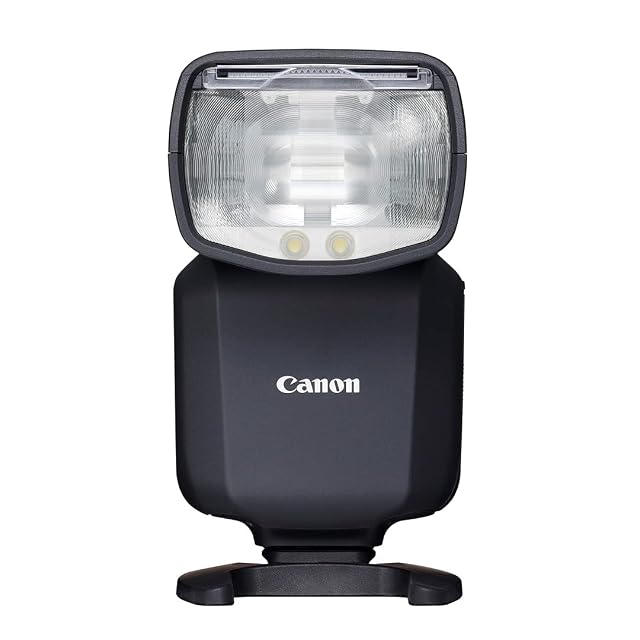
Canon system flash · guide number 60, no sensitivity or coverage stated · recycle 0.1 to 1.2 s · about 85 flashes at full power in a burst · manual levels from 1/1 to 1/1024, eleven stops · LP-EL lithium pack, up to 350 shots at full power · FP high-speed sync named in the title · improved passive cooling · weather-resistant seals · a compatibility list that excludes several current bodies
The dearest flash of the five here at 325 €, with weather seals, eleven stops of manual control and 350 full-power shots from its own lithium pack — and a compatibility list that rules out every reflex and several mirrorless bodies.
Best for: A recent EOS R body used in weather, where fast recycling, deep manual control and sealed construction justify the price.
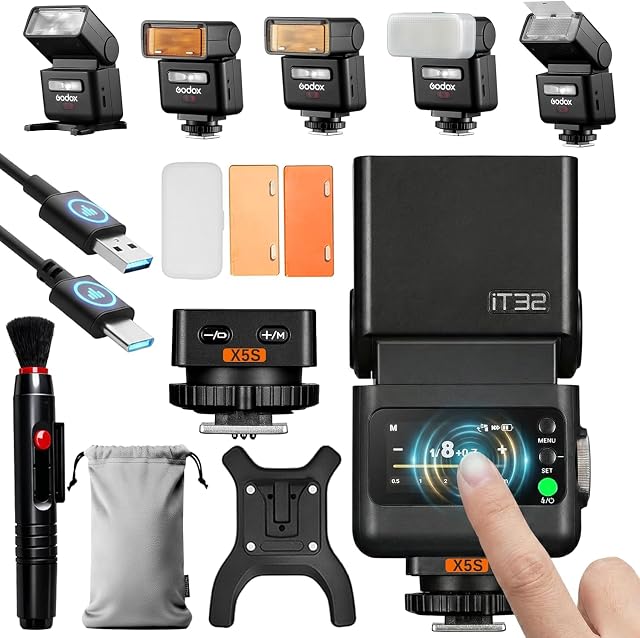
Sony fit · TTL, manual and stroboscopic modes · high-speed sync to 1/8000 s · first and second curtain sync · flash exposure compensation · Godox 2.4G X system, X5S detachable and controlling the flash from up to 20 m · touchscreen · 7.2 V 900 mAh cell, about 70 minutes at full power, recharged in about 70 minutes over USB-C · 10-step LED modelling light · magnetic diffuser, colour filters and a mini stand supplied · no guide number published
A TTL flash sold with its own radio trigger for 107 €, with high-speed sync to 1/8000 and a touchscreen — and no guide number anywhere on the page, which is the one figure this shelf is ranked by.
Best for: A Sony body that needs one small flash working both on and off the camera, inside a system that can grow to studio heads later.
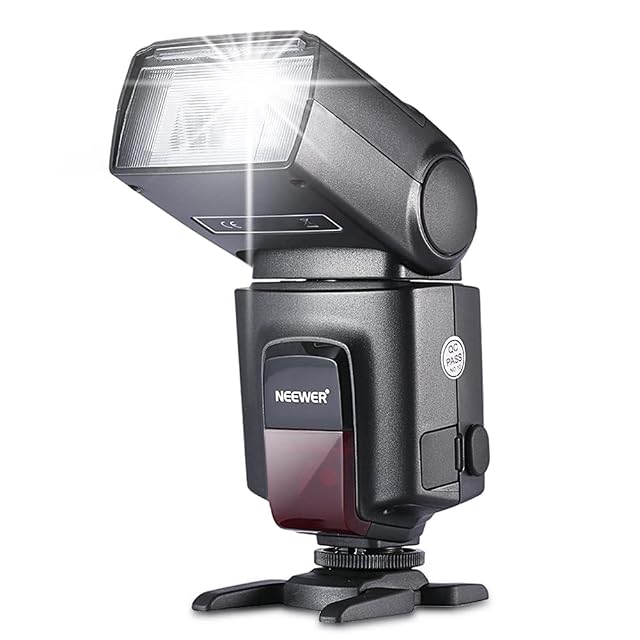
Universal single-contact hot shoe · GN38 at ISO 100 · 8 manual levels from 1/128 to 1/1, seven stops · 5600K plus or minus 200K · recycle 0.1 to 5 s · flash duration 1/300 to 1/20,000 s · head tilts 0 to 90 degrees and swivels 0 to 270 · S1 and S2 optical slave modes and PC sync · 4 AA cells, not supplied, with a socket for a CP-E4 external pack · no TTL, no high-speed sync, no camera-menu control
The only flash here that publishes its guide number with the sensitivity behind it — GN38 at ISO 100 — and a head that tilts through 90 degrees and swivels through 270, for 51 €, with a first bullet that is four warnings.
Best for: Bounced flash on a budget, on almost any camera with a centre-contact shoe, for someone who sets the power by hand and owns rechargeable AA cells.