Reach is easy to buy and hard to hold still · review
Walimex pro 650-1300mm 1:8-16 CSC for Canon EF, manual focus review
The longest reach in the whole catalogue at 1300mm for 250 €, bought at the price of manual focus, f/8 at its widest and a page that publishes neither a weight nor a tripod collar for a lens of that length.
The bottom line Thirteen hundred millimetres for 250 € is the sort of number that sells a lens on its own, and everything about the page is consistent with that trade: manual focus, f/16 at the end of the range, no stabiliser, and no weight or collar published for a metal barrel of that length. Bought knowingly, it reaches where nothing else here does.
On the listing
Five bullets. Travel, nature and wildlife photography named as the uses, with detailed landscape work added; a robust all-metal barrel with an extendable hood and multi-coated glass elements; a claim that mounting the lens on an APS-C body minimises distortion, edge softness and vignetting; a long list of compatible Canon EOS bodies, from the 1D series down to the 1100D; and a box list — the telezoom, a storage bag, lens caps and one T2 adapter for Canon EF and EF-S.
Where 1300 millimetres actually comes from
Nothing else of the five here passes 400mm. The Canon two places up reaches 400mm for 659 €, and this lens starts at 650mm and doubles from there for 250 €. That is the entire proposition, and the rest of the page is the bill for it.
Manual focus is not an omission here
The title states it rather than hiding it, and at these focal lengths with an f/8 maximum aperture most autofocus systems would struggle in any case. What the page does not offer is any form of stabilisation, and this is the lens on the shelf that magnifies movement the most. A tripod is not an accessory to this purchase, it is part of it.
An adapter in the box, and what it implies
The fifth bullet lists a T2 adapter for Canon EF and EF-S. T2 is a generic screw mount, so the barrel is one design fitted to many systems by a ring — the reason the optics can be sold this cheaply, and the reason the mount is named in the title rather than in the glass.
Two blanks a long lens should not have
No tripod collar named. The hub above says that past a certain weight the camera mount should not be carrying the lens. This page never says whether the lens can sit on a support by itself.
No weight at all. An all-metal 1300mm barrel, and not one figure in grams to plan a head or a tripod around.
Availability
Between 250 € and 264 € on the German, French, Italian and Spanish Amazon stores when this page was last checked.
The British Amazon store carry it too, priced in local currency. Those amounts are deliberately absent from the range above, which reads euro stores only.
Nothing came back from the American Amazon store at all, so the button for that country runs a search instead of opening an entry that is not there.
Everything in this section is the figure Keepa carried on the day of the last update to this page. Availability and prices shift without notice.
Prices quoted in this text were read on 13 September 2026. The live price is at the top of the page.
What it does well, and what it gives up
Strengths
650-1300mm for 250 €, a reach nothing else of the five here approaches
An all-metal barrel with a pull-out hood, stated in the second bullet, where plastic is the norm at this price
A bag, both caps and a T2 adapter for Canon EF and EF-S are listed in the box, so the mount is covered without a second purchase
Compromises
Manual focus and no stabilisation of any kind on a lens that magnifies every movement by up to 1300mm
f/16 at the long end, roughly two stops darker than anything else on this shelf
No tripod collar named and no weight published, which are the two figures that decide how a lens this long is actually supported
Specifications
Focal range
650-1300mm, in the title, and double the short end at the long one. Nothing else of the five here reaches past 400mm, so this is the only lens here that arrives at the focal lengths its first bullet describes: wildlife and detailed landscape work from a distance
Maximum aperture
f/8 at 650mm and f/16 at 1300mm, written in the title in the ratio form 1:8-16. At 1300mm that is around two stops darker than anything else on this shelf, and it decides everything about how the lens is used: a bright day, a high sensitivity, or a static subject
Stabilisation and modes
None named on the listing, and no modes. The title states manual focus, and no bullet claims any form of stabilisation. At 1300mm this is the specification that shapes the whole purchase — the hub above notes that a telephoto magnifies movement along with everything else
Tripod collar
Not published on the listing. The page describes a robust all-metal barrel with an extendable hood and lists a bag, caps and an adapter in the box, and never names a collar or a tripod foot. On a lens of this length that is the omission with the most practical consequence
Minimum focus
Not published on the listing. The bullets cover the uses, the build, the APS-C behaviour, the compatible bodies and the box contents, and no close-focus distance appears
Filter thread
Not published in millimetres. The second bullet names an extendable hood and multi-coated glass elements without giving a front diameter
Sealing
Not claimed. The build bullet claims a robust all-metal barrel, which is a construction statement and not a seal against dust or moisture
Weight
Not published in grams — a striking absence on a 1300mm all-metal lens, and the figure a buyer would want before deciding what supports it
Amazon reference
B001UAG9WW (same reference on 5 Amazon marketplaces)
EAN
4250234558631
What people ask before they commit
What does 1:8-16 mean on this lens?
It is the maximum aperture written as a ratio, and it varies with the zoom: f/8 at 650mm, f/16 at 1300mm. The hub above says the aperture at the far end is the one in use most of the time on a long zoom, and f/16 is the darkest figure in this catalogue. In practice the lens asks for bright light, a high ISO setting, or both.
Why does the third bullet recommend an APS-C body?
It claims that using the lens on an APS-C sensor minimises distortion, edge softness and vignetting. The reasoning is geometric: a smaller sensor takes a smaller rectangle out of the middle of the image circle, and the middle is where any lens performs best. The corners the lens handles least well simply fall outside the frame.
What is the T2 adapter listed in the box?
The fifth bullet names one for Canon EF and EF-S. T2 is a generic screw mount, which is how a lens like this is built for many camera systems at once: one barrel, and a small adapter ring for each mount. It is why the title can name Canon while the optics stay the same, and it is why the adapter being included matters.
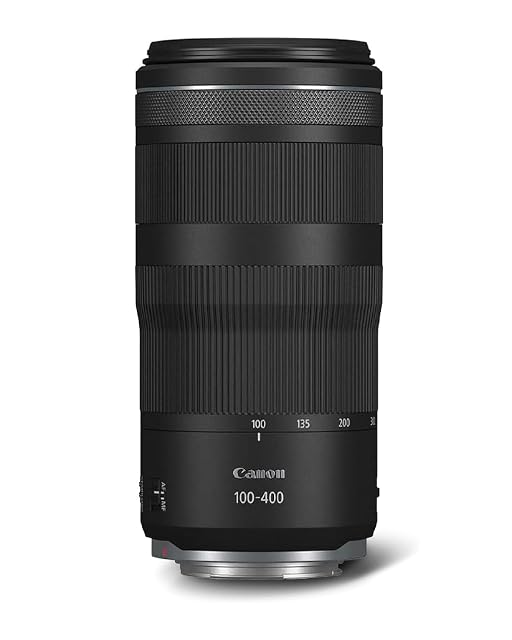
RF mount · 100-400mm · F5.6 at the short end, F8 at the long one · 5.5 stops of stabilisation claimed · UD glass · 635 g · 164.7mm long · no tripod collar published · no minimum focus published · no filter thread published · no sealing claimed
The only lens on this shelf that publishes its weight and its length — 635 g and 164.7mm for 400mm of reach — with 5.5 stops of stabilisation claimed, and a page that names two different autofocus motors in two different places.
Best for: Daylight sport and wildlife on an EOS R body, carried rather than mounted, where 635 g and 5.5 stops matter more than the last stop of aperture.
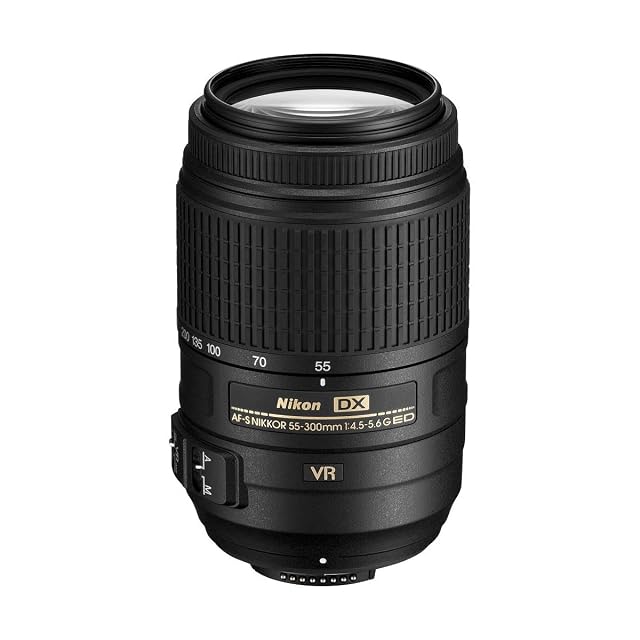
55-300mm · f/4.5 at the short end, f/5.6 at the long one · VR stabilisation, four stops claimed · 17 elements in 11 groups, two of them ED · no tripod collar published · no minimum focus published · no filter thread published · no sealing claimed · no weight published · hood, pouch and both caps supplied
The most conventionally documented lens on this shelf at 342 €, publishing its optical construction element by element and four stops of VR, and leaving the tripod collar, the filter thread and the weight unstated.
Best for: A DX body reaching to 300mm handheld, where four stops of VR do the work a tripod would otherwise have to.
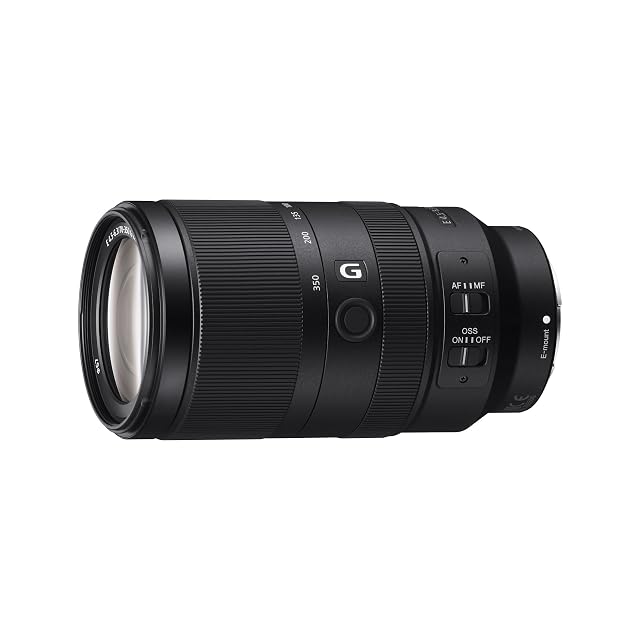
70-350mm · F4.5 at the short end, F6.3 at the long one · Optical SteadyShot, no stop figure · dust and moisture resistant design claimed · XD linear motor · focus mode switch and a customisable focus hold button · one aspherical and three ED elements · 7-blade circular aperture · no tripod collar published · no minimum focus published · no filter thread published · no weight published
The dearest lens of the five here at 932 €, and the only one anywhere on this shelf that claims a dust and moisture resistant design — with a linear focus motor, a focus hold button and no published weight, thread or close-focus distance.
Best for: Outdoor work in unreliable weather on an E-mount body, where the sealing claim and the focus controls are what the extra money is actually buying.