Reach is easy to buy and hard to hold still · review
Nikon AF-S DX Nikkor 55-300mm f/4.5-5.6G ED VR review
The most conventionally documented lens on this shelf at 342 €, publishing its optical construction element by element and four stops of VR, and leaving the tripod collar, the filter thread and the weight unstated.
The bottom line Four stops of VR and a narrow f/4.5-5.6 spread across 55-300mm make this the straightforward choice on the shelf, and the optical description is the best written of the five. The blanks are practical rather than optical: no collar, no thread, no weight, no close-focus distance.
On the listing
Five bullets in the old catalogue style, and they read like a specification sheet rather than advertising. Focal length 55-300mm; maximum aperture f/4.5-5.6; an optical construction of 17 elements in 11 groups, two of them extra-low dispersion glass; a VR stabiliser allowing handheld shots at shutter speeds up to four exposure steps longer; and a list of supplied accessories — the HB-57 hood, the CL-1020 pouch, the LC-77 front cap and the LF-1 rear cap.
Four stops, named as such
The figure comes with what it buys. The fourth bullet does not simply claim stabilisation, it says how many exposure steps it is worth and what that is for. Two of the five lenses on this shelf publish a stop count; this is the one that explains it.
Seventeen elements, eleven groups
The third bullet counts both, and names the two extra-low dispersion elements among them. Long lenses draw coloured edges when different wavelengths land in slightly different places, and ED glass is the standard answer. It is the kind of detail that separates a specification sheet from a sales page.
A narrow spread across five and a half times
f/4.5 to f/5.6 over 55-300mm is less than a third of a stop of loss across the whole range. On this shelf the Walimex loses a full stop across its span and the Canon two places down loses most of one, so the Nikon behaves more consistently than either as it is zoomed.
Four accessories listed, one measurement missing
The page names the hood, the pouch and both caps by part code, and never prints the filter diameter, the weight, the length or the minimum focus distance. It is an unusual set of priorities: everything in the box is identified, and the lens itself is not measured.
Availability
Between 342 € and 455 € on the German, French, Italian and Spanish Amazon stores when this page was last checked.
The American and British Amazon stores carry it too, priced in local currency. Those amounts are deliberately absent from the range above, which reads euro stores only.
Everything in this section is the figure Keepa carried on the day of the last update to this page. Availability and prices shift without notice.
Prices quoted in this text were read on 13 September 2026. The live price is at the top of the page.
What it does well, and what it gives up
Strengths
Four stops of VR, quoted with what it buys — shutter speeds four steps longer, handheld
Seventeen elements in eleven groups with two ED elements, the most detailed optical statement on this shelf
A hood, a pouch and both caps supplied, each named by its own part code
Compromises
No tripod collar among the listed accessories, so a 300mm lens hangs from the camera mount
No filter thread published, on a page that finds room for four accessory part numbers
Neither a weight nor a length, and no minimum focus distance
Specifications
Focal range
55-300mm, given as the first bullet rather than left to the title — this is the only lens on the shelf that opens its description with the figure. Five and a half times the short end
Maximum aperture
f/4.5 at 55mm and f/5.6 at 300mm, given in the second bullet in ratio form. The long end is barely a third of a stop behind the short one, which is a narrow spread for a zoom of this range and the most useful thing on the page after the stabiliser
Stabilisation and modes
VR, quoted at four stops: the fourth bullet says it allows handheld shots at shutter speeds up to four exposure steps longer. No separate panning mode is named, and no measurement protocol is stated alongside the figure
Tripod collar
Not published on the listing. The accessory bullet lists a hood, a pouch and two caps, and no collar or foot appears among them — so on this lens the camera mount carries the weight, which the hub above notes is the arrangement collars exist to avoid
Minimum focus
Not published on the listing, and no magnification ratio either, on a page that otherwise counts its elements and its groups
Filter thread
Not published in millimetres. The last bullet names the supplied hood, pouch and caps by their Nikon codes, and no front diameter is printed anywhere on the page
Sealing
Not claimed. Nothing on the listing mentions dust or moisture, which on a DX zoom at this price is the expected position rather than an oversight
Weight
Not published in grams, and the page gives no length either. It counts seventeen elements and eleven groups and never says what they weigh
Amazon reference
B003ZSHNCC (same reference on 6 Amazon marketplaces)
EAN
0017515216673
What people ask before they commit
What does four-stop VR actually allow?
The fourth bullet states it as the maker intends it to be read: shutter speeds up to four exposure steps longer than would otherwise be usable handheld. Where 1/300 second might be the rule of thumb at 300mm, four stops is the difference between that and something in the region of 1/20. It steadies the lens, not the subject — a moving animal still needs a fast shutter.
What are the two ED elements for?
ED stands for extra-low dispersion glass. Different wavelengths of light refract by different amounts, and at long focal lengths that shows up as coloured fringing along high-contrast edges. ED elements bring the wavelengths back together. The third bullet counts two of them among seventeen elements, which is the sort of detail this shelf rarely publishes.
Will this lens work on a full-frame Nikon body?
The page is a DX design, stated in the product name, which means it was computed for Nikon’s APS-C sensor size. Nikon full-frame bodies can mount DX lenses and generally crop to the smaller area automatically, at a cost in resolution. The listing itself makes no claim about full-frame use, so nothing here should be read as one.
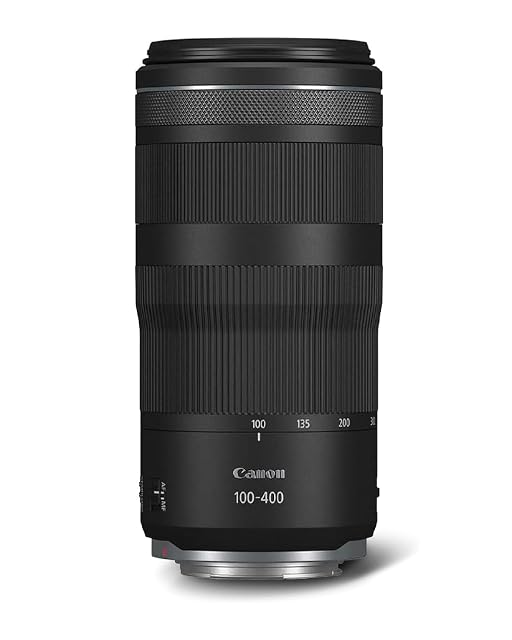
RF mount · 100-400mm · F5.6 at the short end, F8 at the long one · 5.5 stops of stabilisation claimed · UD glass · 635 g · 164.7mm long · no tripod collar published · no minimum focus published · no filter thread published · no sealing claimed
The only lens on this shelf that publishes its weight and its length — 635 g and 164.7mm for 400mm of reach — with 5.5 stops of stabilisation claimed, and a page that names two different autofocus motors in two different places.
Best for: Daylight sport and wildlife on an EOS R body, carried rather than mounted, where 635 g and 5.5 stops matter more than the last stop of aperture.
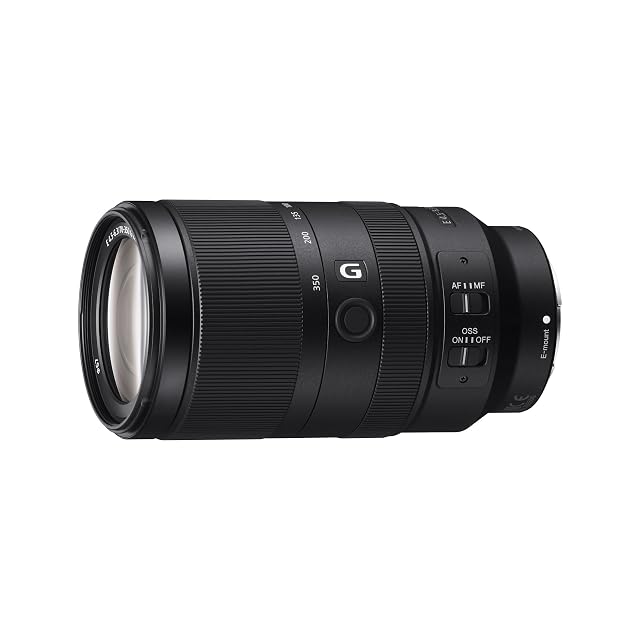
70-350mm · F4.5 at the short end, F6.3 at the long one · Optical SteadyShot, no stop figure · dust and moisture resistant design claimed · XD linear motor · focus mode switch and a customisable focus hold button · one aspherical and three ED elements · 7-blade circular aperture · no tripod collar published · no minimum focus published · no filter thread published · no weight published
The dearest lens of the five here at 932 €, and the only one anywhere on this shelf that claims a dust and moisture resistant design — with a linear focus motor, a focus hold button and no published weight, thread or close-focus distance.
Best for: Outdoor work in unreliable weather on an E-mount body, where the sealing claim and the focus controls are what the extra money is actually buying.
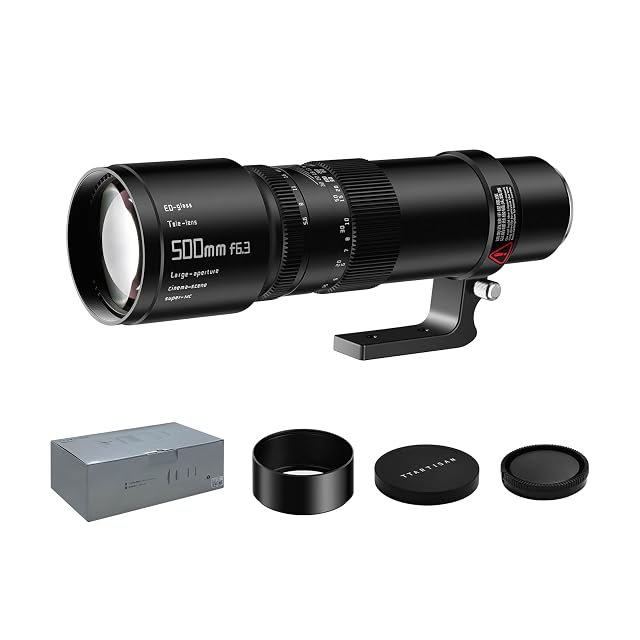
Fixed 500mm · F6.3, closing to F32 · manual focus, no stabilisation named · tripod ring fitted · no minimum focus published · 82mm filter thread · no sealing claimed · no weight published · two ED elements
A fixed 500mm at F6.3 for 419 €, and the only lens on this shelf that publishes both a tripod ring and a filter thread — 82mm, named so that neutral density and polarising filters can be found for it.
Best for: Wildlife, the moon or deep-sky work from a tripod, where a ring, a standard filter size and a single long focal length are worth more than autofocus.