Reach is easy to buy and hard to hold still · review
Sony SEL70350G, 70-350mm F4.5-6.3 G OSS review
The dearest lens of the five here at 932 €, and the only one anywhere on this shelf that claims a dust and moisture resistant design — with a linear focus motor, a focus hold button and no published weight, thread or close-focus distance.
The bottom line Sealing, a linear motor and a focus hold button are what 932 € buys over the lens at 659 €, and all three are real advantages for someone working outdoors in weather. What it does not buy is disclosure: no stop count for the stabiliser, no weight, no thread, no close-focus distance — four blanks on the dearest page of the five here.
On the listing
Five bullets, in Sony’s house pattern. One aspherical element and three extra-low dispersion elements in a precision optical design, credited with suppressing aberration across the whole zoom range; a seven-blade circular aperture for background blur; a dust and moisture resistant design for reliability outdoors in difficult conditions; an XD linear motor said to exploit the speed potential of the camera body and to track fast-moving subjects; and a controls bullet naming a focus mode switch and a customisable focus hold button.
The only sealing claim on this shelf
Four other pages here describe outdoor lenses and none of them makes it. The Walimex names wildlife and landscape work, the TTARTISAN names hiking and field study, and neither says anything about keeping water out. This one does, in the maker’s own words, and for a lens that lives outdoors it is the most consequential sentence on the page.
Seventy to three hundred and fifty
Five times the short end, starting closer than either the Canon at 100mm or the Walimex at 650mm, and stopping short of 400mm. It is the span that stays usable for a portrait at one end and reaches a distant animal at the other, which is a different argument from maximum reach.
A focus hold button, and who asks for one
The fifth bullet names it alongside a focus mode switch. These are controls for someone who focuses on a subject and then waits, and they appear on this shelf exactly once. They are also the clearest sign of which buyer the lens was designed for.
Four blanks at nine hundred and thirty-two euros
The stabiliser has no figure. OSS is in the product name and the bullets never quantify it, while the two cheaper lenses here publish 5.5 stops and four stops respectively.
No weight, no length, no thread, no close-focus distance. The Canon at 659 € publishes its mass to the gram and its length to a tenth of a millimetre.
Availability
Between 810 € and 932 € on the German, French, Italian and Spanish Amazon stores when this page was last checked.
The British Amazon store carry it too, priced in local currency. Those amounts are deliberately absent from the range above, which reads euro stores only.
Listed in the American Amazon catalogue with nothing on sale against the entry: the camera has a page there and no seller behind it.
Everything in this section is the figure Keepa carried on the day of the last update to this page. Availability and prices shift without notice.
Prices quoted in this text were read on 13 September 2026. The live price is at the top of the page.
What it does well, and what it gives up
Strengths
A dust and moisture resistant design, the only sealing claim among these five lenses
An XD linear motor described as exploiting the body’s full speed potential, with focus tracking on fast subjects
A focus mode switch and a customisable focus hold button on the barrel, controls the rest of this shelf does not have
Compromises
Optical SteadyShot named without a stop figure, on the dearest lens of the five here
No weight, no length, no filter thread and no minimum focus distance published at 932 €
No tripod collar named, for a 350mm lens sold for outdoor work
Specifications
Focal range
70-350mm, in the title. Five times the short end, and the range Sony chose over the 100-400mm and 55-300mm spans of the two Canon and Nikon lenses here
Maximum aperture
F4.5 at 70mm and F6.3 at 350mm, in the title. No bullet mentions the aperture, though the second describes the seven-blade circular diaphragm that shapes what it does to a background
Stabilisation and modes
Optical SteadyShot, named in the product title as OSS and never quantified in the bullets. No stop figure and no panning mode appear — the Canon below it claims 5.5 stops and the Nikon four, so the dearest lens here is the one whose stabiliser cannot be compared
Tripod collar
Not published on the listing. Five bullets cover the optics, the bokeh, the sealing, the focus motor and the controls, and none of them names a collar, a foot or a ring
Minimum focus
Not published on the listing, and no magnification ratio. The first bullet describes aberration suppressed across the whole zoom range without giving a distance at either end
Filter thread
Not published in millimetres. The page describes the elements inside the barrel and never the diameter at the front of it
Sealing
Claimed — the third bullet states a dust and moisture resistant design and says it provides the reliability needed outdoors in difficult conditions. It is the only sealing claim on this shelf, and on a lens named for long-range outdoor work it is the claim that most justifies the price
Weight
Not published in grams, and no length either. The Canon below it gives both for 273 € less
Amazon reference
B07X5DGGMQ (same reference on 6 Amazon marketplaces)
EAN
4548736099753
What people ask before they commit
What does a focus hold button do?
The fifth bullet names it as customisable. In its default use it locks focus for as long as it is pressed, so a subject that is briefly crossed by a branch or another animal does not pull the lens away. Being customisable, it can usually be reassigned to another function in the camera menu. It is a control found on longer lenses and rarely below this price.
How much does the sealing claim cover?
The third bullet claims a dust and moisture resistant design offering reliability outdoors in difficult conditions. That is the maker’s wording and it is a resistance claim, not a waterproof rating: no ingress standard is cited and no depth or duration is named. It is still the only such statement on this shelf.
Why does the aspherical element get named separately from the ED ones?
They correct different faults. The three extra-low dispersion elements address colour fringing, where wavelengths fail to converge at the same point — the characteristic long-lens problem. The single aspherical element has a non-spherical surface profile and addresses geometric aberrations that a spherical surface cannot. The first bullet counts them separately because they are doing separate jobs.
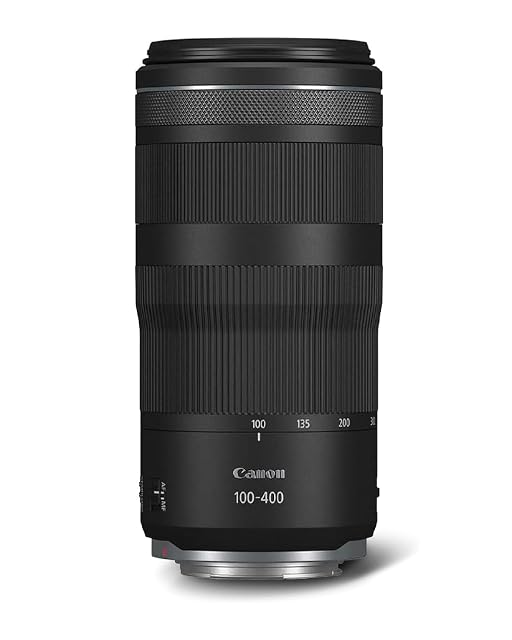
RF mount · 100-400mm · F5.6 at the short end, F8 at the long one · 5.5 stops of stabilisation claimed · UD glass · 635 g · 164.7mm long · no tripod collar published · no minimum focus published · no filter thread published · no sealing claimed
The only lens on this shelf that publishes its weight and its length — 635 g and 164.7mm for 400mm of reach — with 5.5 stops of stabilisation claimed, and a page that names two different autofocus motors in two different places.
Best for: Daylight sport and wildlife on an EOS R body, carried rather than mounted, where 635 g and 5.5 stops matter more than the last stop of aperture.
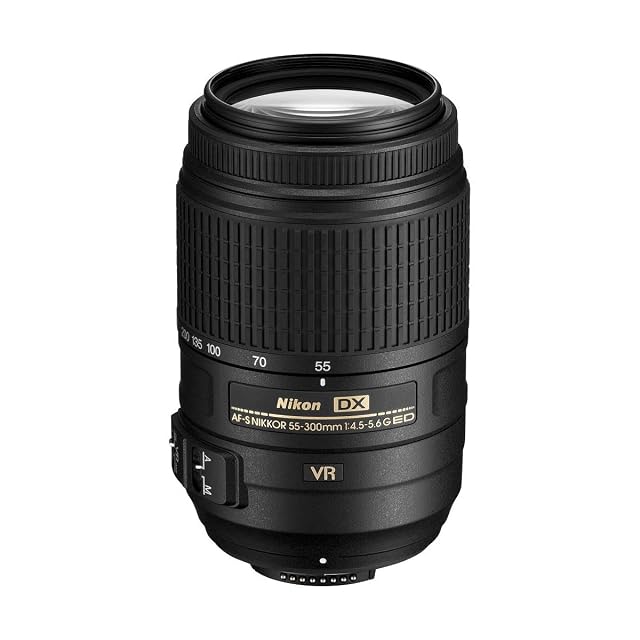
55-300mm · f/4.5 at the short end, f/5.6 at the long one · VR stabilisation, four stops claimed · 17 elements in 11 groups, two of them ED · no tripod collar published · no minimum focus published · no filter thread published · no sealing claimed · no weight published · hood, pouch and both caps supplied
The most conventionally documented lens on this shelf at 342 €, publishing its optical construction element by element and four stops of VR, and leaving the tripod collar, the filter thread and the weight unstated.
Best for: A DX body reaching to 300mm handheld, where four stops of VR do the work a tripod would otherwise have to.
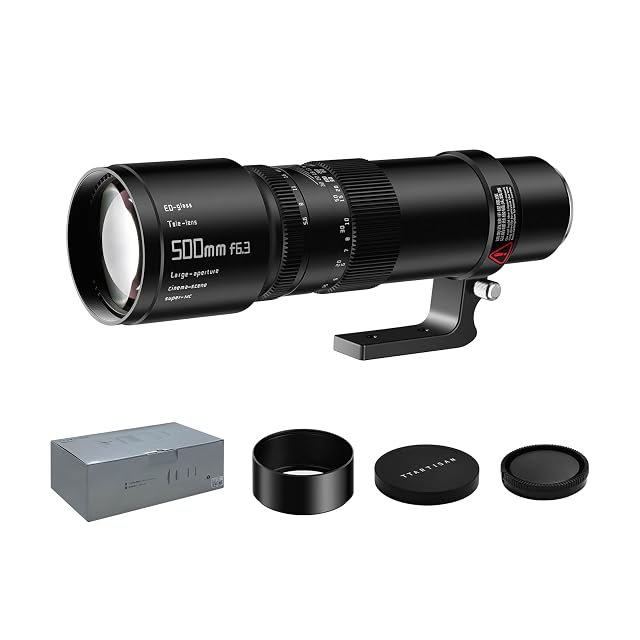
Fixed 500mm · F6.3, closing to F32 · manual focus, no stabilisation named · tripod ring fitted · no minimum focus published · 82mm filter thread · no sealing claimed · no weight published · two ED elements
A fixed 500mm at F6.3 for 419 €, and the only lens on this shelf that publishes both a tripod ring and a filter thread — 82mm, named so that neutral density and polarising filters can be found for it.
Best for: Wildlife, the moon or deep-sky work from a tripod, where a ring, a standard filter size and a single long focal length are worth more than autofocus.