Reach is easy to buy and hard to hold still · review
Canon RF 100-400mm F5.6-8 IS USM, 635 g review
The only lens on this shelf that publishes its weight and its length — 635 g and 164.7mm for 400mm of reach — with 5.5 stops of stabilisation claimed, and a page that names two different autofocus motors in two different places.
The bottom line Four hundred millimetres at 635 g with 5.5 stops claimed is a genuinely portable long lens, and the published weight and length make it the easiest purchase here to plan around. Then the page names two different focus motors, leaves the filter thread and the close-focus distance out, and prints F8 only in the title.
On the listing
Five bullets. A compact, light tele-zoom with advanced stabilisation over a versatile 100-400mm range, named for nature photography and sport; a second bullet on capturing subjects near and far; super-telephoto precision credited to ultra-low dispersion glass and a 5.5-stop stabiliser; a practicality bullet giving 635 g and a length of 164.7mm, and describing an STM autofocus as fast, quiet and smooth; and a compatibility bullet naming the EOS R System.
Six hundred and thirty-five grams, published
It is the only figure of its kind on this shelf. Four other pages describe long lenses and none of them says what one weighs. This one gives the mass and the length to a tenth of a millimetre, which is enough to decide on a bag, a strap and whether a head will hold it.
Five and a half stops, and why the long end needs them
The highest stabilisation claim of the five here, made twice. At 400mm and F8 the shutter speed is always under pressure, so the stabiliser is not a refinement here, it is what makes the aperture survivable in anything short of full sun.
The title says USM and the fourth bullet says STM
Two motor designations for one lens, in two places on the same page. They are different mechanisms with different behaviour, particularly for video, where the quieter one matters near a microphone. The listing states both and reconciles neither, and this page will not guess which the lens actually has.
What is not measured, on a page that measures
Length to a tenth of a millimetre, and no filter diameter. A weight, and no minimum focus distance. Nature and sport named as uses, and no sealing claim. The page is precise about the two figures it chose and silent on the four it did not.
Availability
Between 659 € and 819 € on the German, French, Italian and Spanish Amazon stores when this page was last checked.
The American and British Amazon stores carry it too, priced in local currency. Those amounts are deliberately absent from the range above, which reads euro stores only.
Everything in this section is the figure Keepa carried on the day of the last update to this page. Availability and prices shift without notice.
Prices quoted in this text were read on 13 September 2026. The live price is at the top of the page.
What it does well, and what it gives up
Strengths
635 g and 164.7mm published, the only weight and length on this shelf
5.5 stops of stabilisation claimed, the highest figure among the five here
UD glass named in the third bullet, and 400mm of reach in a barrel that fits a normal bag
Compromises
F8 at 400mm, which is the aperture in use whenever the reach is, and it is published only in the title
The title says USM and the fourth bullet says STM — two different motors named for the same lens on the same page
No tripod collar, no filter thread and no minimum focus distance published
Specifications
Focal range
100-400mm, in the title and in the first two bullets. Four times the short end, and the longest reach here from a lens that still weighs under 650 g
Maximum aperture
F5.6 at 100mm and F8 at 400mm, in the title only — no bullet mentions the aperture. F8 at the long end is a stop and a third behind the Sony above it and is the price paid for the weight
Stabilisation and modes
5.5 stops, claimed in the title and again in the third bullet alongside ultra-low dispersion glass. No panning mode is named and no protocol is stated. It is the highest stop figure of the five here
Tripod collar
Not published on the listing. Canon sells collars separately for lenses of this class, and this page neither includes one nor mentions the possibility, so at 635 g the camera mount carries it
Minimum focus
Not published on the listing, and no magnification ratio. The second bullet speaks of capturing subjects near and far without a figure for the near one
Filter thread
Not published in millimetres, on a page that finds room for the length of the barrel to a tenth of a millimetre
Sealing
Not claimed. Sport and nature are named as the uses in the first bullet, and no protection against dust or moisture is stated anywhere
Weight
635 g, published in the fourth bullet, along with a length of 164.7mm. It is the only lens on this shelf that gives either figure, and for 400mm of reach the number is the point of the lens
Amazon reference
B09G8J5WNZ (same reference on 6 Amazon marketplaces)
EAN
4549292186765
What people ask before they commit
Which autofocus motor does this lens have?
The page names two. The product title ends in USM, Canon’s ultrasonic motor designation, and the fourth bullet describes an STM autofocus providing fast, quiet and smooth focus — STM being the stepping motor used in a different part of the range. Both appear on the same listing, and this page does not settle which is correct: only the maker can.
Is F8 at 400mm a problem?
It depends entirely on the light. In daylight it costs nothing and it is why the lens weighs 635 g rather than twice that. Indoors, or at dusk when wildlife is most active, F8 forces a high sensitivity setting, and the 5.5-stop stabiliser helps with camera shake but not with a moving subject. It is the trade that defines this lens.
Can the lens take a tripod collar?
The listing does not say, and no collar appears in it. Canon offers collars for lenses of this class separately, but this page makes no claim about one, so nothing here should be read as confirmation. At 635 g the camera mount is within the range most bodies handle, which is presumably why the question is left unaddressed.
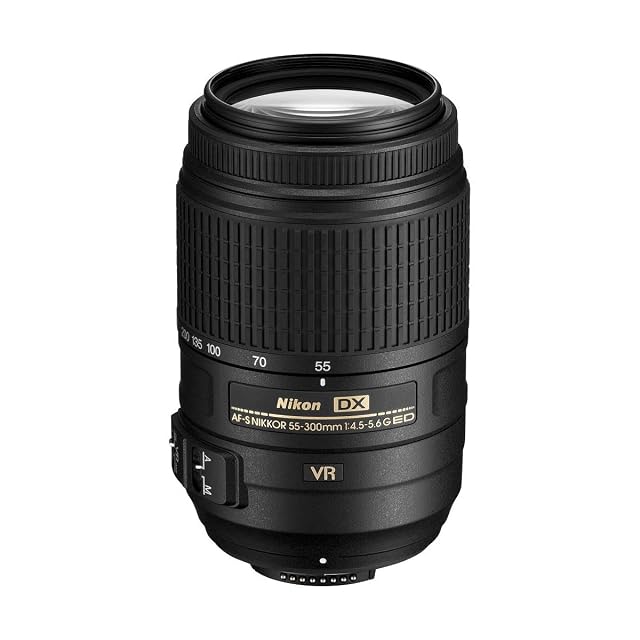
55-300mm · f/4.5 at the short end, f/5.6 at the long one · VR stabilisation, four stops claimed · 17 elements in 11 groups, two of them ED · no tripod collar published · no minimum focus published · no filter thread published · no sealing claimed · no weight published · hood, pouch and both caps supplied
The most conventionally documented lens on this shelf at 342 €, publishing its optical construction element by element and four stops of VR, and leaving the tripod collar, the filter thread and the weight unstated.
Best for: A DX body reaching to 300mm handheld, where four stops of VR do the work a tripod would otherwise have to.
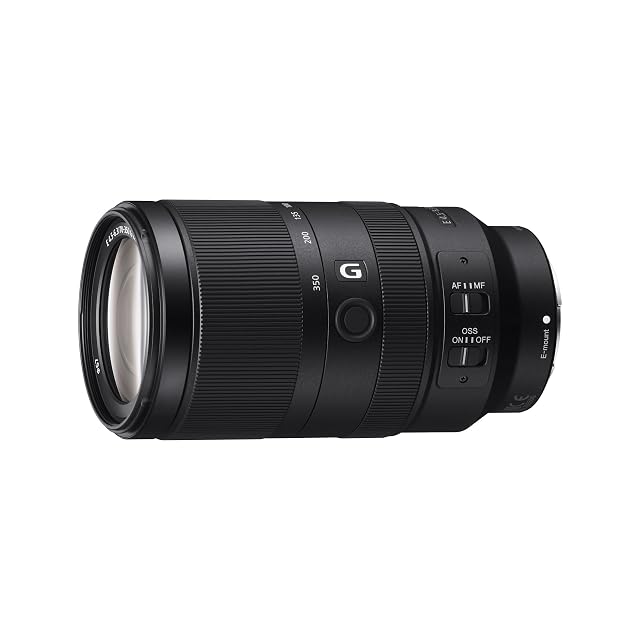
70-350mm · F4.5 at the short end, F6.3 at the long one · Optical SteadyShot, no stop figure · dust and moisture resistant design claimed · XD linear motor · focus mode switch and a customisable focus hold button · one aspherical and three ED elements · 7-blade circular aperture · no tripod collar published · no minimum focus published · no filter thread published · no weight published
The dearest lens of the five here at 932 €, and the only one anywhere on this shelf that claims a dust and moisture resistant design — with a linear focus motor, a focus hold button and no published weight, thread or close-focus distance.
Best for: Outdoor work in unreliable weather on an E-mount body, where the sealing claim and the focus controls are what the extra money is actually buying.
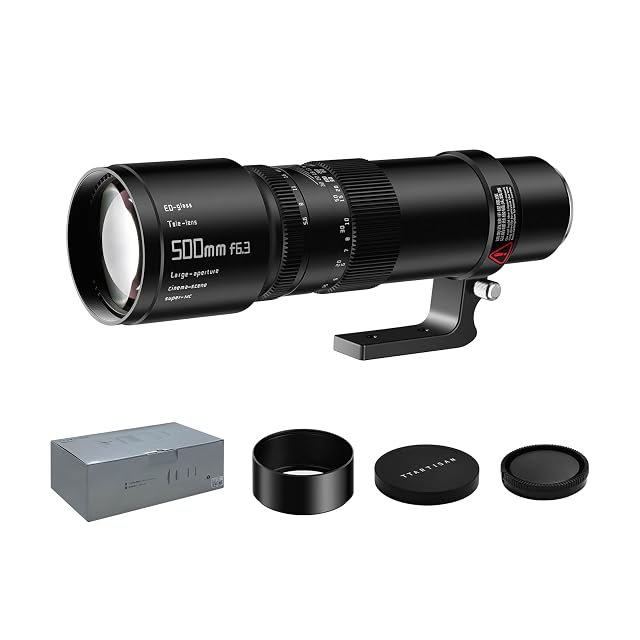
Fixed 500mm · F6.3, closing to F32 · manual focus, no stabilisation named · tripod ring fitted · no minimum focus published · 82mm filter thread · no sealing claimed · no weight published · two ED elements
A fixed 500mm at F6.3 for 419 €, and the only lens on this shelf that publishes both a tripod ring and a filter thread — 82mm, named so that neutral density and polarising filters can be found for it.
Best for: Wildlife, the moon or deep-sky work from a tripod, where a ring, a standard filter size and a single long focal length are worth more than autofocus.