Reach is easy to buy and hard to hold still · review
TTARTISAN 500mm F/6.3 super telephoto prime for Canon EF, manual focus review
A fixed 500mm at F6.3 for 419 €, and the only lens on this shelf that publishes both a tripod ring and a filter thread — 82mm, named so that neutral density and polarising filters can be found for it.
The bottom line Manual focus and no stabiliser put this squarely on a tripod, and the page knows it — the ring is fitted and the filter size is printed so the rest of the kit can be bought around it. For 419 € it publishes more of what this shelf compares than the lens costing 240 € more.
On the listing
Five bullets, and they are written for someone who already knows what a 500mm is for. Distant subjects named as the purpose, from sport to wildlife to deep-sky astrophotography; two ED elements credited with reducing chromatic aberration and delivering clarity from edge to centre; manual focus with an aperture range from F6.3 to F32, described as flexible in poor light; a bullet on simplified, distraction-free composition aimed at beginners and hobbyists; and a closing bullet naming a tripod ring and a standard 82mm filter size so that neutral density and polarising filters are easy to find.
Eighty-two millimetres, printed
No other page on this shelf gives a filter diameter. This one gives it and then explains why it is there: a standard size means compatible filters exist. On a long lens that is the difference between a polariser being a purchase and being a project.
A tripod ring on a 500mm prime
The same bullet names it. Every other lens here leaves the question open, and on a barrel this long the answer decides whether the camera mount is carrying the lens or the other way round.
Two ED elements against colour fringing
The second bullet counts them and states the problem they address. At 500mm, wavelengths that do not converge show as coloured edges on anything bright against anything dark — a bird against a sky, a crater rim against space. It is the failure mode this focal length is most prone to.
What a single focal length costs
There is no zoom ring, so the framing is decided by where the tripod goes. The fourth bullet calls that simplified composition, which is fair as far as it goes, and it is still the thing a buyer coming from a zoom will notice first.
Availability
About 419 € on the German, French, Italian and Spanish Amazon stores when this page was last checked.
Listed in the American and British Amazon catalogues with nothing on sale against the entry: the camera has a page there and no seller behind it.
Everything in this section is the figure Keepa carried on the day of the last update to this page. Availability and prices shift without notice.
Prices quoted in this text were read on 13 September 2026. The live price is at the top of the page.
What it does well, and what it gives up
Strengths
An 82mm filter thread, published with its purpose — the only diameter named on this shelf
A tripod ring fitted, so the lens sits on the support rather than hanging from the camera mount
Two ED elements named against chromatic aberration, and an aperture range given in full at F6.3 to F32
Compromises
Manual focus and no stabilisation, at a focal length where both are usually where the money goes
No minimum focus distance and no weight, on an otherwise well-specified page
Fixed at 500mm, so framing is done by moving rather than by turning a ring
Specifications
Focal range
None — this is a fixed 500mm, stated in the title, which also calls it a prime super telephoto. It is the only lens on this shelf that does not zoom, and the third bullet uses the word prime explicitly
Maximum aperture
F6.3, with the third bullet giving the full range as F6.3 to F32. That is one figure rather than a pair, because nothing extends: a 500mm prime at F6.3 sits between the f/5.6 of the Nikon at 300mm and the f/8 of the Walimex at 650mm
Stabilisation and modes
None named on the listing, and the title states manual focus. The fifth bullet names a tripod ring instead, which is the page being consistent: this is a lens designed to be supported rather than held
Tripod collar
Fitted — the fifth bullet names a tripod ring as part of the lens, alongside the filter size. It is the only lens on this shelf whose page states this, and on a 500mm prime it is the part that decides whether the lens can sit on a head at all
Minimum focus
Not published on the listing, and no magnification ratio. The first bullet describes distant subjects, from sporting events to wildlife and deep-sky astrophotography, which is the opposite end of the scale
Filter thread
82mm, published in the fifth bullet, which adds the reason it is named: a standard size makes compatible neutral density and polarising filters easy to find. This is the only filter diameter published anywhere on this shelf
Sealing
Not claimed. The page describes hiking, field study and astrophotography as uses and never states protection against dust or moisture
Weight
Not published in grams. The last bullet calls the lens light, which is the adjective and not the figure, and on a 500mm barrel with a tripod ring the number would decide the head
Amazon reference
B0H3ZMVHBZ (same reference on 6 Amazon marketplaces)
EAN
0744963279560
What people ask before they commit
Why does the filter thread matter enough to be in a bullet?
Because at 82mm filters are expensive and easy to buy wrongly. The fifth bullet names the size specifically so that neutral density and polarising filters can be matched to it — and the hub above notes that a large front element makes filters an expensive size. It is the only lens here that tells you what to buy for it.
What is the tripod ring for if the lens is not that heavy?
It moves the support point from the camera body to the lens’ own balance point. A 500mm barrel hanging off a camera mount puts all its leverage on the bayonet, and it also means the whole assembly pivots around the wrong place. The ring lets the lens sit on the head and the camera hang behind it, which is both safer and steadier.
Is a prime a disadvantage at 500mm?
It is a trade, and the page is honest about which side it is on. A prime has fewer elements to compromise, which is how F6.3 arrives at this price with two ED elements. What it gives up is framing: the composition is set by where the tripod stands. The fourth bullet turns that into a virtue, calling the results distraction-free.
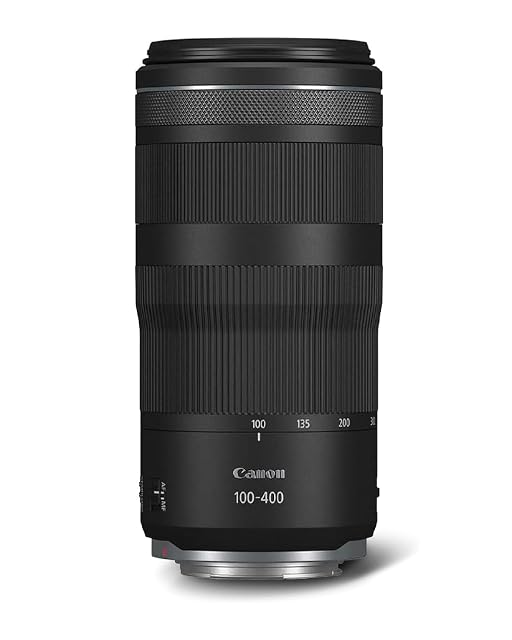
RF mount · 100-400mm · F5.6 at the short end, F8 at the long one · 5.5 stops of stabilisation claimed · UD glass · 635 g · 164.7mm long · no tripod collar published · no minimum focus published · no filter thread published · no sealing claimed
The only lens on this shelf that publishes its weight and its length — 635 g and 164.7mm for 400mm of reach — with 5.5 stops of stabilisation claimed, and a page that names two different autofocus motors in two different places.
Best for: Daylight sport and wildlife on an EOS R body, carried rather than mounted, where 635 g and 5.5 stops matter more than the last stop of aperture.
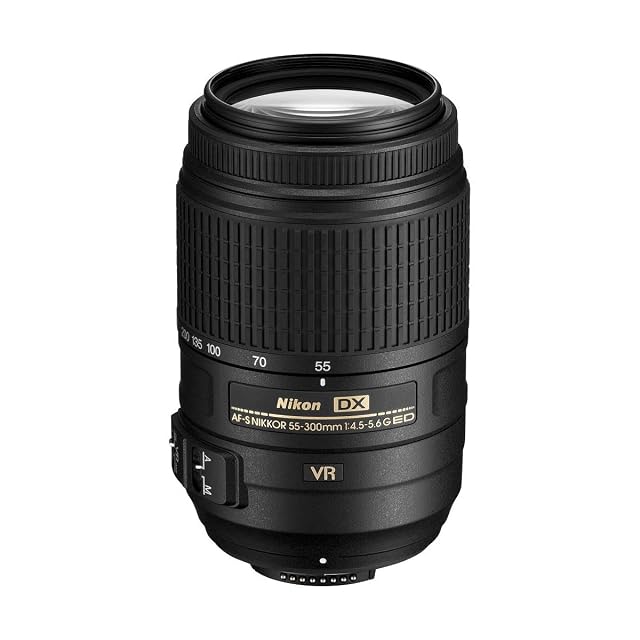
55-300mm · f/4.5 at the short end, f/5.6 at the long one · VR stabilisation, four stops claimed · 17 elements in 11 groups, two of them ED · no tripod collar published · no minimum focus published · no filter thread published · no sealing claimed · no weight published · hood, pouch and both caps supplied
The most conventionally documented lens on this shelf at 342 €, publishing its optical construction element by element and four stops of VR, and leaving the tripod collar, the filter thread and the weight unstated.
Best for: A DX body reaching to 300mm handheld, where four stops of VR do the work a tripod would otherwise have to.
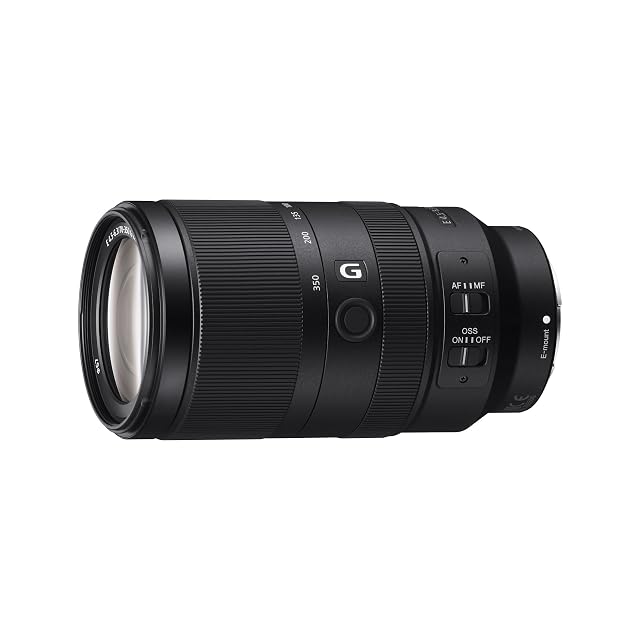
70-350mm · F4.5 at the short end, F6.3 at the long one · Optical SteadyShot, no stop figure · dust and moisture resistant design claimed · XD linear motor · focus mode switch and a customisable focus hold button · one aspherical and three ED elements · 7-blade circular aperture · no tripod collar published · no minimum focus published · no filter thread published · no weight published
The dearest lens of the five here at 932 €, and the only one anywhere on this shelf that claims a dust and moisture resistant design — with a linear focus motor, a focus hold button and no published weight, thread or close-focus distance.
Best for: Outdoor work in unreliable weather on an E-mount body, where the sealing claim and the focus controls are what the extra money is actually buying.