A monitor with camera control, and the converter that publishes its stops
Where it turns up
Field monitors and teleconverters, at 106 € and 219 €.
Two stops, written down
An exposure factor of about 4, which the page itself translates as the equivalent of two apertures: an f/2.8 lens works at f/5.6 behind it, an f/4 at f/8. Every other converter on that shelf leaves the reader to apply the arithmetic, and the shelf’s own advice says to work it out before buying.
A compatibility list with “only” in front of it
L-series primes of 135 mm and above, plus four named professional zooms. A converter protrudes into the space behind the lens, so an unlisted lens can meet it with its rear element — and a page that limits itself explicitly is more useful than one that names a mount.
The monitor that arrives working
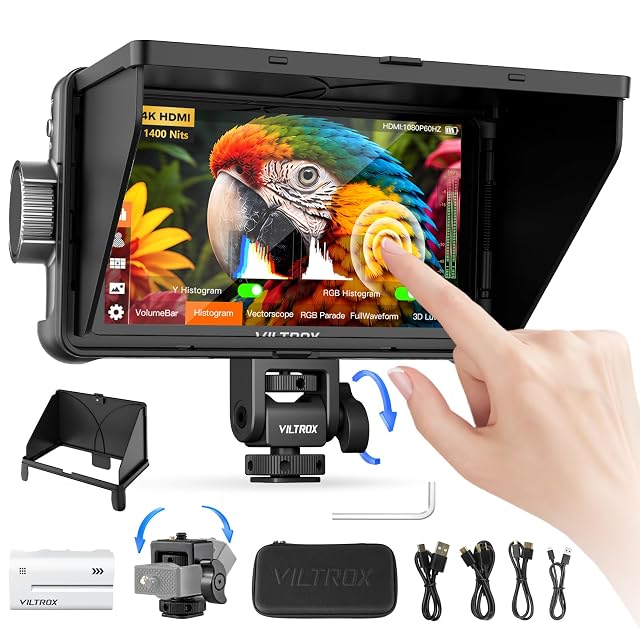
A battery, a case, a hood, a shoe adapter and three cables in the box, 1400 nits, camera control over USB-C and an onion-skin mode for stop-motion. Six other monitors on that shelf name an NP-F cell and supply none.
5.5 inches, touchscreen · 1920 by 1080, 1000:1, Rec.709 · 1400 nits · 4K HDMI in with loop-through, low latency · parade waveform, vectorscope, luminance histogram, focus assist, audio meter, image flip and false colour · CUSTOM 3D LUTs imported by SD CARD, with a note that export through the colour ring is not supported · CAMERA CONTROL over USB-C for shooting modes, plus an ONION-SKIN function for stop-motion · supplied WITH a VILTROX NP-F550 battery, a carrying case, a hot-shoe adapter, a detachable hood and three cables · diagonal markers and a centre point
Fourteen hundred nits, camera control over USB-C and an onion-skin mode for stop-motion — and the only monitor here that arrives with a battery in the box.
Best for: Stop-motion and animation work, and any shoot where the camera should be driven from the monitor rather than from its own buttons.
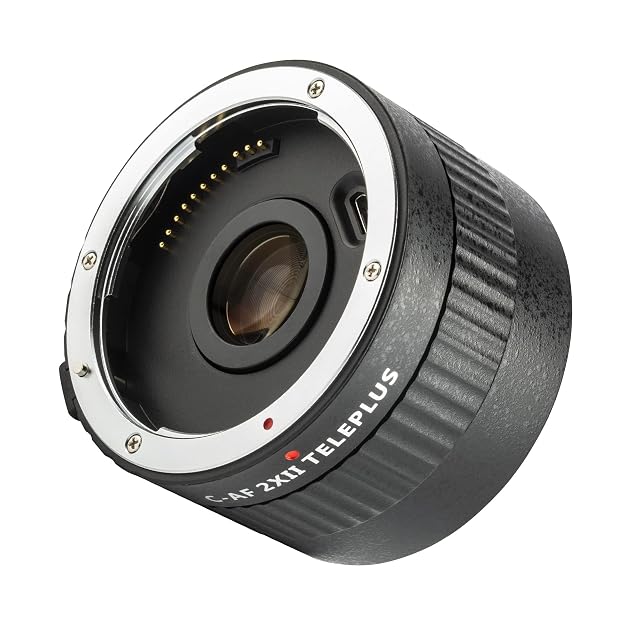
A 2× converter for Canon EF that publishes both things this shelf asks for and rarely gets: the light it costs — two stops — and the five lenses it fits.
Magnification
2×, in the first bullet, doubling the focal length of Canon EF lenses. A 100-400 mm becomes a 200-800 mm, which is the reason anybody buys one
Lenses named as compatible
PUBLISHED, and published as a limit: the second bullet says it is compatible ONLY with L-series fixed focal lengths of 135 mm and above, plus the EF 70-200 mm f/2.8L, the f/2.8L IS, the f/4L and the EF 100-400 mm f/4.5-5.6L. The intro above explains why the list is the gate rather than the mount: a converter protrudes, and fitting one to an unlisted lens can mean contact with the rear element
Light loss in stops
PUBLISHED — an exposure factor of about 4, which the first bullet itself translates as the equivalent of 2 apertures. It is the only page on this shelf to state the cost, and it matches the arithmetic the intro above gives for every 2×: an f/2.8 lens behind it works at f/5.6, an f/4 at f/8
Autofocus limits stated
Autofocus is claimed — the third bullet says the lens autofocus function is supported, with improved performance, fast focusing and reliable subject tracking — and NO minimum aperture is stated. The buying advice on this shelf asks for exactly that figure, because an f/4 lens becomes f/8 here and some bodies stop focusing there
Added length
Not published. Seven elements in four groups is the optical construction, given twice; how much further forward the lens sits is not
Sealing
Not claimed. The 323 € OM SYSTEM, the 349 € Sigma and the 479 € Canon on this shelf all claim dust and splash protection; this one claims coatings against ghosting and flare instead
Published weight
Not published, as on all six converters here
Amazon reference
B08GC59HV2 (same reference on 6 Amazon marketplaces)
EAN
0086291917067
Two stops of light loss published, and translated into apertures on the page itself
Five lenses named, with the word "only" in front of the list
No minimum aperture for autofocus, on a converter that turns f/4 into f/8
Best for: One of the five Canon EF telephotos named on the page, when 400 mm has to become 800 and two stops can be spared.
Each amount in a write-up is what the listing showed when that page was written. The figure next to the product is pulled in as you read, and it is the one that counts.