Camera sliders and flash triggers, from 17 € to 98 €.
What a slider has to publish
Rail length and actual travel, which are not the same number: a 60 cm rail does not move a camera 60 cm. Then the declared load, the bearing type, whether there is drag control, and whether it can be motorised. A slider without a drag adjustment gives a shot that starts and stops abruptly.
Triggers, and the figure that matters
Range, channels, and whether the receiver can also fire a camera rather than only a flash. A cheap trigger that works at five metres in a room is a different product from one that works at fifty in daylight, and the specification is the only way to tell them apart before buying.
The entry position, honestly
At this end of a shelf, the thing either does its one job or it does not. What is bought is a mechanism without refinements, and the refinements are what the dearer entries are selling.
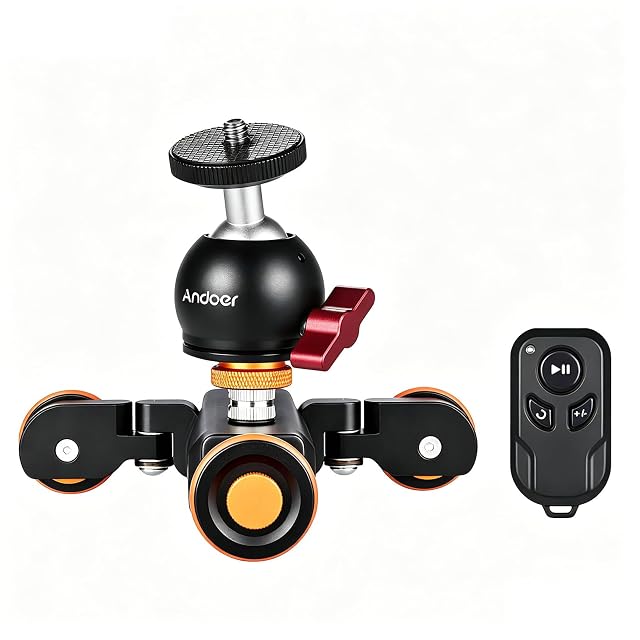
A motorised wheeled dolly rather than a rail · three speeds, 2.4, 2.6 and 2.8 cm per second · reversible direction · wheel angle adjustable through 180 degrees for straight or circular paths · declared load 3 kg · wireless remote effective to 6 m · 1/4 to 3/8 inch convertible screw with a ball head supplied · 1800 mAh cell giving up to 6 hours · plastic body · no weight published
Three published speeds in centimetres per second, a 3 kg load and six hours of battery for 108 € — a motorised dolly whose every figure is stated except its own weight.
Best for: Time-lapse and slow product moves on a smooth floor or table, where a hands-off motorised drift matters more than a guided rail.
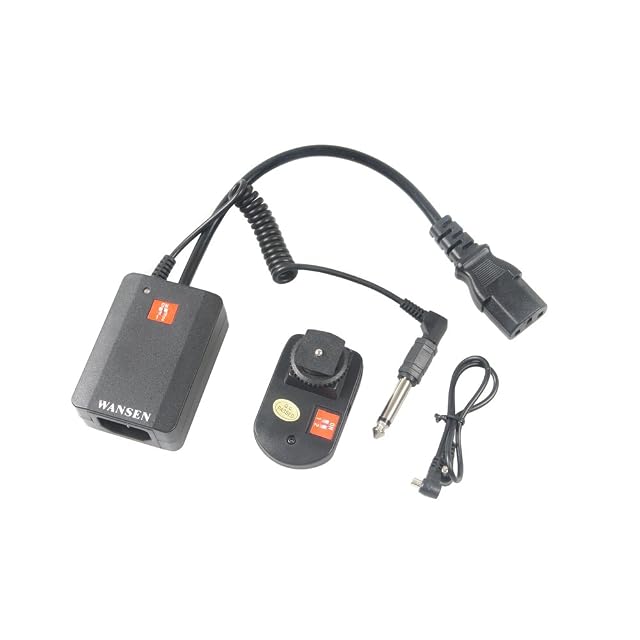
The cheapest trigger here at 17 €, with four channels, a 1/250 s sync claim and a cable for cameras with no hot shoe — and no system, no groups and no stated power source.
Radio system named
None. Five bullets describe a set, a sync speed, a fit, a cable and a range, and no radio system and no frequency appears — less even than the 433 MHz stated by the trigger above it. What arrives in the box works together, and the page gives no basis for saying what else ever will
Camera mounts supported
Canon, Nikon and Sony reflex bodies with a single-point hot shoe, in the third bullet. Single-point means the central firing contact only, so nothing is passed but the signal to fire — and the fourth bullet adds a connecting cable for cameras and transmitters, so a body without a usable shoe can still trigger the set
Channel and group counts
Four channels, in the first bullet, and no groups. It is the smallest channel count on this shelf — the trigger beside it offers sixteen — and four is enough to avoid a clash in a quiet room and not in a busy hall
Remote power control
None. Nothing on the page describes adjusting a light from the transmitter
Metering and sync modes claimed
A highest sync speed of 1/250 second, in the second bullet, and nothing else: no metering, no high-speed sync, no named modes. For a manual studio set that is the honest minimum, and the figure is above the sync speed of many bodies
Power source
Not published on the listing. Neither the transmitter nor the receiver has a cell type or count named, which on a two-piece radio set is a real omission — the trigger above it at least states two AAA cells for its receiver
Amazon reference
B00NTXUQ4U (same reference on 5 Amazon marketplaces)
EAN
0702411269198
Seventeen euros, the cheapest way to get a manual flash off the camera on this shelf
A connecting cable supplied, so a camera without a usable hot shoe can still fire the set
No system and not even a frequency named, so nothing can be said about future compatibility
Best for: Getting one manual studio head off the camera for the least money, on a reflex body with an ordinary hot shoe.
Each amount in a write-up is what the listing showed when that page was written. The figure next to the product is pulled in as you read, and it is the one that counts.