Travel is shorter than the rail, and the rail is what you carry · review
Andoer L4 PRO motorised dolly, three speeds, 3 kg review
Three published speeds in centimetres per second, a 3 kg load and six hours of battery for 108 € — a motorised dolly whose every figure is stated except its own weight.
The bottom line Speeds in centimetres per second, a 3 kg rating, a remote and six hours of running make this a genuine time-lapse tool at 108 €. The speeds are narrowly spaced, the body is plastic, and the one figure it never gives is what it weighs.
On the listing
Five bullets, dense with keywords. An improved motorised dolly with three adjustable speeds — 2.4, 2.6 and 2.8 cm per second — supporting movement in the opposite direction, with a wheel angle adjustable through 180 degrees for circular or straight paths, named for time-lapse, macro and low-angle video; a high-grade plastic body carrying up to 3 kg, pocket-sized and light; a wireless remote changing speed and direction and pausing the move, effective to 6 m, with control keys on the dolly itself; a 1/4 to 3/8 inch convertible screw suiting most camera and phone holders, with a ball head supplied; and a built-in 1800 mAh lithium cell giving up to 6 hours of service, with USB charging and four indicator lights.
Speeds in centimetres per second
A measurement, not a setting number. Two point four, two point six, two point eight. Most motorised supports publish a dial position or a vague range; this page gives the distance the camera covers each second, which is the only form in which a move can be planned against a shot length.
Six hours, which is what time-lapse actually needs
A dolly for time-lapse runs for as long as the sequence lasts, and that is measured in hours rather than seconds. The 1800 mAh cell and its four status lights are aimed squarely at that use, and USB charging means a power bank extends it.
Three speeds, half a centimetre apart
From slowest to fastest is under a fifth quicker. For a creeping time-lapse that is immaterial; for a real-time move it is the difference between this and the continuously adjustable rail at the top of this shelf.
Three kilograms carried, its own mass unstated
Pocket-sized, light, easy to carry — and no grams. The 37 € manual dolly on this shelf publishes 200 g and its three dimensions.
Availability
Between 106 € and 110 € on the German, French, Italian and Spanish Amazon stores when this page was last checked.
The British Amazon store carry it too, priced in local currency. Those amounts are deliberately absent from the range above, which reads euro stores only.
Nothing came back from the American Amazon store at all, so the button for that country runs a search instead of opening an entry that is not there.
Everything in this section is the figure Keepa carried on the day of the last update to this page. Availability and prices shift without notice.
Prices quoted in this text were read on 13 September 2026. The live price is at the top of the page.
What it does well, and what it gives up
Strengths
Three speeds published in centimetres per second, which is a measurement rather than a setting number
A 1800 mAh cell claimed to run up to six hours, with USB charging and four status indicators
A wireless remote to 6 m that changes speed and direction and pauses, plus keys on the dolly
Compromises
A plastic body and no published weight
Three speeds within half a centimetre per second of each other
No rail, so the surface decides the smoothness of every move
Specifications
Rail length
None — this is a three-wheeled dolly, and the first bullet names time-lapse, macro and low-angle video as its uses. As with the manual dolly below it, the track is the surface
Actual travel
Bounded by the battery rather than by a rail. At 2.4 cm per second over the six hours the fifth bullet claims, the arithmetic gives hundreds of metres — the real limit is the length of smooth floor available and the 6 m range of the remote
Declared load
3 kg, in the second bullet, which also names the body material as high-grade plastic. It is a published figure where the manual dolly gives a warning instead, and it sits below the horizontal rating of the motorised rail above it
Bearing type
Three wheels, named in the fifth bullet. No rubber padding is claimed, unlike the manual dolly on this shelf, and nothing is said about running noise from the wheels themselves
Drag control
Replaced by speed selection. Three fixed speeds — 2.4, 2.6 and 2.8 cm per second — are published in the first bullet, along with reverse. The interval between them is narrow: the fastest is under a fifth quicker than the slowest
Motorisation
Yes, and it is the reason for the price. The first bullet gives the three speeds and the reversible direction; the third describes a wireless remote effective to 6 m that changes speed and direction and pauses the move, with control keys on the dolly itself as well
Mounting points
A 1/4 to 3/8 inch convertible screw suiting most camera and phone holders, in the fourth bullet, with a ball head supplied for a more flexible and stable mount
Weight
Not published. The second bullet calls it pocket-sized, light and easy to carry, and gives no figure — the manual dolly on this shelf publishes 200 g and its three dimensions
Amazon reference
B07VQ14FG8 (same reference on 5 Amazon marketplaces)
EAN
0791320898759
What people ask before they commit
Are three speeds enough?
They are three, and they are close together: 2.4, 2.6 and 2.8 cm per second, a spread of under 17 per cent. For time-lapse that hardly matters, since the camera is triggered independently and the dolly simply creeps. For a real-time move it is restrictive — the motorised rail above it offers continuous adjustment from 0.1 to 5 cm per second, which is a different order of control.
What does six hours of battery buy?
A full shooting day without charging, and at 2.4 cm per second it is far more than any single move needs. The fifth bullet pairs the 1800 mAh cell with USB charging and four indicator lights for charge state, battery level and speed. For time-lapse — where the dolly runs for hours by design — the figure is the specification that matters most.
Why does the wheel angle go to 180 degrees?
The first bullet claims adjustment through 180 degrees for creative circular or straight movements. In practice the useful range is the same as on the manual dolly: wheels straight for a line, angled for an arc. A wider stated range means tighter circles are possible, which on a table-top subject is where the move becomes visible.
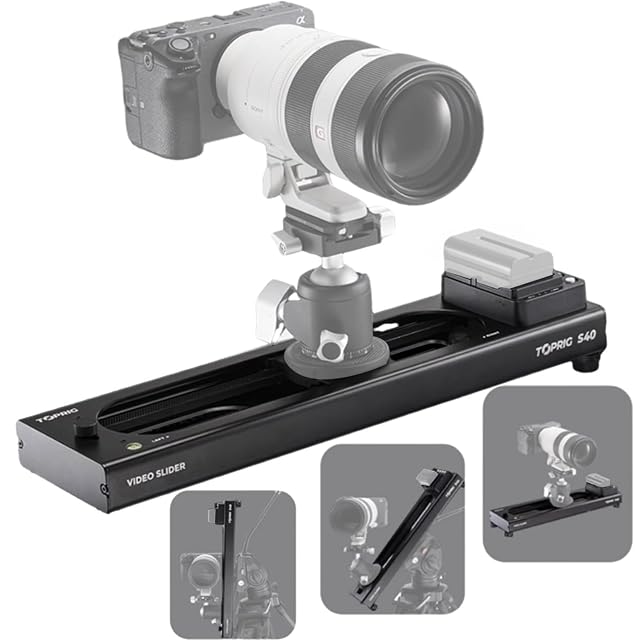
A motorised rail slider · stepless speed from 0.1 to 5 cm per second · declared load 4 kg horizontally and 2.5 kg vertically — the only page here to publish both · brushless motor described as near-silent · full button control without an app · custom motion paths set by Dot AB, manually or through the app · no rail length published in the bullets · no travel published · no weight published · no mounting points published
The only support here that publishes a horizontal AND a vertical load — 4 kg and 2.5 kg — with stepless speed from 0.1 to 5 cm per second, at 319 €.
Best for: Interview and product work where the move has to be repeatable, silent and usable on an incline with a camera worth protecting.
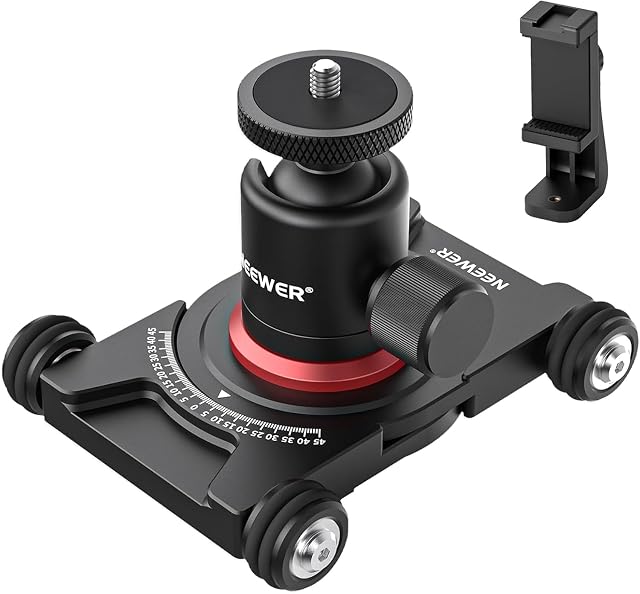
A wheeled dolly rather than a rail · straight-line or circular movement with wheels set between minus 45 and plus 45 degrees · rubber-padded wheels for quiet running · ball head with 360 degrees of pan and 90 of tilt on a 1/4 inch screw · phone holder and a cold shoe · 100 by 84 by 20 mm · 200 g · aluminium · not for telephoto lenses · no declared load published
A 200 g pocket dolly at 37 €, running on rubber wheels that turn through 90 degrees to trace a circle — with a ball head in the box and a warning against telephoto lenses.
Best for: Table-top product and food video where a small camera or a phone has to drift or circle, and the surface is already smooth.
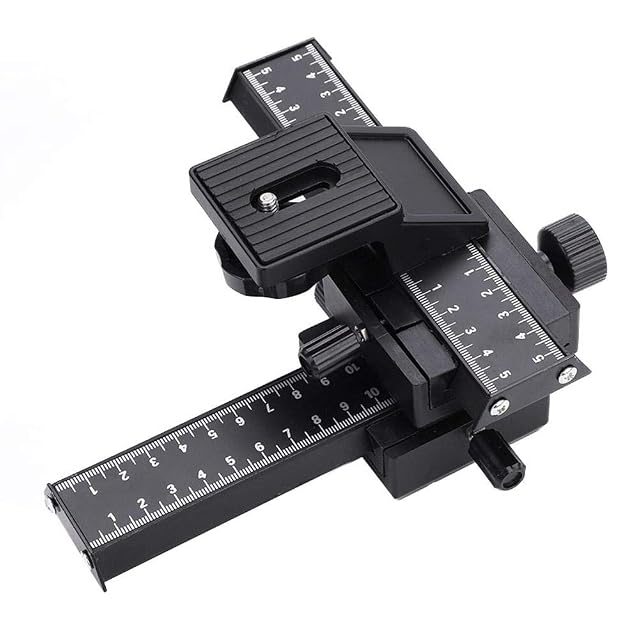
A focusing rail rather than a travelling slider · movement in four directions, left, right, forward and back · rack-and-pinion drive with a precision scale · 1/4 inch mounting screw · aluminium alloy · no rail length published · no travel published · no declared load published · no motorisation · no weight published
A 28 € two-axis macro focusing rail, not a travelling slider: rack and pinion, a precision scale, four directions of movement — and not one dimension published.
Best for: Macro work on a tripod, where focus is set by moving the camera rather than the lens and the position has to be repeatable.