A 28 € two-axis macro focusing rail, not a travelling slider: rack and pinion, a precision scale, four directions of movement — and not one dimension published.
The bottom line For 28 € this is a competent two-axis macro stage with a geared drive and a readable scale, and it is on the wrong shelf: it does not travel, and nothing on its page is measured. Read it as a focus tool, not as a way to make a shot move.
On the listing
Six bullets, of which the first two are identical and four more are blank. A universal 1/4 inch mounting screw compatible with most brands of digital and reflex camera, printed twice; a mainly high-grade aluminium alloy construction, robust and durable; smooth rack-and-pinion movement allowing accurate and fast adjustment of the rail; movement in four directions — right, left, forward and back — with a precision scale for quick focusing; and a closing line about close-up work and positioning the camera with high precision.
Not a slider, a focusing rail
Three of the four supports on this shelf move a camera across a scene. This one moves it by centimetres to place the focus. The hub above compares rail length against actual travel because a slider carries a carriage along a track; a focusing rail carries a camera on two geared stages to set the sharp plane. Both are called sliders in German listings, and they are different tools.
Rack and pinion, and why it suits the job
A geared knob moves the stage a readable amount and holds it there under the weight of a camera. A free-running carriage would drift. For focus stacking — a series of frames each a known distance apart — the gear is the mechanism that makes the series even.
A scale that makes it repeatable
Four directions and a printed scale. The position can be noted and returned to, which is the difference between a stage and a slide.
What twenty-eight euros does not include
No rail length. No travel. No load. No weight. Four empty bullets and one repeated sentence: this is the least measured page on the shelf, and it is also the cheapest object on it.
Availability
Between 28 € and 37 € on the German, French and Spanish Amazon stores when this page was last checked.
On the Italian Amazon store the asking price sits more than 1.6× above the cheapest country. A difference that wide usually means a reshipper rather than a seller on the ground, so it is kept out of the figures above.
Listed in the British Amazon catalogue with nothing on sale against the entry: the camera has a page there and no seller behind it.
Nothing came back from the American Amazon store at all, so the button for that country runs a search instead of opening an entry that is not there.
Everything in this section is the figure Keepa carried on the day of the last update to this page. Availability and prices shift without notice.
Prices quoted in this text were read on 13 September 2026. The live price is at the top of the page.
What it does well, and what it gives up
Strengths
Movement in four directions with a precision scale, so a macro position can be recorded and returned to
Rack and pinion rather than a friction slide, which holds position under a camera
Twenty-eight euros for a two-axis stage, where a single-axis rail often costs more
Compromises
Not a travelling slider — it moves a camera by centimetres for focus, not for a moving shot
No length, no travel, no load and no weight published anywhere
Four of its bullets are empty, and the first two are the same sentence
Specifications
Rail length
Not published. Neither the title nor any bullet gives a length, and the hub above calls the rail length the number that describes what you carry. Here nothing describes what you carry
Actual travel
Not published — and on this object the question means something different. The hub above defines travel as the distance the carriage moves along the rail, always shorter than the rail because the carriage occupies part of it. A macro focusing rail moves a camera by centimetres to set focus, not by tens of centimetres to make a shot move, and the page publishes neither figure
Declared load
Not published. The third bullet claims a robust and durable aluminium alloy structure, and no weight it will carry appears
Bearing type
Rack and pinion, in the fourth bullet, credited with smooth movement and accurate, fast adjustment of the rail. That is a geared drive rather than a bearing: the position is set by turning a knob, and it holds where it is left
Drag control
Not applicable in the sense the hub above means. A geared rail has no free-running carriage to damp — the gear is the resistance, and the fifth bullet describes a precision scale for reading the position rather than a drag knob for controlling a movement
Motorisation
None. The rail is turned by hand, which is the point of a focusing rail: the camera is positioned and left there
Mounting points
A universal 1/4 inch mounting screw, in the first bullet, described as compatible with most digital and reflex cameras. One thread, no tripod sockets at both ends, no levelling feet named
Weight
Not published
Amazon reference
B0881LRPGL (same reference on 5 Amazon marketplaces)
EAN
6458516199895
What people ask before they commit
Is this the same kind of thing as the other three here?
No, and that is the most important sentence on this page. The other three move a camera across a scene to put parallax in a shot. This is a focusing rail: two geared stages that shift the camera a few centimetres to place the plane of focus, which is how macro work is done when turning the lens would change the magnification. Same shelf, different job.
Why move the camera instead of focusing the lens?
Because at high magnification, turning the focus ring changes how large the subject appears as well as where the sharp plane sits. Moving the whole camera keeps the magnification fixed and shifts only the plane — which is also what makes focus stacking possible, since each frame differs by a known distance read off the scale.
What does the precision scale add?
Repeatability. The fifth bullet names it alongside the four directions of movement: the knob is turned by a readable amount, so a series of frames can be taken at even intervals. For stacking, that interval is the whole technique — and it is why a geared rail beats a hand-pushed one at this job.
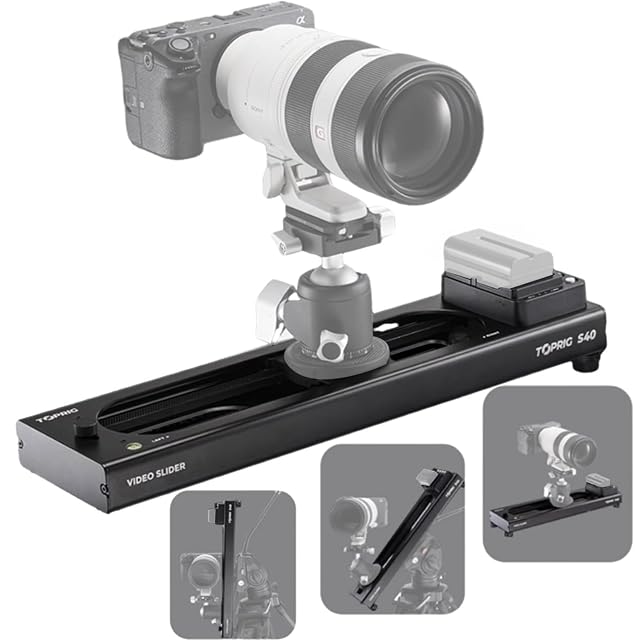
A motorised rail slider · stepless speed from 0.1 to 5 cm per second · declared load 4 kg horizontally and 2.5 kg vertically — the only page here to publish both · brushless motor described as near-silent · full button control without an app · custom motion paths set by Dot AB, manually or through the app · no rail length published in the bullets · no travel published · no weight published · no mounting points published
The only support here that publishes a horizontal AND a vertical load — 4 kg and 2.5 kg — with stepless speed from 0.1 to 5 cm per second, at 319 €.
Best for: Interview and product work where the move has to be repeatable, silent and usable on an incline with a camera worth protecting.
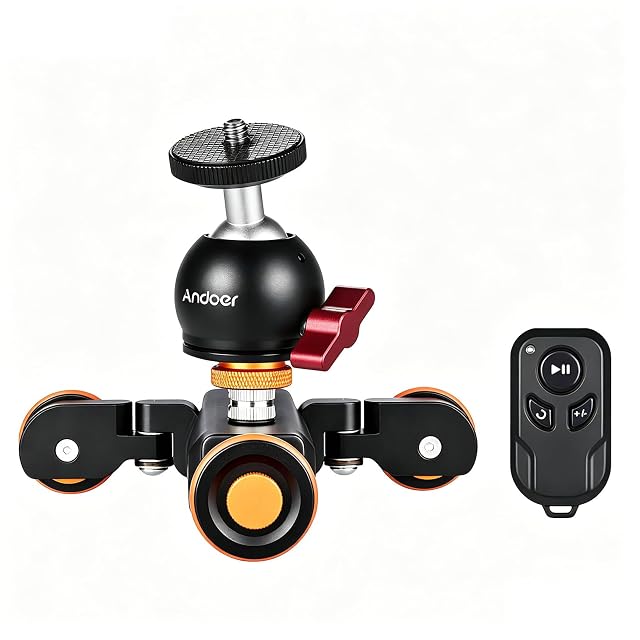
A motorised wheeled dolly rather than a rail · three speeds, 2.4, 2.6 and 2.8 cm per second · reversible direction · wheel angle adjustable through 180 degrees for straight or circular paths · declared load 3 kg · wireless remote effective to 6 m · 1/4 to 3/8 inch convertible screw with a ball head supplied · 1800 mAh cell giving up to 6 hours · plastic body · no weight published
Three published speeds in centimetres per second, a 3 kg load and six hours of battery for 108 € — a motorised dolly whose every figure is stated except its own weight.
Best for: Time-lapse and slow product moves on a smooth floor or table, where a hands-off motorised drift matters more than a guided rail.
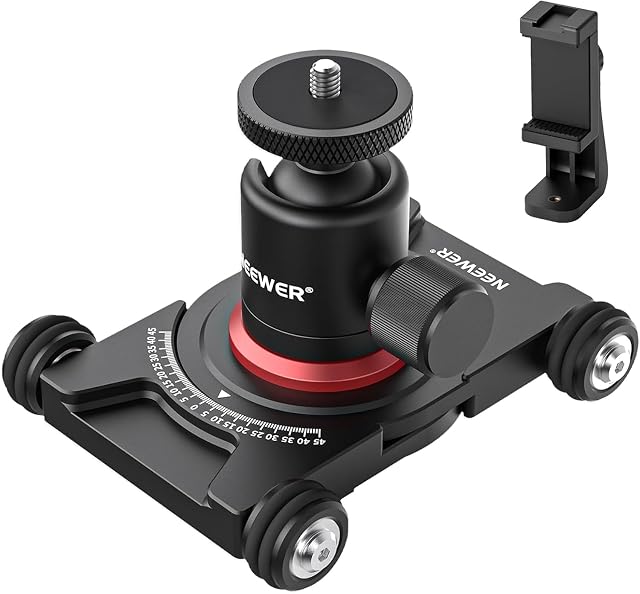
A wheeled dolly rather than a rail · straight-line or circular movement with wheels set between minus 45 and plus 45 degrees · rubber-padded wheels for quiet running · ball head with 360 degrees of pan and 90 of tilt on a 1/4 inch screw · phone holder and a cold shoe · 100 by 84 by 20 mm · 200 g · aluminium · not for telephoto lenses · no declared load published
A 200 g pocket dolly at 37 €, running on rubber wheels that turn through 90 degrees to trace a circle — with a ball head in the box and a warning against telephoto lenses.
Best for: Table-top product and food video where a small camera or a phone has to drift or circle, and the surface is already smooth.