The bottom line Two load figures, a fifty-fold stepless speed range, a brushless motor and repeatable A-to-B paths make this the only professional support on the shelf, and 319 € is priced for that. It never publishes the rail length, the travel, the weight or a single mounting point.
On the listing
Five bullets. Unmatched stability claimed regardless of the lens, from a 200 mm telephoto to a micro-focus lens; effortless stepless speed adjustment from 0.1 to 5 cm per second, saving setup time; a horizontal load capacity of 4 kg and a vertical capacity of 2.5 kg, supporting a wide range of mirrorless cameras and light cinema cameras; intuitive full-button operation giving complete control without an app; and custom motion paths adjustable by Dot AB, manually or through the app, with a brushless motor working almost noiselessly so audio recording stays clean.
Four kilograms flat, two and a half upright
The only page on this shelf to publish both, and the hub above asks for exactly this pair. Laid flat, the rail holds the rig up. Tilted or vertical, the motor and belt carry it along the rail against gravity — a different load path, and a lower number. Stating both is what an honest motorised slider does.
Nought point one to five centimetres per second
A fifty-fold range in one continuous control. The slow end creeps for time-lapse; the fast end reads as movement in a two-second shot. The motorised dolly below it offers three fixed speeds spanning less than half a centimetre per second.
A brushless motor, and the sound it does not make
Named in the fifth bullet for keeping recorded audio clean. On an interview setup, a slider that hums is a slider that gets used only between takes.
The numbers a rail should publish and this one does not
No rail length in the bullets — S40 is in the product name and nowhere confirmed. No travel figure, which the hub above says is always shorter and always the one that matters. No weight, and no mounting points for the tripods that have to hold it up.
Availability
About 319 € on the German, French, Italian and Spanish Amazon stores when this page was last checked.
The British Amazon store carry it too, priced in local currency. Those amounts are deliberately absent from the range above, which reads euro stores only.
Listed in the American Amazon catalogue with nothing on sale against the entry: the camera has a page there and no seller behind it.
Everything in this section is the figure Keepa carried on the day of the last update to this page. Availability and prices shift without notice.
Prices quoted in this text were read on 13 September 2026. The live price is at the top of the page.
What it does well, and what it gives up
Strengths
Both load figures published, horizontal and vertical, which nothing else here does
Stepless speed from 0.1 to 5 cm per second, a fifty-fold range in one control
A brushless motor described as near-silent, and full control from buttons without an app
Compromises
No rail length in the bullets, no travel figure, and no weight
No mounting points named, on a rail that needs one or two tripods under it
Three hundred and nineteen euros, nine times the manual dolly on this shelf
Specifications
Rail length
Not published in the bullets. The model name carries S40, and the page never states a length in centimetres — so the figure the hub above calls the description of what you carry exists only as two characters in a product code, which this page does not confirm
Actual travel
Not published. The hub above is explicit that travel is always shorter than the rail because the carriage occupies part of it, and that a listing giving only the rail length describes what you carry rather than what you get. This page gives neither figure
Declared load
4 kg horizontally and 2.5 kg vertically, in the third bullet — and this is the only page on the shelf to publish the pair. The hub above says a slider used vertically or on an incline has to hold the rig against gravity along the rail, and that makers state a lower figure for that case when they state one at all. Here they do
Bearing type
Not published. The first bullet claims unmatched stability whatever the lens, from a 200 mm telephoto to a micro-focus lens, without describing what the carriage runs on
Drag control
Replaced by stepless speed. The second bullet gives a continuously adjustable range from 0.1 to 5 cm per second, which spans a slow time-lapse creep and a visible real-time drift in one mechanism — against three fixed speeds on the motorised dolly below it
Motorisation
Yes, by a brushless motor the fifth bullet calls almost noiseless, so sound recorded beside it stays clean. The fourth bullet adds full button control without an app, and the fifth custom motion paths set by Dot AB either manually or through the app
Mounting points
Not published. No threads at the ends for two tripods, no central thread, no levelling feet are named — which on a rail that costs 319 € and holds 4 kg is the practical omission
Weight
Not published. The heaviest object on this shelf by function, and the only one whose mass is never stated
Amazon reference
B0CKX3M8NL (same reference on 6 Amazon marketplaces)
EAN
0762704742197
What people ask before they commit
Why publish two load figures?
Because a slider laid flat only has to hold the rig up, while a slider tilted or vertical has to hold it against gravity ALONG the rail — the motor and the belt take the whole weight rather than the bearing. The hub above says makers state a lower figure for that case when they state one at all, and 4 kg against 2.5 kg is exactly that pair. It is the most useful thing on this page.
What does stepless speed change?
It removes the compromise. The second bullet gives 0.1 to 5 cm per second continuously, a fifty-fold range: the slow end is a time-lapse creep invisible in real time, the fast end a drift that reads clearly in a two-second shot. The motorised dolly on this shelf offers three fixed speeds within half a centimetre per second of each other.
What is Dot AB?
The fifth bullet names it as the way custom motion paths are set, manually or through the app: two points are marked and the carriage runs between them. In practice that is what makes a move repeatable — the same start, the same end, the same speed, take after take — which is why it belongs on a slider used for interviews and product sequences rather than single shots.
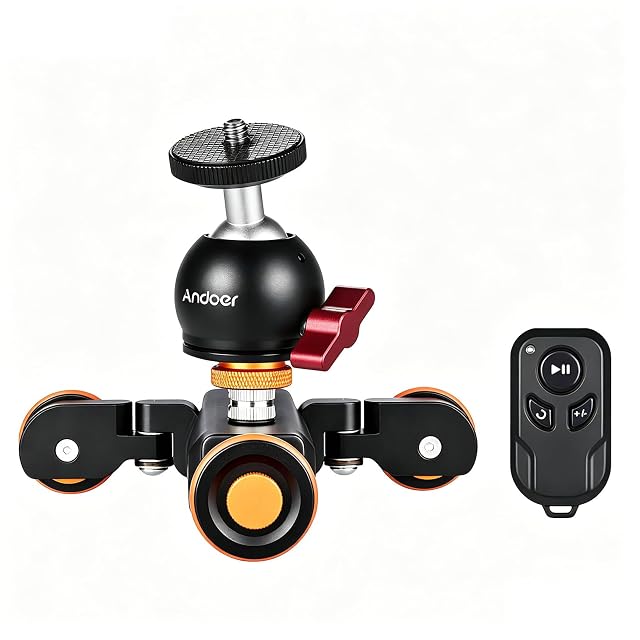
A motorised wheeled dolly rather than a rail · three speeds, 2.4, 2.6 and 2.8 cm per second · reversible direction · wheel angle adjustable through 180 degrees for straight or circular paths · declared load 3 kg · wireless remote effective to 6 m · 1/4 to 3/8 inch convertible screw with a ball head supplied · 1800 mAh cell giving up to 6 hours · plastic body · no weight published
Three published speeds in centimetres per second, a 3 kg load and six hours of battery for 108 € — a motorised dolly whose every figure is stated except its own weight.
Best for: Time-lapse and slow product moves on a smooth floor or table, where a hands-off motorised drift matters more than a guided rail.
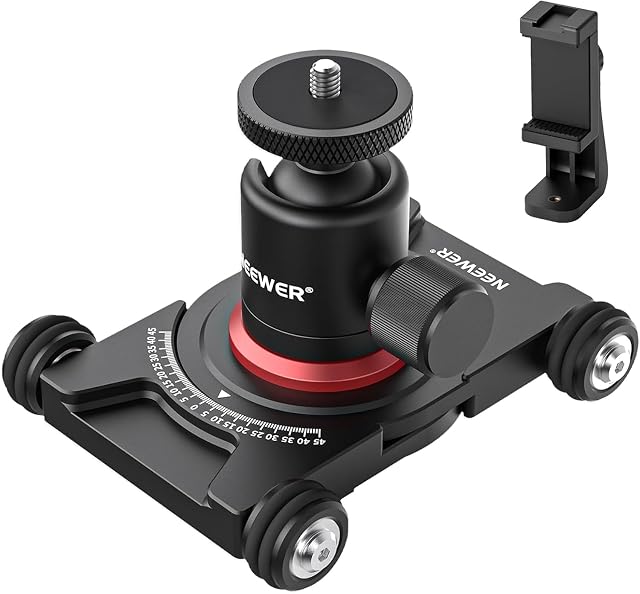
A wheeled dolly rather than a rail · straight-line or circular movement with wheels set between minus 45 and plus 45 degrees · rubber-padded wheels for quiet running · ball head with 360 degrees of pan and 90 of tilt on a 1/4 inch screw · phone holder and a cold shoe · 100 by 84 by 20 mm · 200 g · aluminium · not for telephoto lenses · no declared load published
A 200 g pocket dolly at 37 €, running on rubber wheels that turn through 90 degrees to trace a circle — with a ball head in the box and a warning against telephoto lenses.
Best for: Table-top product and food video where a small camera or a phone has to drift or circle, and the surface is already smooth.
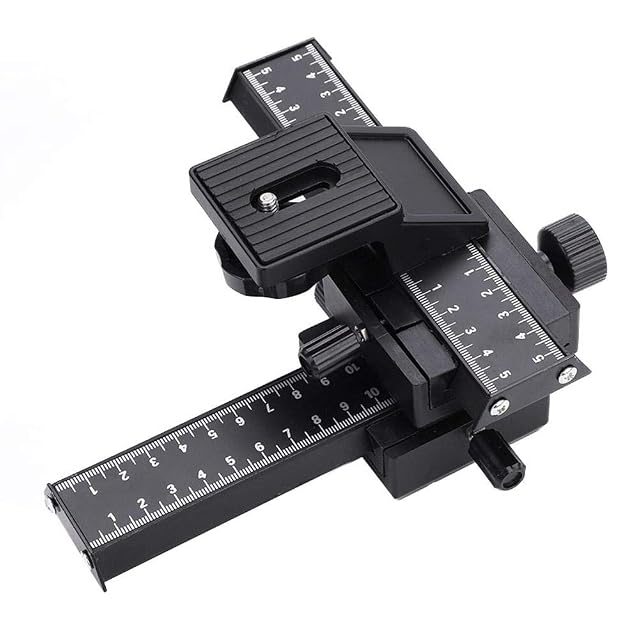
A focusing rail rather than a travelling slider · movement in four directions, left, right, forward and back · rack-and-pinion drive with a precision scale · 1/4 inch mounting screw · aluminium alloy · no rail length published · no travel published · no declared load published · no motorisation · no weight published
A 28 € two-axis macro focusing rail, not a travelling slider: rack and pinion, a precision scale, four directions of movement — and not one dimension published.
Best for: Macro work on a tripod, where focus is set by moving the camera rather than the lens and the position has to be repeatable.