Watt-seconds describe stored energy, not the light that lands · review
Walimex pro Newcomer 100 II, 100 W, Bowens mount review
The cheapest studio head here at 132 €, with a receiver already inside it and a Bowens mount that opens the whole modifier catalogue — and an output figure published in watts, which is not the unit this shelf compares.
The bottom line For 132 € it brings a Bowens mount, a built-in 16-channel receiver, five stops of stepless adjustment and three ways to fire — a genuinely complete starting point. What it does not bring is a comparable output figure, a recycle time, or a stated power source.
On the listing
Five bracketed bullets. A powerful studio flash with 100 watts, adjustable steplessly from 1/1 to 1/32, called ideal for small studios and mobile use thanks to a weight under 1 kg; a 5 W LED modelling lamp for studio, product and portrait work; a built-in receiver with 16 channels and 4 groups, and a Bowens and Walimex pro bayonet compatible with numerous modifiers; control from a panel on the head or by an optionally available radio remote, with radio, photocell and sync-cable triggering; and a closing bullet aimed at hobbyists and beginners, naming passive cooling and overheat protection.
Watts, not watt-seconds
The unit on this page is not the unit this shelf compares. The hub above ranks studio heads by the energy stored in the capacitor, quoted in watt-seconds, and this listing publishes a power figure in watts instead. Going from one to the other needs the duration of the discharge, and that number is not here. So the 100 stands on its own: it is not a hundredth of the Neewer, nor a quarter of the Godox, nor anything else that can be worked out from this page.
Five stops, and a ceiling for the weight
Stepless from full down to a thirty-second is five stops, and the buying advice for this shelf says to check exactly that — how far DOWN a light goes. The weight is handled differently: under 1 kg is a threshold, not a measurement, and it cannot be set beside a figure in grams.
Sixteen channels inside the head
No receiver box, no second set of batteries on the stand. The transmitter is an extra purchase and the fourth bullet says so, but the half that is usually a separate product is already built in at the bottom of this shelf.
Three ways in, and no fan
Radio, photocell, sync cable. Passive cooling with overheat protection means nothing whirrs between frames, which in a room small enough for a 100 W head is worth more than it sounds.
Availability
Between 132 € and 143 € on the German, French, Italian and Spanish Amazon stores when this page was last checked.
Listed in the British Amazon catalogue with nothing on sale against the entry: the camera has a page there and no seller behind it.
Nothing came back from the American Amazon store at all, so the button for that country runs a search instead of opening an entry that is not there.
Everything in this section is the figure Keepa carried on the day of the last update to this page. Availability and prices shift without notice.
Prices quoted in this text were read on 13 September 2026. The live price is at the top of the page.
What it does well, and what it gives up
Strengths
A receiver already inside the head, 16 channels and 4 groups, so no extra box on the light stand
Bowens and Walimex pro bayonet, the mount with the largest modifier catalogue on this shelf
Three ways to fire it — radio, photocell and sync cable — and passive cooling with overheat protection, so no fan noise
Compromises
The output is published in watts, not watt-seconds, so it cannot be compared with either head above it
No recycle time at any power setting
The weight is given as under 1 kg — a ceiling rather than a measurement — and the radio remote is an extra purchase
Specifications
Energy in watt-seconds
Not published in watt-seconds. The first bullet gives 100 watts, and a watt is a rate of power while a watt-second is a quantity of energy — the two are related only through the duration of the discharge, which this page never states. The figure cannot be set beside the 400Ws and 600Ws heads above it, and nothing here converts it
Power range in stops
Stepless from 1/1 down to 1/32, published in the first bullet. That is five stops of adjustment, which is what the buying advice for this shelf says to read first: in a small room the usual difficulty is a light that will not go low enough
Recycle time
Not published on the listing. Five bullets cover the output, the modelling lamp, the receiver, the controls and the cooling, and no time appears at either full or reduced power
Modelling lamp
5 W LED, published in the second bullet. LED rather than halogen, so it runs cool, and the page does not say whether its brightness tracks the flash power — the behaviour that decides whether the preview means anything when the head is turned down
Mount type
Bowens and Walimex pro bayonet, named in the third bullet, which adds that it is compatible with numerous modifiers. This is the ecosystem decision the hub above describes: the mount ties every softbox and reflector bought afterwards, and Bowens is the widest catalogue on the market
Triggering systems
A receiver is built in — 16 channels and 4 groups, stated in the third bullet, so no separate receiver box is needed. The fourth adds three ways to fire it: a radio trigger, a photocell slave, and a sync cable. The radio remote itself is sold separately, which the same bullet states plainly
Power source
Not stated on the listing. Nothing names a mains lead or a battery pack, and nothing claims outdoor use — where the 600Ws head above it puts the word in its title. The page describes a small studio and mobile use without saying what powers the head
Amazon reference
B0C5DJYZHV (same reference on 5 Amazon marketplaces)
EAN
4056929234022
What people ask before they commit
Is 100 watts the same as 100 watt-seconds?
No, and the difference is not a formality. A watt is a rate — energy per second — while a watt-second is a quantity of energy stored and released. Converting between them requires the duration of the flash discharge, which this listing does not publish. Two heads quoted in different units cannot be ranked against each other, and this page does not pretend otherwise.
What does the Bowens mount actually buy?
Access to a catalogue. Softboxes, reflectors, beauty dishes and grids are made to fit specific bayonets, and Bowens-style is the most widely copied fitting there is. The hub above calls the mount the ecosystem decision, because every modifier bought after the head has to fit it — and that spending usually exceeds the head itself.
Why does a built-in receiver matter?
Because the alternative is a separate box strapped to each light stand, with its own batteries to go flat. The third bullet says the receiver is integrated with 16 channels and 4 groups, so a transmitter on the camera talks straight to the head. The fourth bullet is equally clear that the transmitter itself is an optional purchase.
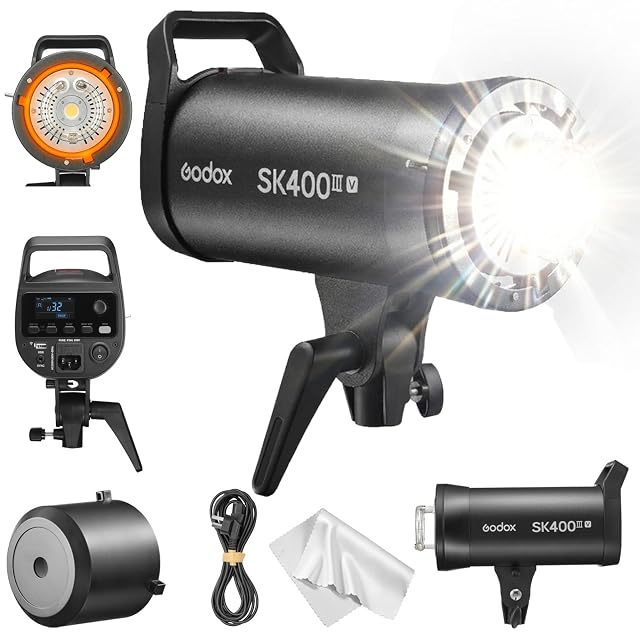
400Ws · guide number 65 at ISO 100 · 1/32 to 1/1 in 50 steps, five stops · recycle 0.1 to 1.5 s · 10 W LED modelling lamp dimmable from 5 to 100 per cent · standard Bowens bayonet · Godox 2.4G X system built in · colour temperature 5600K plus or minus 200K
The one head on this shelf that publishes everything the shelf is compared on: 400 watt-seconds, a guide number with its sensitivity, a recycle time of 0.1 to 1.5 seconds and fifty steps of adjustment, for 199 €.
Best for: A studio head bought to be built on, where the X system and the Bowens mount decide every purchase that follows and the published figures make it comparable.
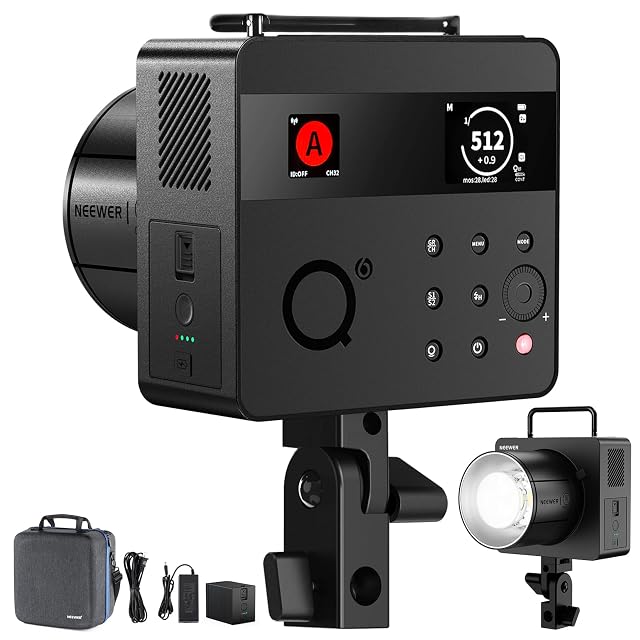
600Ws · 1/1 to 1/512 in 0.1-stop increments, nine stops · no recycle time published · 30 W bi-colour LED modelling lamp, 2700K to 6500K, CRI 95+ · colour temperature 5700K plus or minus 100K across the whole power range · TTL, manual and multi modes · HSS to 1/8000 s · NEEWER 2.4G Q system, 5 groups, 32 channels, 99 IDs, 100 m · Bluetooth app control · two TFT displays · quartz tube rated about 300,000 flashes
Nine stops of adjustment in tenth-stop increments, a 30 W bi-colour modelling lamp with a published colour index, and a tube rated for 300,000 flashes — at 449 €, with no recycle time anywhere on the page.
Best for: Portrait work away from a studio where nine stops and stable colour matter, for someone already inside the NEEWER Q system or willing to enter it.
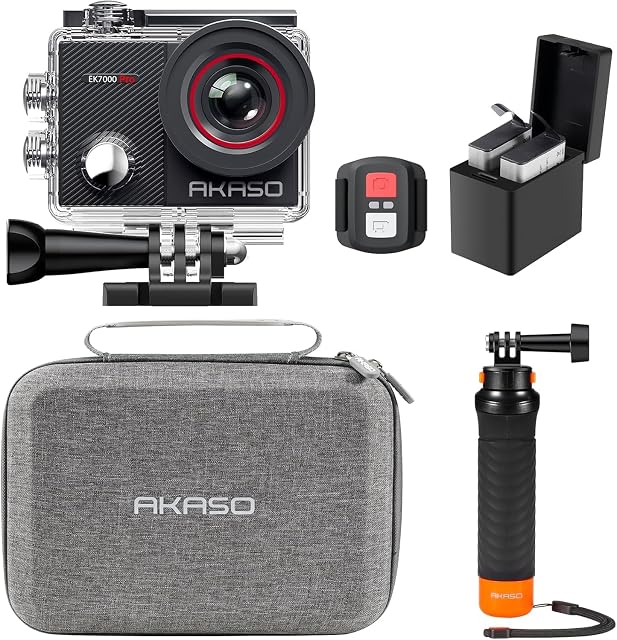
40 m waterproof housing · 4K 30, 2.7K 30, 1080p 60 · 20 MP stills · EIS stated · four selectable view angles: super wide, wide, medium, narrow · 2 inch IPS touchscreen · floating hand grip and bag supplied · no field of view in degrees
An established name at ninety-three euros, selling a touchscreen, three video modes and four selectable view angles — described by name rather than in degrees — with a floating grip in the box.
Best for: Water use where the floating grip and the touchscreen earn their keep, by someone who will buy a spare battery blind.