Watt-seconds describe stored energy, not the light that lands · review
Godox SK400III-V, 400Ws, GN65 at ISO 100 review
The one head on this shelf that publishes everything the shelf is compared on: 400 watt-seconds, a guide number with its sensitivity, a recycle time of 0.1 to 1.5 seconds and fifty steps of adjustment, for 199 €.
The bottom line Four hundred watt-seconds, a guide number with its sensitivity, a recycle range and fifty numbered steps: this is the only page of the three here that answers its shelf in full, and at 199 € it does it for a third of the dearest head here. The power source is the one line it never addresses.
On the listing
Five bracketed bullets. 400Ws of output with a guide number of 65 at ISO 100, adjustable from 1/32 to 1/1 in 50 steps shown as 5.0 to 10.0; an upgraded 10 W LED modelling lamp dimmable from 5 to 100 per cent, contrasted with older halogen lamps for heat and lifespan; the Godox 2.4G X system built in, controlled by X2, XPro, X3 or XT16 triggers, with support for Canon, Nikon, Sony, Fuji, Olympus and Panasonic; a standard Bowens bayonet compatible with softboxes, reflectors and beauty dishes; and a closing bullet giving a recycle time of 0.1 to 1.5 seconds and a colour temperature of 5600K plus or minus 200K.
Four hundred watt-seconds, and a guide number too
Two readings of the same output, which nothing else here offers. The watt-seconds rank it against the shelf; the guide number of 65 at ISO 100 says something about what will actually reach a face. The hub above insists a guide number is meaningless without its conditions — this one carries its sensitivity, and the coverage is set by whichever reflector is fitted.
Nought point one to one and a half seconds
The only recycle figure on this shelf. It is a range because recycling is quick at low power and slowest at full, and 1.5 seconds at 400Ws is a working rhythm rather than a limitation. The 600Ws head costing more than twice as much publishes no time at all.
Fifty steps between the ends
Five stops, cut into fifty numbered increments displayed from 5.0 to 10.0. A number that can be written on a lighting diagram and dialled back in tomorrow is worth more in practice than a stepless dial with nothing to read off it.
Where the page says nothing
No power source. No statement on whether the modelling lamp follows the flash setting — the behaviour that decides whether the preview is honest when the head is turned down. And a colour tolerance of plus or minus 200K, which is twice the spread the head above it claims.
Availability
About 199 € on the German, French, Italian and Spanish Amazon stores when this page was last checked.
The American and British Amazon stores carry it too, priced in local currency. Those amounts are deliberately absent from the range above, which reads euro stores only.
Everything in this section is the figure Keepa carried on the day of the last update to this page. Availability and prices shift without notice.
Prices quoted in this text were read on 13 September 2026. The live price is at the top of the page.
What it does well, and what it gives up
Strengths
400 watt-seconds, a guide number of 65 at ISO 100, and a recycle time of 0.1 to 1.5 seconds — every figure this shelf compares
Fifty steps of adjustment across five stops, displayed numerically from 5.0 to 10.0
The Godox 2.4G X system built in, with four named transmitters and six camera makers supported
Compromises
No power source stated, so nothing on the page says whether it can leave a mains socket
The modelling lamp dims from 5 to 100 per cent, and the page never says whether it follows the flash power
Colour temperature is quoted at 5600K plus or minus 200K, a wider tolerance than the head above it claims
Specifications
Energy in watt-seconds
400Ws, in the title and the first bullet — the unit the hub above actually compares. The same bullet adds a guide number of 65 at ISO 100, which is unusual on a studio head and gives a second way to read the output
Power range in stops
From 1/32 to 1/1, which is five stops, and the first bullet adds the resolution: 50 steps across it, displayed as 5.0 to 10.0. Five stops is the same span as the 132 € Walimex pro; fifty steps is far finer control within it
Recycle time
0.1 to 1.5 seconds, published in the fifth bullet. The range covers the whole power scale — fastest at minimum, 1.5 seconds at full — and it is the only recycle figure on this shelf. The 600Ws head above it publishes none
Modelling lamp
10 W LED, dimmable from 5 to 100 per cent, in the second bullet, which contrasts it with older halogen lamps for heat and lifespan. Twice the wattage of the cheaper head below, and the dimming range is published — though the page does not say whether it tracks the flash power automatically
Mount type
Standard Bowens bayonet, named in the fourth bullet with the modifiers it opens: softboxes, reflectors, beauty dishes. The same ecosystem as the cheaper head here, which means modifiers can move between the two
Triggering systems
The Godox 2.4G X system, built in, named in the third bullet along with the transmitters that drive it: X2, XPro, X3 and XT16. The same bullet lists camera support for Canon, Nikon, Sony, Fuji, Olympus and Panasonic. This is the named radio system the hub above says decides which remotes ever work
Power source
Not stated on the listing. No mains lead and no battery option is named, and unlike the head above it the page makes no outdoor claim
Amazon reference
B0GJCS82X7 (same reference on 6 Amazon marketplaces)
EAN
0767637541275
What people ask before they commit
Why does a studio head publish a guide number at all?
It is unusual, and useful. Watt-seconds describe stored energy, which says nothing about how much light reaches a subject once a reflector is fitted. A guide number is a photographic figure — it relates aperture and distance — so quoting 65 at ISO 100 gives a second, more practical reading. The hub above warns that a guide number needs its conditions; here the sensitivity is stated.
What do fifty steps give over a head with fewer?
Precision within the same five stops. The cheaper head here is stepless from 1/1 to 1/32, which sounds finer but is set by feel on a dial; fifty numbered steps displayed as 5.0 to 10.0 can be written down and returned to exactly. For work that has to be repeated — a product series, a portrait session across two days — repeatability is the point.
How much does the X system commit me to?
A great deal, and that is the hub above talking: choose the system before the trigger. A transmitter speaks to receivers and lights of the same system only, so every light added afterwards must speak Godox 2.4G X. The third bullet names four compatible transmitters, which is the sign of a mature system rather than a proprietary dead end.
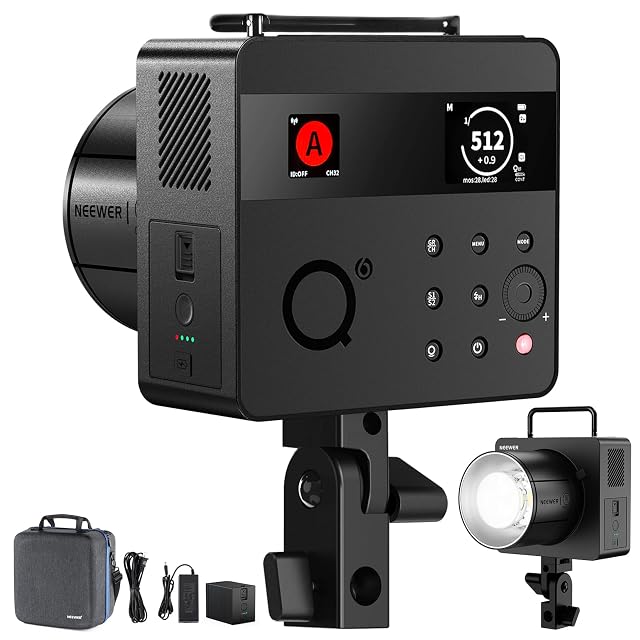
600Ws · 1/1 to 1/512 in 0.1-stop increments, nine stops · no recycle time published · 30 W bi-colour LED modelling lamp, 2700K to 6500K, CRI 95+ · colour temperature 5700K plus or minus 100K across the whole power range · TTL, manual and multi modes · HSS to 1/8000 s · NEEWER 2.4G Q system, 5 groups, 32 channels, 99 IDs, 100 m · Bluetooth app control · two TFT displays · quartz tube rated about 300,000 flashes
Nine stops of adjustment in tenth-stop increments, a 30 W bi-colour modelling lamp with a published colour index, and a tube rated for 300,000 flashes — at 449 €, with no recycle time anywhere on the page.
Best for: Portrait work away from a studio where nine stops and stable colour matter, for someone already inside the NEEWER Q system or willing to enter it.
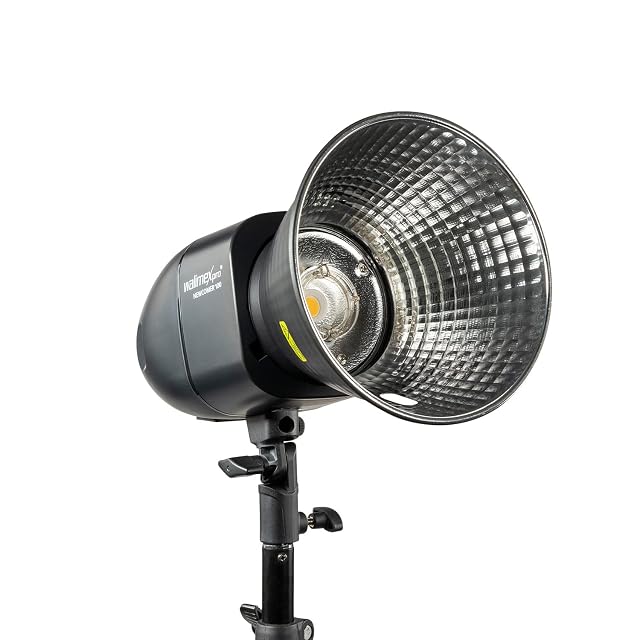
100 W published — watts, not watt-seconds · stepless from 1/1 to 1/32, five stops · no recycle time published · 5 W LED modelling lamp · Bowens and Walimex pro bayonet · built-in receiver, 16 channels and 4 groups, plus photocell and sync cable · under 1 kg, stated as a ceiling · passive cooling with overheat protection
The cheapest studio head here at 132 €, with a receiver already inside it and a Bowens mount that opens the whole modifier catalogue — and an output figure published in watts, which is not the unit this shelf compares.
Best for: A first studio light in a small room, where the Bowens mount matters more than the headline figure and the receiver being built in saves a purchase.
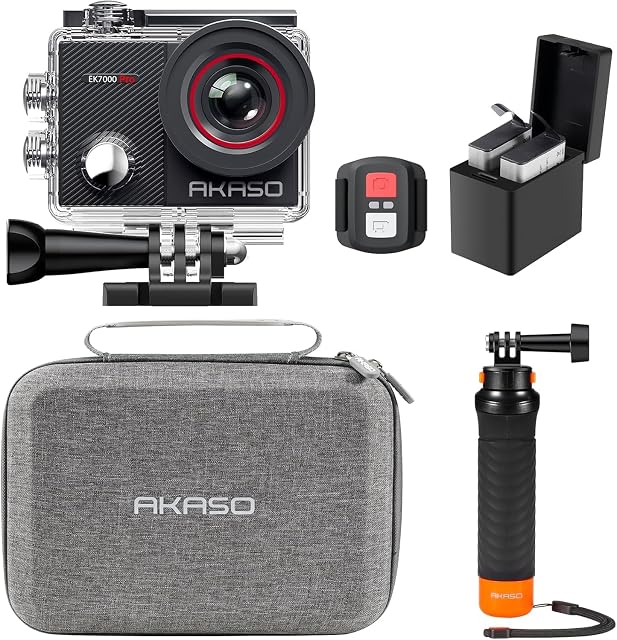
40 m waterproof housing · 4K 30, 2.7K 30, 1080p 60 · 20 MP stills · EIS stated · four selectable view angles: super wide, wide, medium, narrow · 2 inch IPS touchscreen · floating hand grip and bag supplied · no field of view in degrees
An established name at ninety-three euros, selling a touchscreen, three video modes and four selectable view angles — described by name rather than in degrees — with a floating grip in the box.
Best for: Water use where the floating grip and the touchscreen earn their keep, by someone who will buy a spare battery blind.