Skip to content

PROfezzion

Filters and releases that publish their own figures

Where it turns up

UV protection filters, polarising filters and remote shutter releases, from 12 € to 33 €.

The only transmission figure on its shelf

At least 99.5 per cent average, on twelve coating layers, through 0.7 mm of Japanese optical glass in a 3 mm aviation-alloy frame. Both thicknesses published, with vignetting named as the reason — where a rival counts eighteen layers and publishes no percentage at all.

A radio release that says what it will not do

Fifty metres, sixteen channels, five modes including bulb, a receiver that doubles as a cable switch, batteries included for both units, and more than forty bodies named. And a plain statement, in its own bullet, that it does not control video start and stop.

Where a page trips over itself

The 58 mm polariser gives 52 mm in its fourth bullet, against 58 in the title and in the part number. The same bullet explains where the true figure is printed: on the lens barrel, after a ⌀ symbol.

Every PROfezzion accessory reviewed here

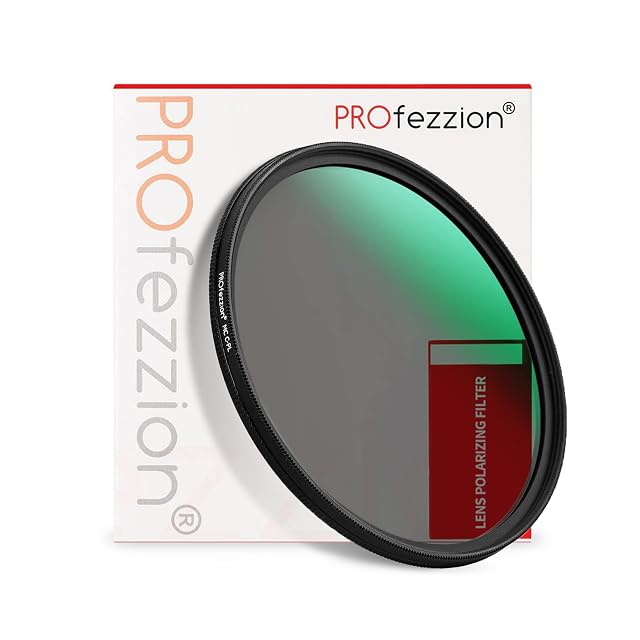
  • PROfezzion 58 mm circular polariser with its rotating ring and case

    PROfezzion 58 mm CPL, twelve layers

    Twelve coating layers on a 58 mm circular polariser for 16 € — from a page whose fourth bullet gives the thread as 52 mm and explains where to check it.

    Thread size
    58 mm in the title — AND 52 mm in the fourth bullet, which says the filter fits any lens with a 52 mm thread. The same bullet then explains, usefully, that the correct size is printed on the lens after a ⌀ symbol. The title and the part number PF-58CPL agree on 58; the bullet is the odd one out, and the ⌀ on the lens settles it
    Type
    CIRCULAR, in the title and throughout. The hub above treats circular versus linear as the first question: a circular polariser keeps autofocus and metering working on a modern camera, and a linear one does not
    Light loss stated
    NOT STATED. A polariser costs light — commonly one and a half to two stops — and no page on this shelf publishes the figure. The hub above asks for it in stops, and four filters here leave it out
    Coating description
    TWELVE layers, multi-coated, in the third bullet, credited with reducing reflection and named for outdoor and landscape work over water, sky and plants. The same count as the maker’s UV filter on this site
    Frame thickness
    Not published — where the same maker publishes 3 mm on its UV filter. On a polariser the frame is necessarily thicker, because it has to rotate, and that makes the missing figure more significant rather than less
    Rotation mechanism
    Not described. A polariser is used by turning it, and how the ring turns — knurled, geared, stiff, smooth — is the whole ergonomics of the thing. The 28 € NEEWER on this shelf describes straight knurling and smooth rotation; this page is silent
    Amazon reference
    B093247YD6 (same reference on 6 Amazon marketplaces)
    EAN
    6940202350500
    • Twelve multi-coating layers, on named Japanese glass in an aviation-aluminium frame
    • A bullet that explains where the thread size is printed, after the ⌀ symbol
    • The title says 58 mm and the fourth bullet says 52 mm

    Best for: A 58 mm lens used over water and foliage, where twelve coating layers for 16 € matter more than a published stop figure.

    ≈ $16 / £13 / 16 €
    Check price on Amazon
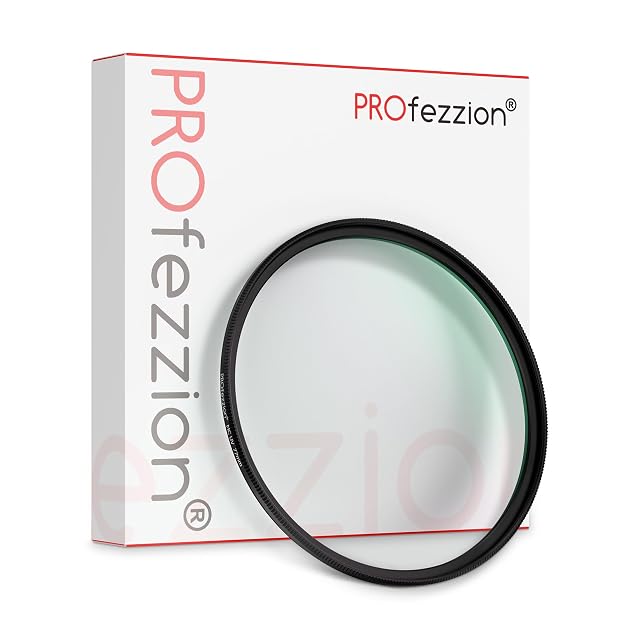
  • PROfezzion 67 mm UV filter in its slim aluminium frame beside its padded case

    PROfezzion 67 mm, 99.5 per cent transmission, 0.7 mm glass

    The only filter on this shelf that publishes what it passes — 99.5 per cent on twelve layers, through 0.7 mm of glass in a 3 mm frame, for 13 €.

    Thread size
    67 mm, in the title, which also names Canon R6 Mark III, II, 90D, 80D and 70D bodies. Naming bodies on a filter is loose — a filter fits a thread, not a camera — but it tells a buyer the size is the common one for those kits
    Glass
    Japanese optical glass, finely ground and polished, in the third bullet, with a hardness given as up to 9HD. The hardness notation is unusual and unexplained on the page; what it is reaching for is scratch resistance on the surface that gets wiped most
    Coating description
    TWELVE layers, multi-coated, in the second bullet, to prevent internal ghosting and reflections. Fewer than the eighteen claimed by the 11 € K&F here — and unlike that page, this one publishes the result the layers produce
    Frame thickness
    BOTH figures published, and this is the page that measures itself: the GLASS is 0.7 mm thick and the FRAME only 3 mm, in the fourth bullet, stated as minimising the likelihood of vignetting. Three millimetres is the thinnest frame on this shelf, against 3.4 mm on the Hama and nothing at all from the two others
    Material
    An aviation-grade aluminium alloy frame, in the third bullet — the only frame alloy named on this shelf
    Front thread provision
    Not mentioned, which on a 3 mm frame is worth noting: the thinner the ring, the less room for a front thread, and the page does not say whether a cap or hood still screws on
    Stated transmission figure
    PUBLISHED — an average light transmission of AT LEAST 99.5 PER CENT, in the second bullet, and the only such figure on this shelf. It is the number that makes the coating count meaningful: twelve layers passing 99.5 per cent is a measurable claim, where eighteen layers and no percentage is an assertion
    Amazon reference
    B09366T36S (same reference on 6 Amazon marketplaces)
    EAN
    6940202350425
    • Ninety-nine point five per cent transmission published — alone on this shelf
    • Both thicknesses published: 0.7 mm of glass in a 3 mm frame, the thinnest here
    • No front thread provision mentioned, on the thinnest frame here

    Best for: A 67 mm lens used at its widest, where a 3 mm frame and a measured transmission are worth 4 € over the cheapest lid on this shelf.

    ≈ $13 / £11 / 12 €
    Check price on Amazon
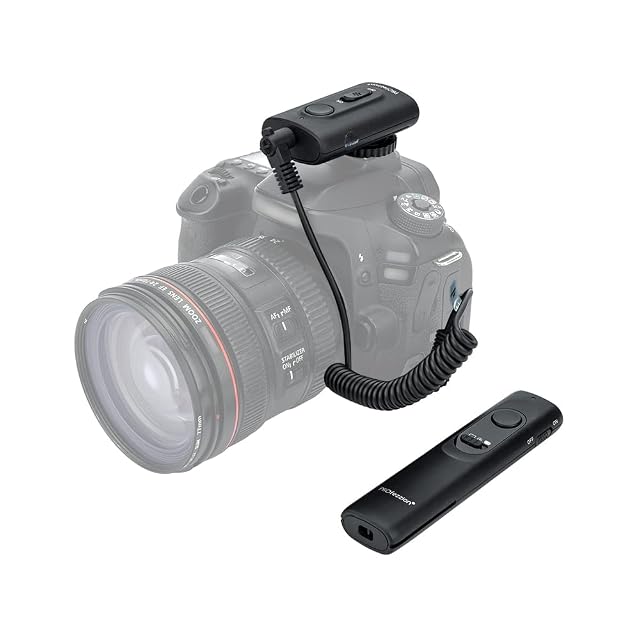
  • PROfezzion wireless shutter release transmitter and receiver with its tripod clip

    PROfezzion 50 m radio, 16 channels, 5 modes, batteries included

    Thirty-five euros for a 50 metre radio release with sixteen channels and five modes including bulb — batteries included, and one transmitter fires several cameras.

    Connection type
    2.4 GHz RADIO, in the second bullet — a transmitter and a separate receiver that plugs into the camera. Radio needs no line of sight, which the first bullet names directly: the shutter fires at up to 50 metres without a clear view of the camera
    Sockets and bodies named
    MORE THAN FORTY, in the fifth bullet — the longest compatibility list on this shelf by a wide margin. It runs from the EOS R and RP through the R6 Mark III, R7, R8, R10, R100 and R50V to the 2000D, 1500D, 850D, 90D and 77D, the M6 Mark II and M5, and then leaves Canon entirely for Contax 645 and N1, Samsung NX, and Pentax K-3 II, 645D, K500 and K200D — bodies sharing the same release socket
    Half-press support
    Not named as half-press, but answered in a better way: the third bullet says the RECEIVER ITSELF FUNCTIONS AS A CABLE SWITCH. Unplugged from the transmitter’s control, it becomes a wired release on the camera — which is where a half-press lives
    Intervalometer functions
    NONE, and the page is explicit about a second limit in the same bullet: IT DOES NOT CONTROL VIDEO START AND STOP. What it does give is FIVE MODES — single shot, a 5-second delay, a 3-frame burst, unlimited burst, and BULB for long exposures
    Stated range
    50 METRES, published in the first and second bullets, over 16 CHANNELS. Channels matter where several photographers work together: sixteen means two people can fire their own cameras in the same room without triggering each other
    Power source
    AAA batteries for BOTH units, and the fourth bullet says they are INCLUDED — which on this shelf is rare enough to note. The same bullet adds a detachable clip for fixing the transmitter to a tripod leg
    Amazon reference
    B09HJQBBHM (same reference on 6 Amazon marketplaces)
    EAN
    6940202352160
    • Fifty metres over sixteen channels, with one transmitter able to fire several receivers
    • Five modes including bulb, and the receiver works alone as a cable switch
    • It does not control video start and stop, stated by the maker

    Best for: Wildlife or group work at a distance, and long exposures — where bulb mode and 50 metres matter more than a timer.

    ≈ $36 / £34 / 34 €
    Check price on Amazon

Each amount in a write-up is what the listing showed when that page was written. The figure next to the product is pulled in as you read, and it is the one that counts.