The bottom line Three thousand two hundred dpi for film and 700 for prints, published separately alongside a distinguished 14-to-22 MP interpolation, with three holders, a brush, a battery, an HDMI output and the ability to scan an album page in place — 242 €. It is the heaviest here, its 110 and 126 holders cost extra, and it removes no dust.
On the listing
Five dense bullets. An HDMI output for live preview and editing on a television, named for slides, negatives, photographs and newspaper cuttings, with a 5-inch LCD, a 14 MP sensor interpolated to 22 MP, digitising without a computer and scanning photographs glued into an album; a standalone 3-in-1 SD-1700 with one holder each for slides with and without frames at 5 by 5 cm, 135 negative film and loose photographs at 9 by 13 and 10 by 15 cm, a scan speed of about 15 frames a minute, resolutions of 4416 by 2944 for film and 3280 by 2208 for photographs, and lighting by 3 white LEDs for negatives and 24 for prints; scanning by simply placing it down, also for 110 and 126 film with holders ordered separately, a 0.5-second preview, sampling quality of 3200 dpi for film and 700 dpi for photographs, automatic or manual lighting, and image transfer by USB to a PC, notebook or television; a large 5-inch IPS colour display, no computer needed, storage to SD or SDHC up to 32 GB, a 14 MP CMOS sensor interpolated to 22 MP, JPEG format, automatic colour balance, an HDMI output and dimensions of 20.9 by 18.2 by 16.2 cm at 1.1 kg with battery; and a contents list of the scanner, slide holder, negative holder, base plate with photo holder, battery, USB power supply, USB cable, HDMI cable, cleaning brush and German manual.
Three thousand two hundred for film, seven hundred for paper
Two jobs, two figures, published. A negative needs enormous magnification; a print does not. One headline number would have to lie about one of them.
Fourteen megapixels, interpolated to twenty-two
Stated as two numbers rather than one. Interpolation adds pixels, not detail, and two pages on this shelf say so — this and the 103 € Rollei.
It sits on the album
Twenty-four LEDs light from the front for a glued-in photograph or a newspaper cutting. The album stays bound, which for brittle paper is the whole point.
Three holders, and the two that are not here
Slides, negatives, prints — itemised. One hundred and ten and 126 film need holders ordered separately.
One point one kilograms, and an HDMI socket
The heaviest machine on this shelf, and the only one that will put a preview on a television.
Availability
Between 242 € and 260 € on the German and Italian Amazon stores when this page was last checked.
Listed in the British, French and Spanish Amazon catalogues with nothing on sale against the entry: the camera has a page there and no seller behind it.
Nothing came back from the American Amazon store at all, so the button for that country runs a search instead of opening an entry that is not there.
Everything in this section is the figure Keepa carried on the day of the last update to this page. Availability and prices shift without notice.
Prices quoted in this text were read on 13 September 2026. The live price is at the top of the page.
What it does well, and what it gives up
Strengths
Separate published dpi figures for film and prints, 3200 and 700, with the interpolation distinguished
Three holders, a brush, a battery and an HDMI output, all itemised
Scans photographs still glued in an album by sitting on top of them
Compromises
One point one kilograms, the heaviest machine on this shelf
The 110 and 126 holders must be ordered separately
A 32 GB card ceiling, and the card is not included
Specifications
Optical resolution
TWO FIGURES, and it is the only page on this shelf to give either properly: 3200 dpi for film and 700 dpi for photographs, in the third bullet. Two numbers are correct rather than untidy — a negative is 36 mm wide and needs high sampling, a 10 by 15 cm print is fifteen times wider and needs far less. The same bullet publishes the resulting pixel counts: 4416 by 2944 for film, 3280 by 2208 for prints, and separates the 14 MP sensor from its 22 MP interpolation
Formats accepted
The widest range here: 135 negatives; slides both mounted and unmounted at 5 by 5 cm; and loose photographs at 9 by 13 and 10 by 15 cm — including, per the third bullet, PHOTOGRAPHS STILL GLUED IN AN ALBUM and newspaper cuttings, scanned by placing the machine on top of them. Film types 110 and 126 need holders ordered separately
Holders supplied
THREE, itemised in the second bullet: one for slides with and without frames, one for 135 negative film, and a base plate with a photo holder. The fifth bullet adds a cleaning brush, a battery, a USB power supply, a USB cable, an HDMI cable and a German manual
Bit depth
Not published. A 14 MP CMOS sensor is named, and its depth is not
Dust removal method
None, beyond the supplied cleaning brush. As on the 195 € HP here, that is prevention rather than subtraction
Output formats
JPEG, in the fourth bullet, to an SD or SDHC card up to 32 GB — card not included — or over USB to a PC, a notebook or even a television with a USB socket
Scan speed
PUBLISHED: about 15 frames a minute, in the second bullet, with a 0.5-second preview. Fifteen a minute is four seconds a frame — slower than the under-two-seconds of the 130 € Reflecta, and the only other speed figure on this shelf
Amazon reference
B0BKLQ2KSL (same reference on 5 Amazon marketplaces)
EAN
4022107402446
What people ask before they commit
Why publish two resolutions?
Because two jobs need different sampling. A 36 mm negative has to be magnified enormously, so 3200 dpi across it yields 4416 pixels; a 10 by 15 cm print is already large, so 700 dpi gives 3280 pixels and nothing is lost. A single headline figure would flatter one job and mislead about the other, and this is the only page on this shelf that refuses to do that.
How does it scan a photograph in an album?
By sitting on it. The third bullet describes placing the scanner over glued-in photographs and newspaper cuttings, with 24 white LEDs lighting from the front — where negatives are lit from behind by three. It means an album stays intact, which for anything old enough to be brittle is the difference between digitising it and destroying it.
Is 1.1 kg a problem?
It is the price of the flatbed-like function. The machine has to carry a base plate, a photo holder and two lighting systems, and 20.9 by 18.2 by 16.2 cm of body with a battery weighs 1.1 kg. The 365 g Reflecta on this shelf is a third of that and scans film only.
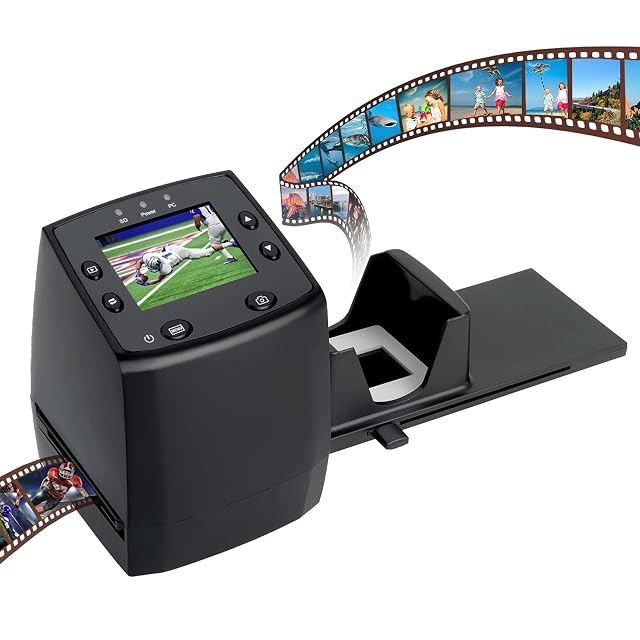
OPTICAL RESOLUTION 1800 dpi, published · 35 mm and 135 negatives and slides ONLY · an adjustable quick slide feeder supplied, no other holder described · bit depth NOT published · NO dust removal of any kind · JPEG to an SD card up to 8 GB SDHC, card not included, or to a computer over USB 2.0 · scan speed NOT published · no computer required · a video output switchable NTSC or PAL, for a television · Windows XP, Vista, 7, 8 and Mac OS listed
Fifty-two euros for a standalone 1800 dpi scanner that writes JPEGs to its own SD card — and can show them on a television through an NTSC or PAL output.
Best for: A box of mounted 35 mm slides to be got through quickly and viewed on a television, where a print larger than A4 is not the goal.
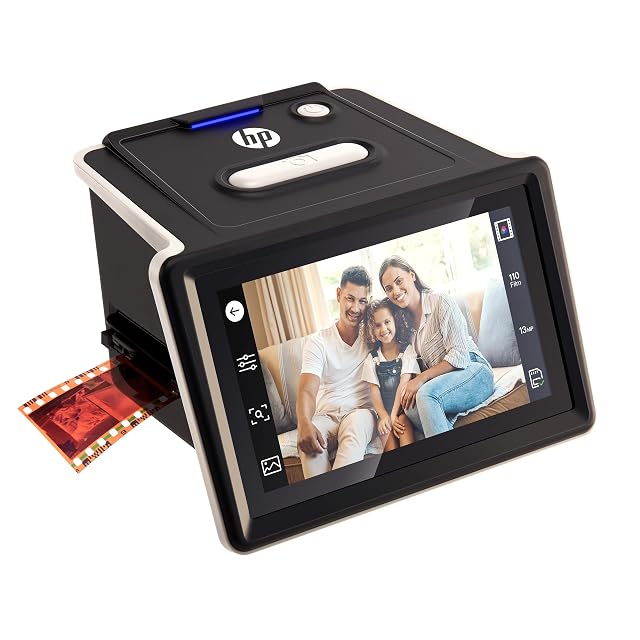
RESOLUTION AS A SENSOR: 22 MP JPEG output, no dpi figure published · 135 — 35 mm — plus 110 AND 126 film, colour and black-and-white negatives and positive slides, all INCLUDED rather than optional · SLIDE FRAMES AND FILM ADAPTERS SUPPLIED, plus a CLEANING BRUSH · bit depth NOT published · dust removal by the SUPPLIED BRUSH — mechanical, not infrared · JPEG · scan speed NOT published · a 5-inch LCD TOUCHSCREEN with gallery view, usable as a digital picture frame · a quick-loading tray for continuous import · automatic cropping with manual correction · slides must be in standard 50 mm mounts
Twenty-two megapixels, a 5-inch touchscreen, three film formats included and a cleaning brush in the box — the most completely equipped scanner here at 195 €.
Best for: A household box holding several film formats at once, digitised by someone who wants the whole kit — adapters, brush and screen — in one purchase.
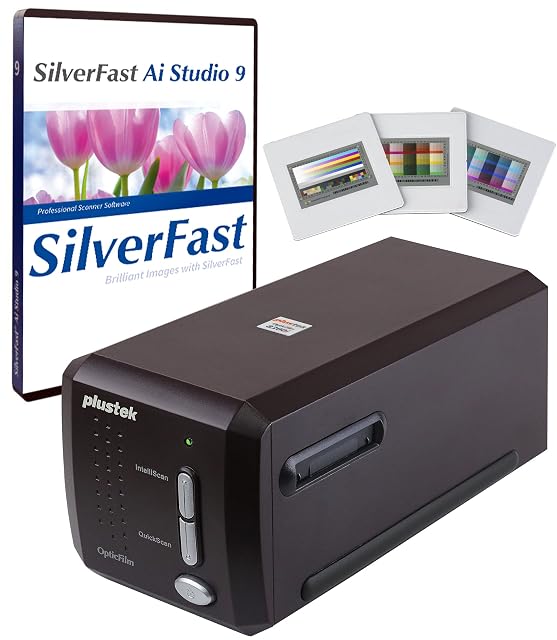
OPTICAL RESOLUTION 7200 dpi — four times the next figure on this shelf · 35 mm film and slides · holders not itemised · bit depth not published as a number, but SilverFast 9 is credited with a 16-BIT HISTOGRAM · DUST REMOVAL BY INFRARED: iSRD, the only true infrared channel on this shelf · output formats not listed; SilverFast 9 Ai Studio and Plustek QuickScan Plus supplied · scan speed described as 38 PER CENT FASTER than the previous model, with no absolute figure · REQUIRES A COMPUTER: Windows 7 to 11, Mac OS 10.13 to 12.x · an ADVANCED IT8 COLOUR TARGET on 3 slides, ISO 12641-2 compliant, valued at 99 dollars on the page · multi-exposure, HDRi and NegaFix named
Seven thousand two hundred dpi with a true infrared dust channel, SilverFast 9 Ai Studio and an ISO-compliant IT8 calibration target — the only scanner here built for archival work.
Best for: An archive of 35 mm negatives that has to be digitised once, properly, with colour that can be trusted and dust that does not have to be painted out.