Fifty-two euros for a standalone 1800 dpi scanner that writes JPEGs to its own SD card — and can show them on a television through an NTSC or PAL output.
The bottom line A standalone 1800 dpi scanner writing JPEGs to an SD card or a computer, with a slide feeder and a television output, for 52 €. It removes no dust, produces no raw file, accepts 35 mm only, and publishes no scan speed or bit depth.
On the listing
Five bullets, two of them identical. An adjustable quick slide feeder, with digitised JPEG files then copied, moved and duplicated by a mouse click; a 5 or 10 megapixel standalone film and slide scanner writing to an SD card up to 8 GB SDHC, card not included, or to a computer, at 1800 dpi high resolution; a USB 2.0 interface with a video cable converting to a television output, NTSC or PAL — printed twice; and an operating-system list of Windows XP, Vista, 7 and 8 and Mac OS.
Eighteen hundred dots per inch, published
Two thousand five hundred and fifty pixels across a 35 mm frame. An A4 print, and not a great deal more. It is the same figure as the 103 € Rollei here and a quarter of the Plustek’s claim.
No computer, and a television if you want one
The output switches NTSC or PAL, which is a 2010s convenience that still works: the slides appear on the screen in the room rather than on a laptop.
Not one word about dust
Five bullets, no infrared, no cleaning, no brush. Every speck on the film lands in the file and leaves by hand.
JPEG, and nothing underneath it
There is no raw file, so the exposure and colour the machine chose are the exposure and colour you keep.
Eight gigabytes, and a card that is not in the box
Thousands of frames at this resolution — and an SDHC ceiling that says when this design was drawn.
Availability
Between 52 € and 60 € on the German, French, Italian and Spanish Amazon stores when this page was last checked.
Listed in the British Amazon catalogue with nothing on sale against the entry: the camera has a page there and no seller behind it.
Nothing came back from the American Amazon store at all, so the button for that country runs a search instead of opening an entry that is not there.
Everything in this section is the figure Keepa carried on the day of the last update to this page. Availability and prices shift without notice.
Prices quoted in this text were read on 13 September 2026. The live price is at the top of the page.
What it does well, and what it gives up
Strengths
Standalone, with no computer required, at the lowest price on this shelf
An 1800 dpi optical figure published, and an adjustable quick feeder for mounted slides
A television output, switchable NTSC or PAL, for viewing on a screen already in the room
Compromises
No dust removal of any kind
JPEG only, so the scanner’s processing cannot be revisited
Thirty-five millimetre film only, and an 8 GB card limit that dates the design
Specifications
Optical resolution
1800 dpi, in the second bullet, alongside a sensor described as 5 or 10 megapixels — two numbers for the same machine, because dpi measures what the optics resolve on the film and megapixels count the file. At 1800 dpi a 35 mm frame yields roughly 2550 by 1700 pixels, which is an A4 print and no more. The 559 € Plustek on this shelf reaches 7200
Formats accepted
35 mm and 135 film only — negatives and slides, in the title and the second bullet. No 110 and no 126, where the 130 € Reflecta and the 195 € HP both take them
Holders supplied
One: an adjustable quick slide feeder, in the first bullet. A feeder rather than a tray means slides are pushed through one after another, which is faster for mounted slides and awkward for a cut strip of negatives
Bit depth
Not published, as on five of the six scanners here
Dust removal method
NONE. No infrared channel, no software cleaning and no brush is mentioned anywhere in five bullets. On film this is the work that decides how long the afterwards takes: every mote on a negative arrives in the scan and is removed by hand
Output formats
JPEG, in the title and the second bullet, to an SD card up to 8 GB SDHC — card not included — or to a computer over USB 2.0. JPEG only means the scanner’s own processing is final: there is no raw file to reinterpret
Scan speed
Not published
Amazon reference
B01IADT54K (same reference on 5 Amazon marketplaces)
EAN
0190835032861
What people ask before they commit
What does 1800 dpi actually give you?
About 2550 by 1700 pixels from a 35 mm frame — roughly 4 megapixels. That prints to A4 comfortably and will not enlarge much beyond it. It is the same optical figure as the 103 € Rollei on this shelf, and a quarter of the 7200 dpi the 559 € Plustek claims. For putting a shoebox of slides on a screen, it is enough.
How much work does no dust removal create?
One pass per frame, by hand. Film attracts dust electrostatically and a scanner records every speck as a white or black dot. The 559 € Plustek here uses an infrared channel to map the dust and subtract it; on this machine a blower before the scan and a retouching brush afterwards are the whole method.
Is the 8 GB card limit a problem?
It is a limit and a date stamp. Eight gigabytes of JPEGs at this resolution is thousands of frames, so the ceiling is unlikely to be reached in one sitting — but SDHC cards below 8 GB are now difficult to buy, and the card is not included. The USB 2.0 alternative writes straight to a computer instead.
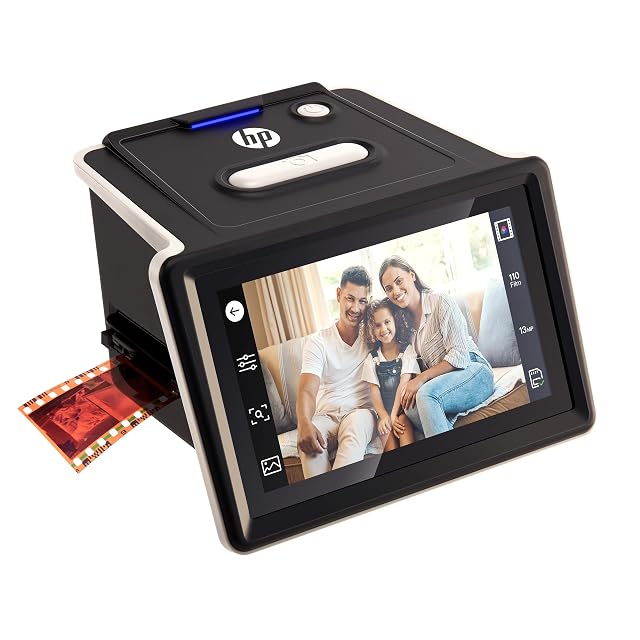
RESOLUTION AS A SENSOR: 22 MP JPEG output, no dpi figure published · 135 — 35 mm — plus 110 AND 126 film, colour and black-and-white negatives and positive slides, all INCLUDED rather than optional · SLIDE FRAMES AND FILM ADAPTERS SUPPLIED, plus a CLEANING BRUSH · bit depth NOT published · dust removal by the SUPPLIED BRUSH — mechanical, not infrared · JPEG · scan speed NOT published · a 5-inch LCD TOUCHSCREEN with gallery view, usable as a digital picture frame · a quick-loading tray for continuous import · automatic cropping with manual correction · slides must be in standard 50 mm mounts
Twenty-two megapixels, a 5-inch touchscreen, three film formats included and a cleaning brush in the box — the most completely equipped scanner here at 195 €.
Best for: A household box holding several film formats at once, digitised by someone who wants the whole kit — adapters, brush and screen — in one purchase.
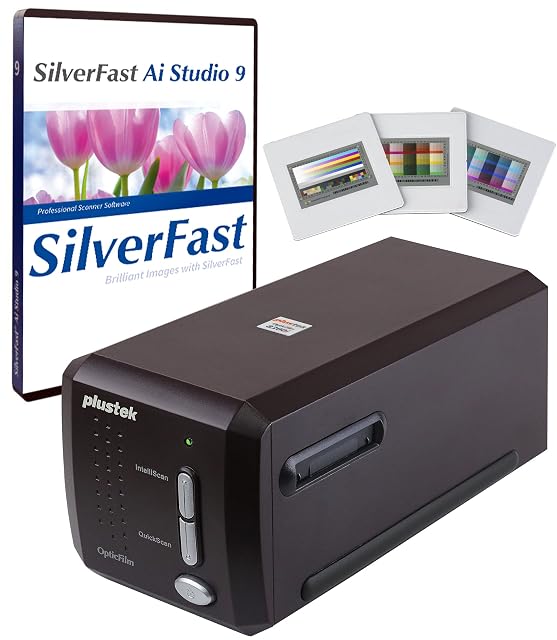
OPTICAL RESOLUTION 7200 dpi — four times the next figure on this shelf · 35 mm film and slides · holders not itemised · bit depth not published as a number, but SilverFast 9 is credited with a 16-BIT HISTOGRAM · DUST REMOVAL BY INFRARED: iSRD, the only true infrared channel on this shelf · output formats not listed; SilverFast 9 Ai Studio and Plustek QuickScan Plus supplied · scan speed described as 38 PER CENT FASTER than the previous model, with no absolute figure · REQUIRES A COMPUTER: Windows 7 to 11, Mac OS 10.13 to 12.x · an ADVANCED IT8 COLOUR TARGET on 3 slides, ISO 12641-2 compliant, valued at 99 dollars on the page · multi-exposure, HDRi and NegaFix named
Seven thousand two hundred dpi with a true infrared dust channel, SilverFast 9 Ai Studio and an ISO-compliant IT8 calibration target — the only scanner here built for archival work.
Best for: An archive of 35 mm negatives that has to be digitised once, properly, with colour that can be trusted and dust that does not have to be painted out.
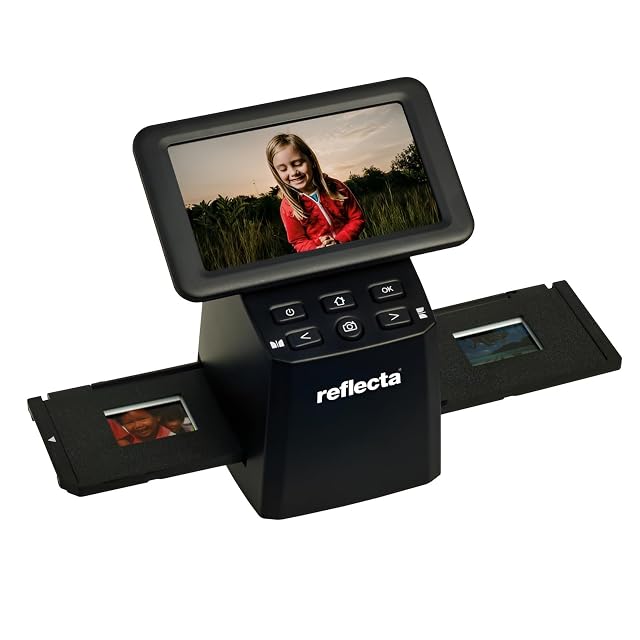
RESOLUTION AS A SENSOR: 15.3 MP CMOS, no dpi figure published · 135 film, slides and black-and-white, with 110 and 126 OPTIONAL · holders not itemised, the optional formats implying extra ones · bit depth NOT published · dust removal NOT described; IET technology is named for automatic COLOUR and CONTRAST correction, which is a different job · JPEG to SD or SDHC up to 128 GB · SCAN SPEED PUBLISHED: under two seconds a frame, the only figure on this shelf · a 5-inch IPS screen · standalone, no PC required · 365 g
Under two seconds a frame — the only scan speed published here — from a 15.3 MP standalone scanner with a 5-inch screen, at 365 g.
Best for: A large box of 35 mm slides and negatives that has to be got through in one sitting, on the table, with no computer.