Optical resolution is the real figure; the interpolated one is arithmetic · review
HP FilmScan, 22 MP, 135, 110 and 126, touchscreen review
Twenty-two megapixels, a 5-inch touchscreen, three film formats included and a cleaning brush in the box — the most completely equipped scanner here at 195 €.
The bottom line Twenty-two megapixels, three film formats with their adapters, a cleaning brush, a USB cable and a 5-inch touchscreen with gallery view — the best-equipped box on this shelf at 195 €. It publishes no dpi, no bit depth and no scan speed, and it writes JPEG only.
On the listing
Five bullets. A 5-inch LCD screen with gallery view, a large clear touchscreen with precise control and a wide viewing angle for quick preview and editing, usable for a slideshow or as a digital picture frame; a simple film-loading system, the quick-loading tray allowing continuous import of rolls and slides, compatible with colour and black-and-white negative strips and positive slides in 135, 110 and 126, with film strips required and slides needing standard 50 mm mounts; a built-in effortless editing mode adjusting size, colour and brightness with one tap, selecting the film type and digitising without complicated settings, with automatic cropping and manual correction; everything needed included — slide frames, film adapters, a cleaning brush and a USB cable, named as a gift for enthusiasts and beginners; and a closing keyword bullet listing formats and functions.
Three formats, adapters in the box
One hundred and thirty-five, 110 and 126. The two older ones are the family formats of the 1970s, and the 130 € Reflecta here treats them as optional extras it never names or prices.
A brush, supplied
One cleaning tool on this whole shelf, and it is in this box. A second per frame with a brush saves a minute per frame with a retouching cursor.
Twenty-two megapixels, and no dots per inch
The largest sensor figure here. It still cannot be set against 1800 or 7200 dpi without assuming what the optics resolve.
A screen that earns its keep between sessions
Gallery view, slideshow, picture frame. A scanning project that gets looked at is a scanning project that gets finished.
The conditions, stated
Film strips required. Slides in standard 50 mm mounts. Two sentences that prevent an unpleasant discovery.
Availability
Between 195 € and 200 € on the German, French, Italian and Spanish Amazon stores when this page was last checked.
The American and British Amazon stores carry it too, priced in local currency. Those amounts are deliberately absent from the range above, which reads euro stores only.
Everything in this section is the figure Keepa carried on the day of the last update to this page. Availability and prices shift without notice.
Prices quoted in this text were read on 13 September 2026. The live price is at the top of the page.
What it does well, and what it gives up
Strengths
Three film formats included — 135, 110 and 126 — with the adapters in the box
A cleaning brush supplied, alone on this shelf
A 5-inch touchscreen with gallery view, usable as a digital picture frame
Compromises
No dpi figure, so the resolution cannot be compared with half this shelf
JPEG only, with no raw or TIFF
No scan speed published, and slides must be in standard 50 mm mounts
Specifications
Optical resolution
NOT GIVEN IN DPI. The title publishes 22 MP JPEG output — the largest sensor figure on this shelf — and no dots-per-inch anywhere. As with the 130 € Reflecta, the figure cannot be set against the 1800 and 7200 dpi machines here without assuming what the optics resolve
Formats accepted
The widest INCLUDED list on this shelf: 135 at 35 mm, plus 110 and 126, in colour and black-and-white negative and as positive slides — with the adapters in the box rather than optional. The second bullet states the conditions plainly: film strips are required, and slides must sit in standard 50 mm mounts
Holders supplied
Slide frames, film adapters AND a cleaning brush, in the fourth bullet, with a USB cable. It is the only scanner here whose holders are itemised, and the brush is the only cleaning tool supplied anywhere on this shelf
Bit depth
Not published
Dust removal method
MECHANICAL: the supplied cleaning brush, in the fourth bullet. That is dust prevention rather than dust removal — the brush takes the specks off before the scan, where the 559 € Plustek’s infrared channel finds what the brush missed and subtracts it from the file. A brush is nevertheless the cheapest effective step, and no other page here includes one
Output formats
JPEG, in the title. No raw and no TIFF, so the scanner’s processing is final
Scan speed
Not published. The quick-loading tray in the second bullet is described as allowing continuous import of film rolls and slides, which addresses handling time rather than exposure time
Amazon reference
B0F8D5LXQ3 (same reference on 6 Amazon marketplaces)
EAN
0198869003475
What people ask before they commit
How much does the supplied brush really help?
More than its price suggests. Film holds dust electrostatically and every speck becomes a mark in the file; a brush before the scan removes most of them in a second per frame. It is not the same as the infrared dust channel on the 559 € Plustek, which finds what remains and subtracts it — but it is the step that most reduces retouching, and no other scanner on this shelf includes the tool.
Why do 110 and 126 matter?
Because they are in the boxes people actually inherit. Pocket Instamatic 110 and square-format 126 cartridges were the family formats of the 1970s, and most scanners ignore them — the 130 € Reflecta here treats them as optional extras it does not name. This page includes the adapters, which is the difference between scanning the whole box and scanning part of it.
What does the gallery view add?
A reason to keep it out. The first bullet describes a slideshow for family and use as a digital picture frame, and on a machine that spends a week on a table that is a real function: the results are looked at as they accumulate, which is how a scanning project keeps its momentum.
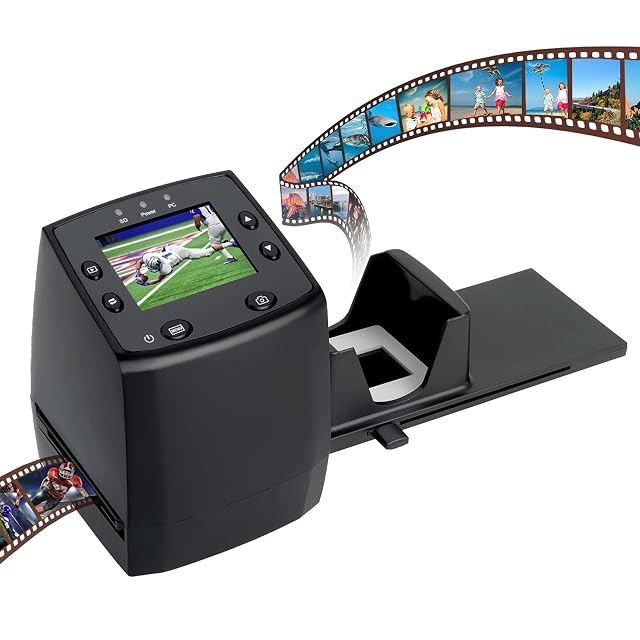
OPTICAL RESOLUTION 1800 dpi, published · 35 mm and 135 negatives and slides ONLY · an adjustable quick slide feeder supplied, no other holder described · bit depth NOT published · NO dust removal of any kind · JPEG to an SD card up to 8 GB SDHC, card not included, or to a computer over USB 2.0 · scan speed NOT published · no computer required · a video output switchable NTSC or PAL, for a television · Windows XP, Vista, 7, 8 and Mac OS listed
Fifty-two euros for a standalone 1800 dpi scanner that writes JPEGs to its own SD card — and can show them on a television through an NTSC or PAL output.
Best for: A box of mounted 35 mm slides to be got through quickly and viewed on a television, where a print larger than A4 is not the goal.
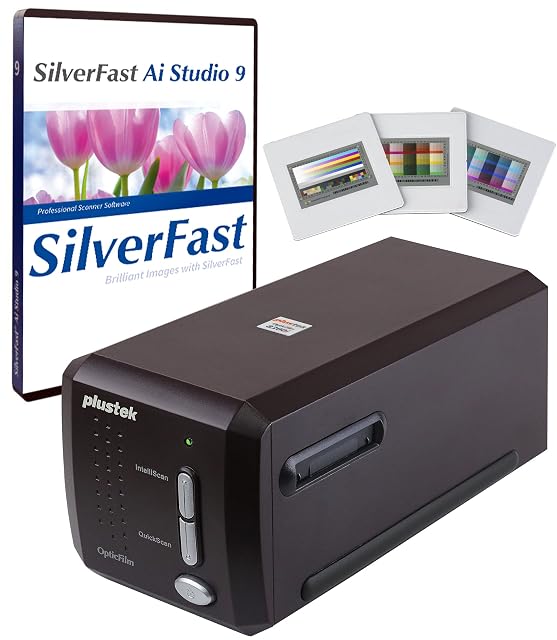
OPTICAL RESOLUTION 7200 dpi — four times the next figure on this shelf · 35 mm film and slides · holders not itemised · bit depth not published as a number, but SilverFast 9 is credited with a 16-BIT HISTOGRAM · DUST REMOVAL BY INFRARED: iSRD, the only true infrared channel on this shelf · output formats not listed; SilverFast 9 Ai Studio and Plustek QuickScan Plus supplied · scan speed described as 38 PER CENT FASTER than the previous model, with no absolute figure · REQUIRES A COMPUTER: Windows 7 to 11, Mac OS 10.13 to 12.x · an ADVANCED IT8 COLOUR TARGET on 3 slides, ISO 12641-2 compliant, valued at 99 dollars on the page · multi-exposure, HDRi and NegaFix named
Seven thousand two hundred dpi with a true infrared dust channel, SilverFast 9 Ai Studio and an ISO-compliant IT8 calibration target — the only scanner here built for archival work.
Best for: An archive of 35 mm negatives that has to be digitised once, properly, with colour that can be trusted and dust that does not have to be painted out.
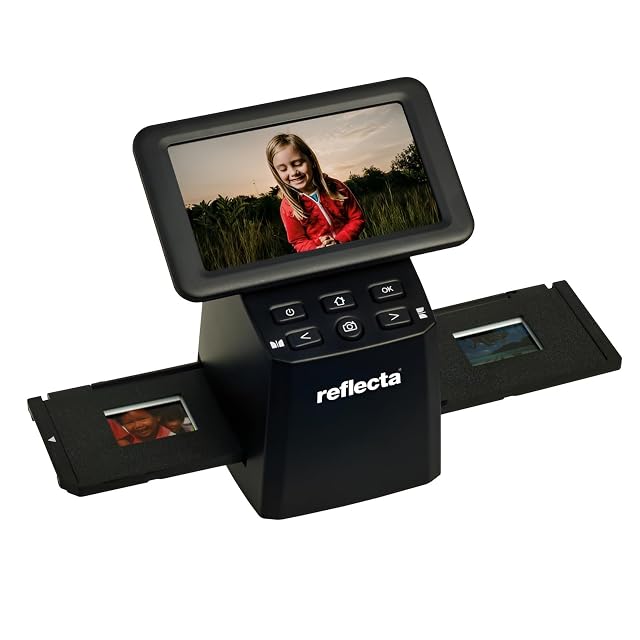
RESOLUTION AS A SENSOR: 15.3 MP CMOS, no dpi figure published · 135 film, slides and black-and-white, with 110 and 126 OPTIONAL · holders not itemised, the optional formats implying extra ones · bit depth NOT published · dust removal NOT described; IET technology is named for automatic COLOUR and CONTRAST correction, which is a different job · JPEG to SD or SDHC up to 128 GB · SCAN SPEED PUBLISHED: under two seconds a frame, the only figure on this shelf · a 5-inch IPS screen · standalone, no PC required · 365 g
Under two seconds a frame — the only scan speed published here — from a 15.3 MP standalone scanner with a 5-inch screen, at 365 g.
Best for: A large box of 35 mm slides and negatives that has to be got through in one sitting, on the table, with no computer.