Seven thousand two hundred dpi with a true infrared dust channel, SilverFast 9 Ai Studio and an ISO-compliant IT8 calibration target — the only scanner here built for archival work.
The bottom line Seven thousand two hundred dpi, infrared dust removal, a 16-bit histogram, SilverFast 9 Ai Studio and an ISO-compliant IT8 target for 559 € — the only scanner here that treats film as an archive. It needs a computer, takes 35 mm only, never itemises its holders, and states its speed as a percentage of an unnamed model.
On the listing
Five bracketed bullets. A newly introduced chip generation scanning film at up to 7200 dpi and raising scan speed 38 per cent over the last model, with SilverFast 9 supplying over a hundred functions; dual professional software, bundling SilverFast 9 Ai Studio and Plustek QuickScan Plus for digitising and archiving slides and film; an advanced IT8 target included on three slides of a 35 mm colour calibration target valued at 99 dollars, compliant with ISO 12641-2 and offering more measurement patches to reduce interpolation during calibration; new algorithms in SilverFast 9 credited with removing the boundary between film and digital image through integrated infrared, iSRD, HDRi, a 16-bit histogram, multi-exposure and NegaFix; and support for Windows 7, 8, 10 and 11 and Mac OS 10.13 to 12.x, with the driver on a supplied USB stick and telephone and online-chat support offered in Germany.
Infrared, which is the only real answer to dust
Film dye passes infrared; dust does not. One pass maps every speck and scratch, and the software subtracts them. Five scanners on this shelf offer a brush or nothing at all.
Seven thousand two hundred dots per inch
Fourfold the next figure here, and more than most 35 mm film holds — which is the point: the scanner stops being the limit.
A calibration target, on three slides
ISO 12641-2, more patches, less interpolation. Scanning it teaches the software how this machine sees colour, and every frame afterwards inherits the correction.
Sixteen bits of histogram
Sixty-five thousand levels per channel instead of 256. It is what lets a dense shadow be lifted later without the sky banding.
Thirty-five millimetre, and a computer
No prints, no 110, no 126, no standalone mode. One format, done to a standard nothing else on this shelf attempts.
Thirty-eight per cent faster than what
A percentage against a model the page never names. At 7200 dpi with multi-exposure, a frame takes minutes regardless.
Availability
About 559 € on the German, French, Italian and Spanish Amazon stores when this page was last checked.
The American and British Amazon stores carry it too, priced in local currency. Those amounts are deliberately absent from the range above, which reads euro stores only.
Everything in this section is the figure Keepa carried on the day of the last update to this page. Availability and prices shift without notice.
Prices quoted in this text were read on 13 September 2026. The live price is at the top of the page.
What it does well, and what it gives up
Strengths
Seven thousand two hundred dpi, four times the next figure on this shelf
True infrared dust and scratch removal, alone here
SilverFast 9 Ai Studio plus an ISO 12641-2 IT8 calibration target on three slides
Compromises
Requires a computer, where five scanners here are standalone
Thirty-five millimetre only — no prints, no 110, no 126
Its speed claim is a percentage against an unnamed predecessor
Specifications
Optical resolution
7200 dpi, in the first bullet, from a new chip generation — fourfold the 1800 dpi of the 52 € DIGITNOW and the 103 € Rollei. At 7200 dpi a 35 mm frame yields roughly 10,000 pixels across, which is more than 35 mm film itself holds: the figure is there so that nothing the negative contains is left behind
Formats accepted
35 mm film and slides only. No 110, no 126, no prints — the opposite trade from the 242 € Somikon here, which scans five things adequately. This machine does one thing at a resolution nothing else here approaches
Holders supplied
Not itemised on the page, which is an odd omission at 559 € — the holder is what keeps a negative flat, and flatness at 7200 dpi is the difference between resolution and blur
Bit depth
Not published as a number, but the fourth bullet credits SilverFast 9 with a 16-BIT HISTOGRAM, multi-exposure and HDRi. Sixteen bits per channel is 65,536 levels against the 256 of an 8-bit file, and it is what lets a dense shadow in a negative be opened up afterwards without banding
Dust removal method
INFRARED — iSRD, named in the fourth bullet, and the only true infrared dust removal on this shelf. An infrared pass sees dust and scratches as opaque while film dye is transparent to it, so the defects are mapped and subtracted from the colour scan. Five scanners here offer a brush or nothing; this is the one that does the work for you
Output formats
Not listed. Two pieces of software are: SilverFast 9 Ai Studio and Plustek QuickScan Plus, in the second bullet — and SilverFast writes the formats archival work needs
Scan speed
RELATIVE ONLY: 38 per cent faster than the previous model, in the first bullet, with no absolute figure. A percentage against an unnamed baseline is not a measurement — and at 7200 dpi with multi-exposure, a frame takes minutes rather than seconds either way
Amazon reference
B09L7NDNFG (same reference on 6 Amazon marketplaces)
EAN
0783064369626
What people ask before they commit
What does infrared dust removal actually do?
It separates dirt from picture. Film dye is transparent to infrared while dust and scratches are not, so an infrared pass produces a map of every defect that the software then subtracts from the colour scan. On a thousand negatives that is the difference between a week of retouching and none — and it is why this machine exists at 559 € while five others here hand you a brush.
Why does an IT8 target matter?
Because it makes the colour true rather than plausible. The third bullet supplies three slides of a 35 mm colour target compliant with ISO 12641-2, and describes it as offering more measurement patches so less interpolation is needed during calibration. Scanning that target teaches the software exactly how this scanner sees colour, and every scan afterwards is corrected against it. Nothing else on this shelf ships one.
Is 7200 dpi more than 35 mm film can hold?
For most film, yes — and that is the intention. Fine-grained slide film resolves somewhere below this figure, so scanning above it guarantees the scanner is not the limit. The cost is time and file size: at 7200 dpi with multi-exposure a single frame takes minutes, which is why this is a machine for an archive rather than a shoebox.
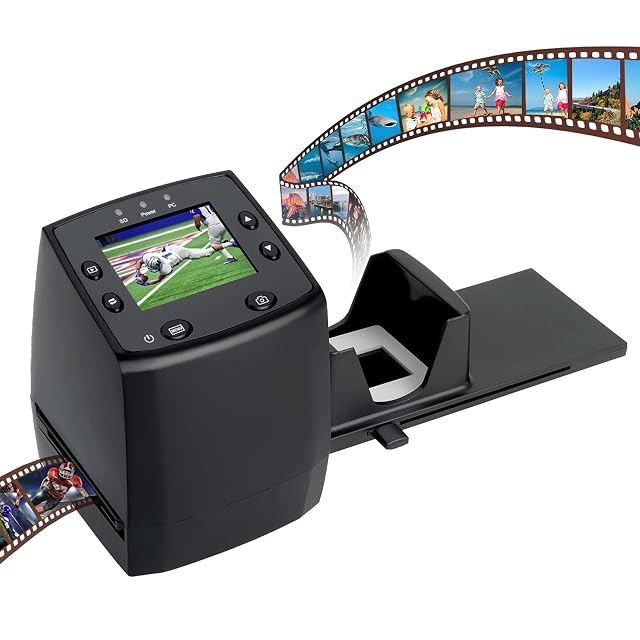
OPTICAL RESOLUTION 1800 dpi, published · 35 mm and 135 negatives and slides ONLY · an adjustable quick slide feeder supplied, no other holder described · bit depth NOT published · NO dust removal of any kind · JPEG to an SD card up to 8 GB SDHC, card not included, or to a computer over USB 2.0 · scan speed NOT published · no computer required · a video output switchable NTSC or PAL, for a television · Windows XP, Vista, 7, 8 and Mac OS listed
Fifty-two euros for a standalone 1800 dpi scanner that writes JPEGs to its own SD card — and can show them on a television through an NTSC or PAL output.
Best for: A box of mounted 35 mm slides to be got through quickly and viewed on a television, where a print larger than A4 is not the goal.
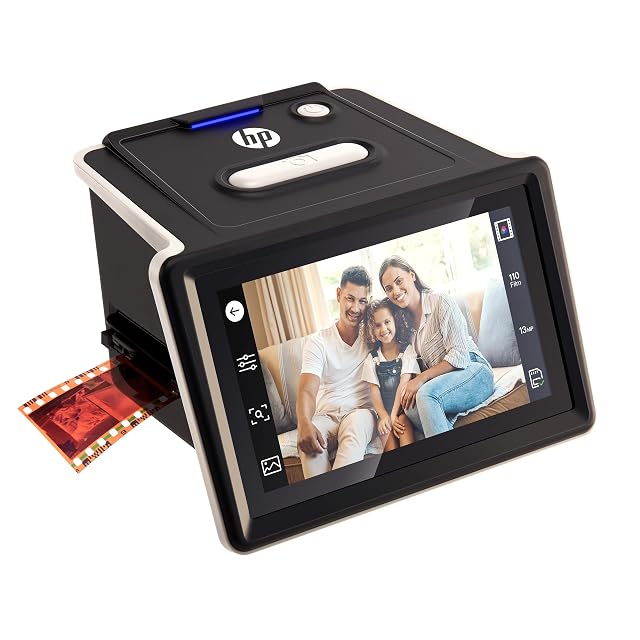
RESOLUTION AS A SENSOR: 22 MP JPEG output, no dpi figure published · 135 — 35 mm — plus 110 AND 126 film, colour and black-and-white negatives and positive slides, all INCLUDED rather than optional · SLIDE FRAMES AND FILM ADAPTERS SUPPLIED, plus a CLEANING BRUSH · bit depth NOT published · dust removal by the SUPPLIED BRUSH — mechanical, not infrared · JPEG · scan speed NOT published · a 5-inch LCD TOUCHSCREEN with gallery view, usable as a digital picture frame · a quick-loading tray for continuous import · automatic cropping with manual correction · slides must be in standard 50 mm mounts
Twenty-two megapixels, a 5-inch touchscreen, three film formats included and a cleaning brush in the box — the most completely equipped scanner here at 195 €.
Best for: A household box holding several film formats at once, digitised by someone who wants the whole kit — adapters, brush and screen — in one purchase.
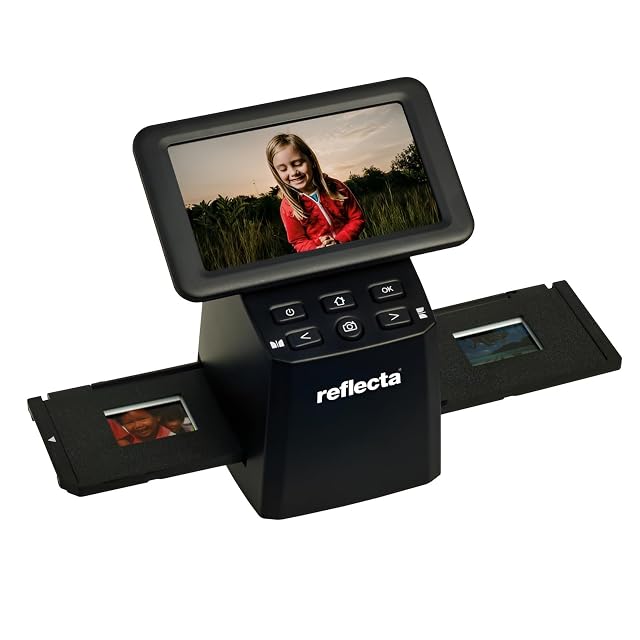
RESOLUTION AS A SENSOR: 15.3 MP CMOS, no dpi figure published · 135 film, slides and black-and-white, with 110 and 126 OPTIONAL · holders not itemised, the optional formats implying extra ones · bit depth NOT published · dust removal NOT described; IET technology is named for automatic COLOUR and CONTRAST correction, which is a different job · JPEG to SD or SDHC up to 128 GB · SCAN SPEED PUBLISHED: under two seconds a frame, the only figure on this shelf · a 5-inch IPS screen · standalone, no PC required · 365 g
Under two seconds a frame — the only scan speed published here — from a 15.3 MP standalone scanner with a 5-inch screen, at 365 g.
Best for: A large box of 35 mm slides and negatives that has to be got through in one sitting, on the table, with no computer.