The bottom line A 5.5-inch 1920 by 1080 touchscreen at 401 PPI with the full monitoring set, lookup tables that work on arrival, and an 8 V output that powers the camera — for 149 €. It is the dimmest but one on this shelf and describes no mounting hardware.
On the listing
Five bracketed bullets. A 5.5-inch touchscreen with capacitive multi-touch for swiping, scrolling, selecting and zooming; full HD professional colour standards at 1920 by 1080, 800 nits, 1000:1 contrast, 16:9, 401 PPI and 178° viewing angles under Rec.709, described as more natural and true than the camera’s own screen; full function with 3D LUT, importing colour-calibration files over USB with the supplied U-disk, plus full-screen waveform, histogram, vectorscope, waveform, false colour, peaking focus assist and zoom; a 4K HDMI input and output at 30 Hz listing 3840 by 2160 at 24, 25 and 30 Hz and 4096 by 2160 at 24 Hz, with audio monitoring through a 3.5 mm socket, headphones not included; and power options covering NP-F550, NP-F750, NP-F970 and E6 batteries, a 7-24 V DC input and an 8 V DC output to feed the camera through a dummy battery, with a one-year warranty.
Four hundred and one pixels per inch
The figure nobody else on this shelf publishes. On a 5.5-inch panel it is what decides whether the image looks like a photograph or like pixels, and it is why a small monitor can be as useful as a large one.
A stick in the box, for the lookup tables
Five monitors here support 3D LUTs. This is the one that ships the medium to carry them, which is the difference between the feature and the idea of it.
Eight volts, going the other way
The monitor feeds the camera. One NP-F970 then runs both, and the mid-take battery swap stops happening.
Eight hundred nits, and a hood to go with them
Below the 1400 and 2000 elsewhere on this shelf, and the 278 € VILTROX is the first of them. The hood is in the box because 800 nits needs it.
Four hundred and one pixels per inch, and no mounting hardware
How it mounts. The 88 € Portkeys publishes three quarter-inch threads and a swivel bracket; this page names a sun hood and stops.
Availability
Between 149 € and 189 € on the German, French, Italian and Spanish Amazon stores when this page was last checked.
The British Amazon store carry it too, priced in local currency. Those amounts are deliberately absent from the range above, which reads euro stores only.
Listed in the American Amazon catalogue with nothing on sale against the entry: the camera has a page there and no seller behind it.
Everything in this section is the figure Keepa carried on the day of the last update to this page. Availability and prices shift without notice.
Prices quoted in this text were read on 13 September 2026. The live price is at the top of the page.
What it does well, and what it gives up
Strengths
A supplied USB stick for importing 3D LUTs, so the feature works out of the box
An 8 V DC output that powers the camera from the monitor’s own battery
Four hundred and one PPI published, and four battery types accepted
Compromises
Eight hundred nits, against 1400, 1500 and 2000 elsewhere on this shelf
No mounting threads described
Headphones and batteries both excluded
Specifications
Size
5.5 inches, in the title, with a capacitive multi-touch panel the first bullet describes by gesture — swipe, scroll, select, zoom in, zoom out. The smaller format on this shelf, beside the 5.2-inch Atomos
Resolution
1920 by 1080, in the second bullet, with 401 PPI, a 1000:1 contrast ratio, a 16:9 ratio and 178° viewing angles horizontally and vertically. The PPI figure is the one nobody else here publishes, and on a 5.5-inch panel it is what decides whether pixels are visible at arm’s length
Brightness in nits
800 nits, in the second bullet, alongside the Rec.709 colour standard — the lowest-but-one figure on this shelf, above the 500 of the FEELWORLD and the LILLIPUT and well under the 2000 of the NEEWER
Inputs and outputs
4K HDMI in AND out at 30 Hz, in the fourth bullet, which lists the formats: 3840 by 2160 at 24, 25 and 30 Hz, and 4096 by 2160 at 24 Hz. Loop-out is what lets a second monitor or a recorder sit downstream. Audio through a 3.5 mm socket, headphones not included
Exposure and focus tools
The full professional set, in the third bullet: full-screen waveform, histogram, vectorscope, waveform, false colour, peaking focus assist and zoom, described as helping with exposure, focus and composition
Lookup table support
YES, and with the means to use it: 3D LUT files are imported through the USB port using a SUPPLIED U-disk. A LUT socket without a stick is a feature waiting on a purchase; this one ships with the stick
Power
The broadest arrangement here: NP-F550, NP-F750, NP-F970 or Canon E6 batteries, a 7-24 V DC input, and an 8 V DC OUTPUT that powers the camera through a dummy battery. The output is the part that matters on a long day — one battery on the monitor runs both devices
Mounting
Not described beyond the supplied sun hood. No thread count and no bracket are named, where the 88 € Portkeys publishes three quarter-inch threads
Amazon reference
B09G2XC1KW (same reference on 6 Amazon marketplaces)
EAN
0723884577863
What people ask before they commit
What does the 8 V output actually save?
One battery and one charger. The fifth bullet describes a DC output feeding the camera through a dummy battery, so a single NP-F970 on the monitor runs the screen and the body together. On a long interview that replaces three camera batteries with one large one, and it removes the swap that always happens mid-take.
Why does a supplied U-disk matter?
Because a LUT has to get into the monitor somehow. The third bullet says files are imported over USB and that the stick is included — which sounds trivial until the alternative is discovering on location that the socket needs media nobody packed. It is the difference between a specification and a working feature.
Is 800 nits enough outdoors?
With the hood, usually. Direct summer sun beats 800 nits, which is why the sun hood is in the box and why the 1400-nit VILTROX costs 278 € and the 2000-nit NEEWER 297 €. Indoors and in shade, 800 nits is comfortable and draws less power.
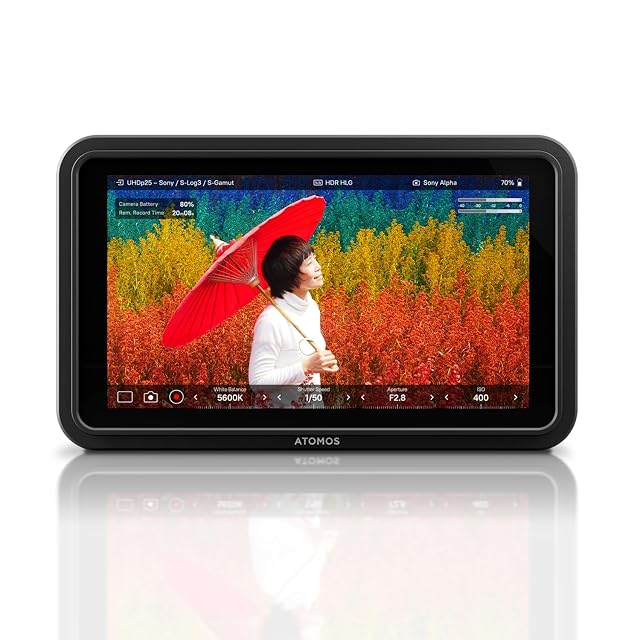
5.2 inches, IPS · 1920 by 1080 Full HD, HDR · 1500 nits · 4K HDMI input · waveform, histogram, RGB parade, vectorscope, false colour, zebra, focus peaking, zoom and frame guides · LUT SUPPORT stated · CAMERA CONTROL over USB-C for Canon, Sony, Panasonic and Z CAM, including record start and stop and selected parameters · NP-F L-series battery or USB-C Power Delivery · slim body named for gimbals and rigs · no loop-out mentioned · no weight or dimensions published
Fifteen hundred nits of HDR on 5.2 inches, with camera control for four named systems and power over USB-C Power Delivery — the dearest monitor on this shelf at 395 €.
Best for: A gimbal or travel rig where HDR monitoring and a power bank matter more than feeding a second screen.
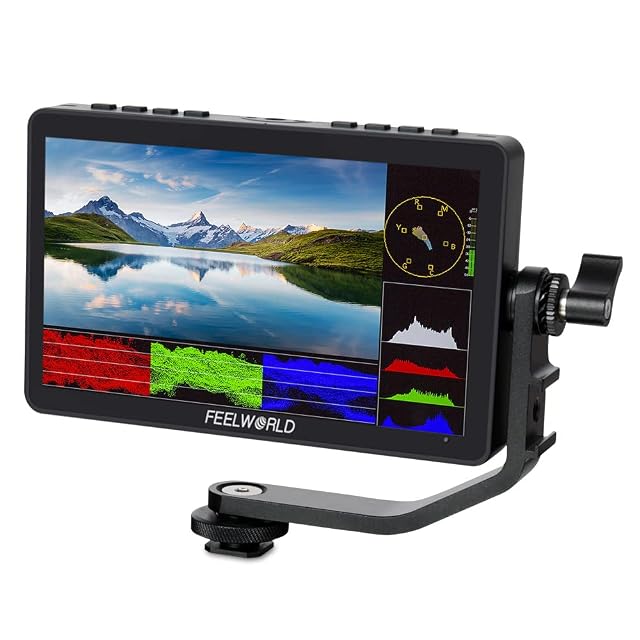
5.2 inches — 15.2 cm — touchscreen with pinch-to-zoom · 1920 by 1080 native · 500 nits · 4K HDMI IN AND LOOP-OUT · histogram, false colour, focus assist, embedded audio, pixel-to-pixel, frame guides and a nine-field grid · 3D LUT support with REC-709 calibration · Type-C input, an F970 battery plate, an external POWER KIT for wireless transmitters and LED lights, and an 8.4 V DC output · supplied with micro-HDMI cable, sun hood, tilt arm and removal key · battery and 12 V 1.5 A adapter NOT included
A 5.2-inch monitor whose back carries a Sony F970 power kit for a wireless transmitter or an LED light — one battery for the whole accessory stack, for 170 €.
Best for: A rig that already carries a wireless transmitter or a small LED, where one Sony battery should power the lot.
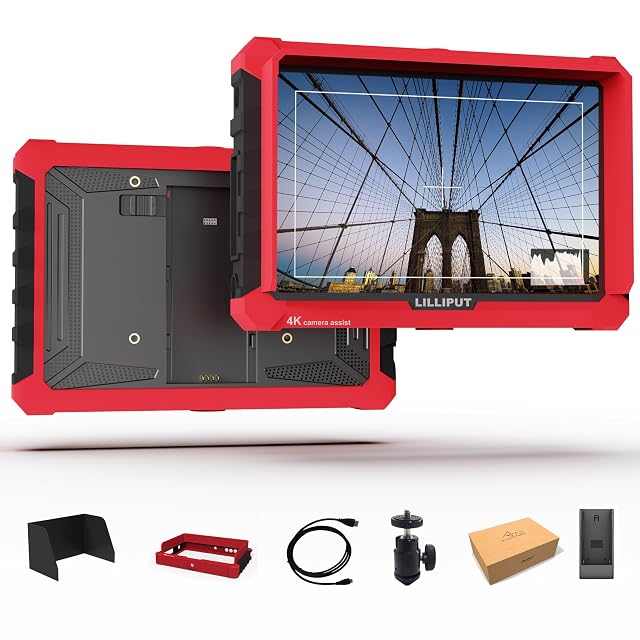
7 inches · 1920 by 1200 native — the only monitor here above 1080 — on an 8-BIT panel, 1000:1, 170° wide viewing angle, full lamination · 500 cd/m² · 4K HDMI in and LOOP-OUT plus 3G-SDI, named in the title · full waveform, oscillogram in RGB/YUV/Y, vectorscope, luminance histogram, peaking focus in ten steps and five colours, audio bars, zebra, single colour, false colour, nine fields, de-squeeze, magnification, auto flip, point-to-point, centre marker, safety marker and crop marker · firmware updates from a SUPPLIED U-DISK · F1 and F2 assignable buttons with a dial · silicone rubber case and integrated sun hood · one-year warranty · batteries NOT included
The only 1920 by 1200 panel on this shelf, with 3G-SDI alongside 4K HDMI and the longest list of monitoring tools here — in a silicone rubber case, for 181 €.
Best for: A set where an SDI cable runs from the camera to the monitor, and where the extra 120 lines and a published bit depth matter more than brightness.