Brightness in nits decides whether it can be used outdoors at all · review
Atomos Shinobi II, 5.2 inches, 1500 nits, HDR review
Fifteen hundred nits of HDR on 5.2 inches, with camera control for four named systems and power over USB-C Power Delivery — the dearest monitor on this shelf at 395 €.
The bottom line Fifteen hundred nits on an HDR panel, camera control for four named systems, and power from a USB-C bank — the most modern arrangement on this shelf at 395 €. It lists nothing in the box, publishes neither weight nor dimensions, and has no loop-out.
On the listing
Five bullets. A 5.2-inch Full HD HDR display, a compact HDMI camera monitor at 1920 by 1080 with an IPS panel and 1500 nits for clear images in daylight and outdoor shoots; a 4K HDMI input supporting signals up to 4K for precise real-time control on DSLR and mirrorless cameras; USB-C camera control for compatible Canon, Sony, Panasonic and Z CAM bodies directly from the monitor, including record start and stop and selected parameters; professional monitoring tools listing waveform, histogram, RGB parade, vectorscope, false colour, zebra, focus peaking, zoom, frame guides and LUT support for checking exposure, colour and sharpness; and a light, flexible design with a slim housing for gimbals, camera rigs and mobile setups, powered by an NP-F L-series battery or USB-C Power Delivery.
HDR, and the nits to show it
A wider range needs a bright panel to put the highlights in. Fifteen hundred nits and an HDR claim arrive together on this page, and nowhere else on this shelf.
A power bank instead of a battery
USB-C Power Delivery means the thing already in the bag runs the monitor. Six other screens here want a Sony NP-F and its charger.
Four systems, named
Canon, Sony, Panasonic, Z CAM. A list is a narrower claim than “compatible cameras” and a more useful one — a fifth body is monitored rather than driven.
Five point two inches, for a gimbal
The smallest panel on this shelf, and the fifth bullet says why: slim, for rigs and mobile setups where mass at the end of an arm is the enemy.
What three hundred and ninety-five euros does not publish
A weight, a dimension, a loop-out, or a single item in the box — on the monitor whose argument is that it is light.
Availability
Between 395 € and 417 € on the German, French, Italian and Spanish Amazon stores when this page was last checked.
The American and British Amazon stores carry it too, priced in local currency. Those amounts are deliberately absent from the range above, which reads euro stores only.
Everything in this section is the figure Keepa carried on the day of the last update to this page. Availability and prices shift without notice.
Prices quoted in this text were read on 13 September 2026. The live price is at the top of the page.
What it does well, and what it gives up
Strengths
Fifteen hundred nits driving an HDR panel, the only HDR claim on this shelf
Camera control over USB-C for Canon, Sony, Panasonic and Z CAM, named individually
USB-C Power Delivery, so a phone power bank runs it
Compromises
Three hundred and ninety-five euros, the dearest here, with nothing listed in the box
No loop-out, where five monitors on this shelf have one
No weight and no dimensions, on a monitor sold for being slim
Specifications
Size
5.2 inches, IPS, in the first bullet — the smallest on this shelf, tied with the FEELWORLD, and the page names the reason in its fifth bullet: a slim body for gimbals, camera rigs and mobile setups
Resolution
1920 by 1080 Full HD, in the first bullet, with HDR — and HDR is the word this page carries that the others do not. It means the panel is being driven to show a wider range between the darkest and brightest parts of a log or HLG signal rather than clipping it flat
Brightness in nits
1500 nits, in the first bullet, named for daylight and outdoor shoots. Behind the 2000 of the NEEWER and ahead of everything else here — and brightness is what makes HDR visible, since a wider range needs somewhere bright to put the highlights
Inputs and outputs
A 4K HDMI input, in the second bullet. NO LOOP-OUT is mentioned, where the Desview, FEELWORLD, LILLIPUT, VILTROX and NEEWER on this shelf all publish one — so nothing else can be fed from this monitor
Exposure and focus tools
Waveform, histogram, RGB parade, vectorscope, false colour, zebra, focus peaking, zoom and frame guides, in the fourth bullet, for exposure, colour and focus
Lookup table support
Stated in the fourth bullet as LUT support, without a count, a format or a loading method. The 297 € NEEWER here publishes fifteen preinstalled and sixty custom slots by SD card; this page publishes the capability alone
Power
An NP-F L-series battery OR USB-C Power Delivery, in the fifth bullet. The USB-C option is the one nothing else here offers properly: a phone power bank runs the monitor, which on a travel shoot removes the Sony battery and its charger from the bag entirely
Mounting
Not described beyond a slim housing named for gimbals, rigs and mobile setups. No thread count, no shoe, no dimensions and NO WEIGHT — on the monitor whose whole argument is that it is light
Amazon reference
B0DBQWXY4B (same reference on 6 Amazon marketplaces)
EAN
0814164022941
What people ask before they commit
What does USB-C Power Delivery change in practice?
It removes a whole class of accessory. Every other monitor on this shelf runs on Sony NP-F cells, which means carrying those cells and their charger. The fifth bullet offers the same phone power bank that is already in the bag, and on a flight that is one less lithium item to declare.
Which cameras does the control work with?
The third bullet names four systems — Canon, Sony, Panasonic and Z CAM — for record start and stop and selected parameters over USB-C. Naming them is more useful than the phrase "compatible cameras", and it is a narrower claim than it looks: a body outside those four is monitored, not driven.
Is the missing loop-out a real limitation?
It is, if a second screen or a recorder sits downstream. Five monitors here pass the signal through; this one is the end of the chain. For a single operator on a gimbal that is no loss at all — which is exactly the setup the fifth bullet is written for.
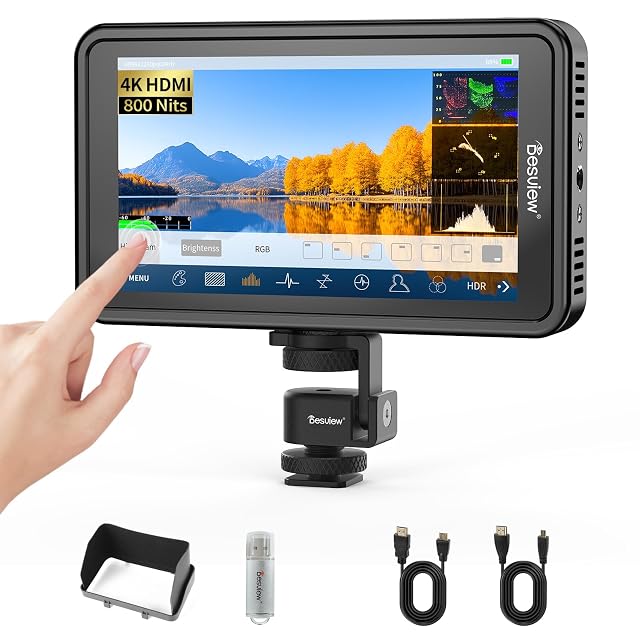
5.5 inches, touchscreen · 1920 by 1080, 401 PPI, 1000:1, 16:9, 178° viewing, Rec.709 · 800 nits · 4K HDMI IN AND OUT at 30 Hz, 3.5 mm headphone socket · full-screen waveform, histogram, vectorscope, false colour, peaking focus assist and zoom · 3D LUT files imported over USB with a SUPPLIED U-DISK · NP-F550/750/970 or E6 batteries, 7-24 V DC in, 8 V DC OUT to power the camera through a dummy battery · sun hood included · one-year warranty stated
A 5.5-inch 800-nit touchscreen at 401 PPI that imports lookup tables from a supplied USB stick and can feed 8 volts back into the camera.
Best for: Log footage that has to be judged through a lookup table on a small, light monitor, on a rig where one battery should run both camera and screen.
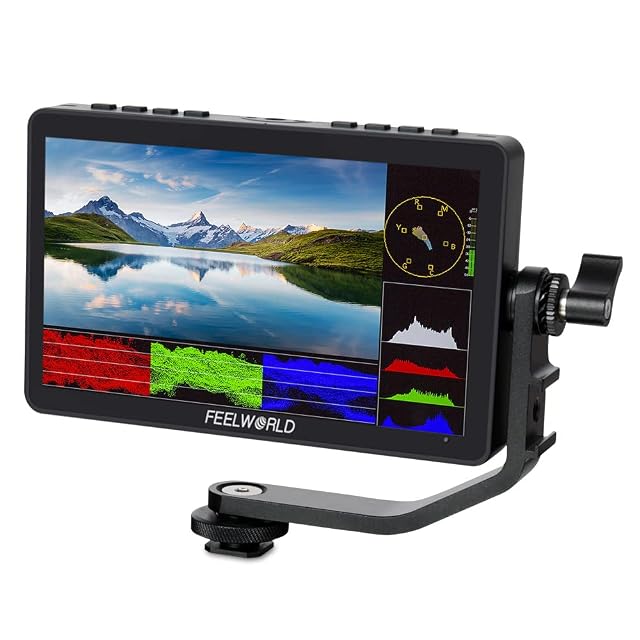
5.2 inches — 15.2 cm — touchscreen with pinch-to-zoom · 1920 by 1080 native · 500 nits · 4K HDMI IN AND LOOP-OUT · histogram, false colour, focus assist, embedded audio, pixel-to-pixel, frame guides and a nine-field grid · 3D LUT support with REC-709 calibration · Type-C input, an F970 battery plate, an external POWER KIT for wireless transmitters and LED lights, and an 8.4 V DC output · supplied with micro-HDMI cable, sun hood, tilt arm and removal key · battery and 12 V 1.5 A adapter NOT included
A 5.2-inch monitor whose back carries a Sony F970 power kit for a wireless transmitter or an LED light — one battery for the whole accessory stack, for 170 €.
Best for: A rig that already carries a wireless transmitter or a small LED, where one Sony battery should power the lot.
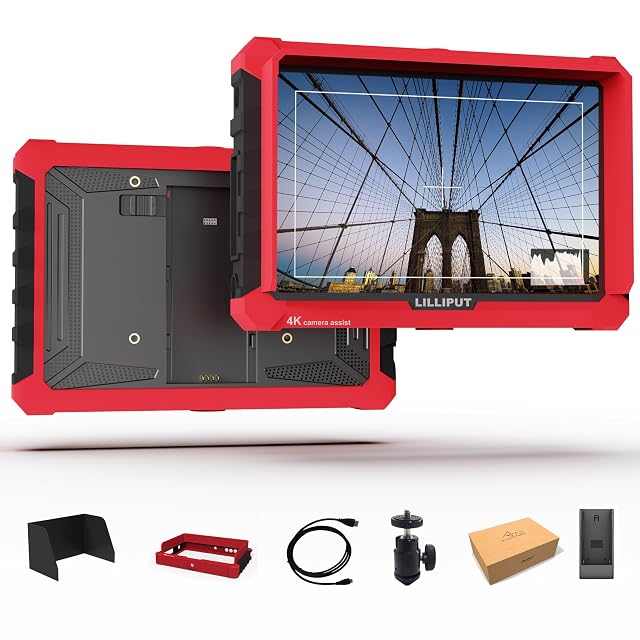
7 inches · 1920 by 1200 native — the only monitor here above 1080 — on an 8-BIT panel, 1000:1, 170° wide viewing angle, full lamination · 500 cd/m² · 4K HDMI in and LOOP-OUT plus 3G-SDI, named in the title · full waveform, oscillogram in RGB/YUV/Y, vectorscope, luminance histogram, peaking focus in ten steps and five colours, audio bars, zebra, single colour, false colour, nine fields, de-squeeze, magnification, auto flip, point-to-point, centre marker, safety marker and crop marker · firmware updates from a SUPPLIED U-DISK · F1 and F2 assignable buttons with a dial · silicone rubber case and integrated sun hood · one-year warranty · batteries NOT included
The only 1920 by 1200 panel on this shelf, with 3G-SDI alongside 4K HDMI and the longest list of monitoring tools here — in a silicone rubber case, for 181 €.
Best for: A set where an SDI cable runs from the camera to the monitor, and where the extra 120 lines and a published bit depth matter more than brightness.