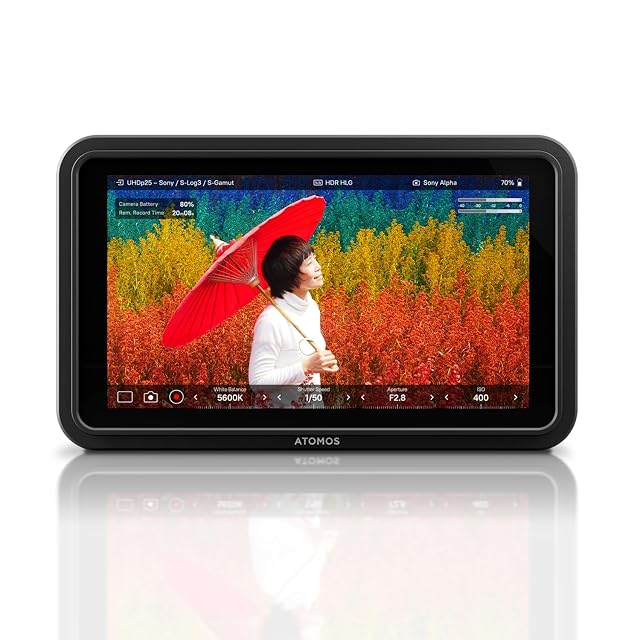
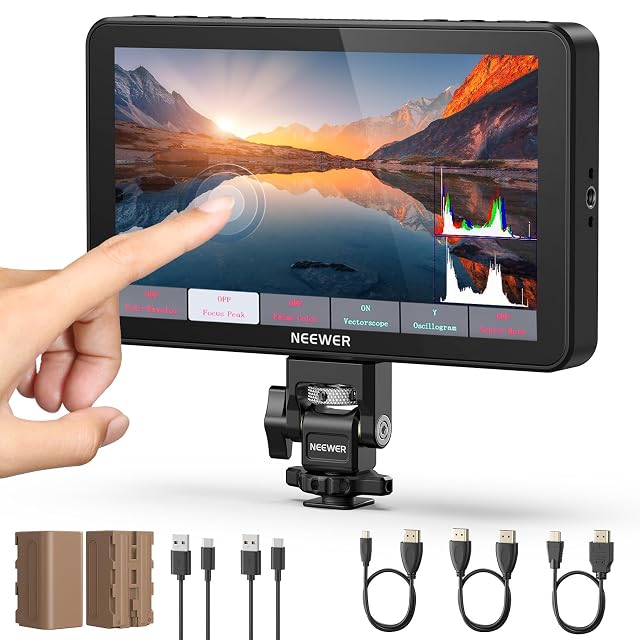
Both are 1920 by 1080. After that they part company: one is a slim panel for a gimbal that runs off a phone power bank and ends the signal chain, the other a full 7-inch monitor that loops the signal onward, carries fifteen lookup tables and publishes its own dimensions and two weights. The gap is 98 € and the question is what the rig has to carry.
F700, 7 inches, 2000 nits, 175 by 107 by 25 mm, 445 g
Size
5.2 inches, IPS, in the first bullet — the smallest on this shelf, tied with the FEELWORLD, and the page names the reason in its fifth bullet: a slim body for gimbals, camera rigs and mobile setups
7 inches, IPS, in the first bullet, with both buttons and touch — and the touch layer can be switched off, which matters on a rig where a sleeve brushes the screen mid-take
Resolution
1920 by 1080 Full HD, in the first bullet, with HDR — and HDR is the word this page carries that the others do not. It means the panel is being driven to show a wider range between the darkest and brightest parts of a log or HLG signal rather than clipping it flat
1920 by 1080, in the first bullet, at 1000:1, 16:9 and 160° ultra-wide viewing
Brightness in nits
1500 nits, in the first bullet, named for daylight and outdoor shoots. Behind the 2000 of the NEEWER and ahead of everything else here — and brightness is what makes HDR visible, since a wider range needs somewhere bright to put the highlights
2000 NITS — the brightest on this shelf by 500 — with manual AND AUTOMATIC backlight adjustment across a 1 to 100 range. The automatic mode is what nothing else here has: the panel reads the ambient light and follows it, which saves both battery and the guesswork of matching a screen to a sky
Inputs and outputs
A 4K HDMI input, in the second bullet. NO LOOP-OUT is mentioned, where the Desview, FEELWORLD, LILLIPUT, VILTROX and NEEWER on this shelf all publish one — so nothing else can be fed from this monitor
4K HDMI loop in and out, and the second bullet publishes the whole format list — 480i through 4096 by 2160 at 24 and 25 Hz, with every frame rate written out. A 3.5 mm headphone socket carries audio; headphones not included
Exposure and focus tools
Waveform, histogram, RGB parade, vectorscope, false colour, zebra, focus peaking, zoom and frame guides, in the fourth bullet, for exposure, colour and focus
False colour, zebras, histogram, oscillogram, full waveform, vectorscope, HDR, single colour, peak focus and an audio bar, in the third bullet, with THREE shortcut keys — F1, F2, F3 — on the top of the body
Lookup table support
Stated in the fourth bullet as LUT support, without a count, a format or a loading method. The 297 € NEEWER here publishes fifteen preinstalled and sixty custom slots by SD card; this page publishes the capability alone
The deepest here: FIFTEEN 3D LUTs preinstalled, and up to SIXTY custom files loadable by SD card, with firmware upgrades the same way. Preinstalled tables mean log footage can be viewed correctly before anyone builds anything
Power
An NP-F L-series battery OR USB-C Power Delivery, in the fifth bullet. The USB-C option is the one nothing else here offers properly: a phone power bank runs the monitor, which on a travel shoot removes the Sony battery and its charger from the bag entirely
NP-F550, 750 or 970, a DC input, Type-C charging, and an 8 V 1.5 A DC OUTPUT that powers the camera as a dummy battery. The fourth bullet does the arithmetic nobody else does: two 4400 mAh NP-F750 cells run 2.4 hours each, 4.8 hours together
Mounting
Not described beyond a slim housing named for gimbals, rigs and mobile setups. No thread count, no shoe, no dimensions and NO WEIGHT — on the monitor whose whole argument is that it is light
Quarter-inch threads on the base AND the side, a cold shoe with 180° adjustment, and BUILT-IN FANS for heat — in the fifth bullet, with 175 by 107 by 25 mm and two weights: 445 g bare, 857 g with two batteries. It is the only monitor on this shelf that publishes a dimension or a weight at all
A tick means one listing published something the other did not, or published
a better figure. It does not mean the product is better, and the column is not
a score out of anything: a maker who says less loses lines here without losing
a comparison. The two verdicts below are where the page is settled.
Which one, for whom
Buy the Atomos Shinobi II, 5.2 inches, 1500 nits, HDR
The Atomos wins on the two things a travelling operator feels: it is the only monitor here that runs from a USB-C power bank, and the only one claiming HDR to put its 1500 nits to work. It ends the signal chain — no loop-out — and publishes neither a weight nor a dimension, on the product whose argument is that it is slim.
Buy the NEEWER F700, 7 inches, 2000 nits, 175 by 107 by 25 mm, 445 g
The NEEWER wins the specification sheet outright: 2000 nits that adjust themselves, a loop-out with every format written down, fifteen lookup tables ready on arrival, two threads, a cold shoe, cooling fans, and the only published dimensions and weights on the shelf. At 857 g with two batteries it is also the one a gimbal will notice.
What people ask before they commit
Does HDR on a monitor change what you shoot?
It changes what you can judge. A log or HLG signal holds a wider range between shadow and highlight than a standard panel can show, so a conventional monitor flattens it and exposure has to be read off a waveform instead of the picture. The Atomos claims HDR and 1500 nits together, which is the pairing that matters: a wide range needs somewhere bright to put the highlights. The NEEWER lists HDR among its tools rather than as a panel property.
How much does a missing loop-out cost?
Nothing at all for a single operator, and everything for a second screen. A loop-out passes the signal onward, so a director’s monitor or a recorder can sit downstream. The NEEWER has one and publishes every format it carries; the Atomos does not mention one. On a gimbal with one person watching, that is no loss — which is exactly the setup the Atomos page describes.
What does USB-C Power Delivery remove from the bag?
A battery type and its charger. Both monitors accept Sony NP-F cells, and the Atomos alone will also run from the phone power bank already in the bag. The NEEWER answers the same question from the other end: it publishes runtimes — 2.4 hours per NP-F750, 4.8 for two — and sends 8 volts back out to power the camera, which is the arrangement that replaces three camera batteries with one big one.
5.2 inches, IPS · 1920 by 1080 Full HD, HDR · 1500 nits · 4K HDMI input · waveform, histogram, RGB parade, vectorscope, false colour, zebra, focus peaking, zoom and frame guides · LUT SUPPORT stated · CAMERA CONTROL over USB-C for Canon, Sony, Panasonic and Z CAM, including record start and stop and selected parameters · NP-F L-series battery or USB-C Power Delivery · slim body named for gimbals and rigs · no loop-out mentioned · no weight or dimensions published
Fifteen hundred nits of HDR on 5.2 inches, with camera control for four named systems and power over USB-C Power Delivery — the dearest monitor on this shelf at 395 €.
Best for: A gimbal or travel rig where HDR monitoring and a power bank matter more than feeding a second screen.
7 inches, IPS touchscreen, buttons AND touch (touch disableable) · 1920 by 1080, 1000:1, 16:9, 160° · 2000 NITS, with manual and AUTOMATIC backlight adjustment from 1 to 100 · 4K HDMI loop in and out, with the full format list published, plus a 3.5 mm headphone socket · false colour, zebras, histogram, oscillogram, full waveform, vectorscope, HDR, single colour, peak focus, audio bar, with F1, F2 and F3 shortcut keys · FIFTEEN preinstalled 3D LUTs and up to SIXTY custom ones by SD card · NP-F550/750/970, DC input, Type-C charging, and an 8 V 1.5 A DC OUTPUT as a dummy battery; two NP-F750 cells give 2.4 h each, 4.8 h together · quarter-inch threads on the base AND the side, a cold shoe, 180° adjustment, BUILT-IN FANS · 175 by 107 by 25 mm · 445 g bare, 857 g with two batteries
Two thousand nits with automatic backlight, fifteen lookup tables preinstalled, built-in cooling fans — and the only monitor here that publishes its dimensions and two weights.
Best for: Long days in changing light on a camera or a rig that can carry 857 g, where log footage has to look right without any setup.
Each amount in a write-up is what the listing showed when that page was written. The figure next to the product is pulled in as you read, and it is the one that counts.