Both are APS-C, and there the listings diverge. One arrives as a kit with two lenses and publishes almost nothing about the body; the other is a body alone that publishes stabilisation, sealing, video modes and a finder. Neither names its own mount, which on a camera page is a strange thing to leave out — and the gap between them is large enough that they are really answering different questions.
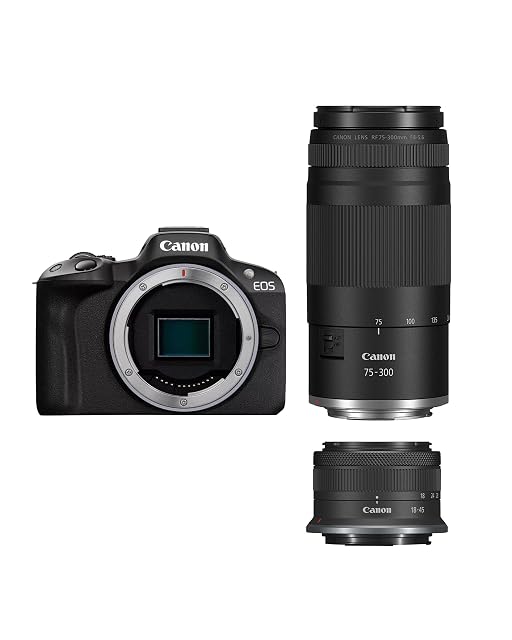
Canon EOS R50 double zoom kit, RF-S 18-45 mm and RF 75-300 mm, 24.2 MP APS-C
APS-C — stated plainly in the first bullet, one of three listings of the four here to name a format rather than a sensor technology
APS-C — stated in the title, and the first bullet adds an Exmor R sensor of 26 MP with a BIONZ XR processor behind it
Resolution
24.2 MP — stated in the first bullet, with 4K 30p UHD video given as oversampled from 6K sensor data
26 MP — stated in the first bullet, alongside a burst capacity given as 11 frames per second
Mount
Not published as a designation — the page names the lenses rather than the bayonet: RF-S 18-45mm f/4.5-7.1 IS STM in the kit contents and RF 75-300mm in the title. The two prefixes are the only indication of what the body accepts
Not published as a designation — the first bullet promises a large choice of Sony APS-C lenses without naming the bayonet, and the box contents list an Abdeckung Objektiv-Anschluss, a mount cover, which confirms a mount exists without naming it
Stabilisation claims and protocol
IS, in the kit lens designation only — the fifth bullet lists an RF-S 18-45mm IS STM, and no bullet claims stabilisation in the body or names a protocol or a stop count for either
Five-axis image stabilisation, stated in the title, with an Active mode named in the third bullet as providing stability in any situation. No stop figure is published and no measurement protocol is named, so the claim is a mechanism rather than a quantity
Viewfinder specification
Not published on the listing — five bullets cover resolution, subject detection, the shooting assistant, handling and box contents, and none names a finder of any kind
An electronic viewfinder, described in the fourth bullet as bright, beside a tilting touchscreen and a front dial. No resolution or magnification is given for it
Card slots
Not published on the listing — the kit contents bullet lists a strap, a charger, a battery and a mains cable, and no card or slot appears among them
Not published on the listing — the box contents run to the body, an NP-FZ100 battery and a mount cover, and no slot or card format appears anywhere on the page
Autofocus modes published
A deep-learning algorithm that detects people, animals and vehicles, stated in the second bullet, with eye detection named in the title and continuous tracking claimed as subjects move. No focus point count is published
A dedicated AI processing unit, stated in the second bullet, which analyses subject pose and switches between subjects; real-time tracking is named, and full-time DMF is offered as an alternative. No focus point count is given
Video modes
4K 30p UHD, stated in the first bullet as oversampled from 6K sensor data — the only video figure on the page, with no other frame rate or codec given
4K at up to 120p in slow motion and 4K 30p in 10-bit 4:2:2 downsampled from 6K, both in the third bullet, with S-Cinetone and S-Log3 profiles and active-mode stabilisation named beside them
Sealing
Not published on the listing — the fourth bullet describes a light design and a comfortable grip, and makes no weather or dust claim
Dust and splash resistant magnesium alloy construction, stated in the fourth bullet as working well in any environment — the only sealing claim made by any of the seven bodies of the four here
A tick means one listing published something the other did not, or published
a better figure. It does not mean the product is better, and the column is not
a score out of anything: a maker who says less loses lines here without losing
a comparison. The two verdicts below are where the page is settled.
Which one, for whom
Buy the Canon EOS R50 double zoom kit, RF-S 18-45 mm and RF 75-300 mm, 24.2 MP APS-C
The Canon wins nothing on this table, and that is partly a fact about the listing rather than the camera: it publishes a sensor, a resolution, one video mode and its subject detection, then spends its remaining bullets on the kit. What it does offer that the Sony does not is two lenses in the box — a wide zoom and a 75-300 mm — which for a first interchangeable-lens camera is the whole proposition.
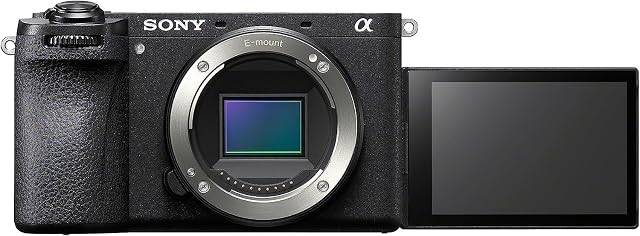
Buy the Sony Alpha 6700 body, 26 MP APS-C Exmor R, five-axis stabilisation
The Sony takes six of the nine lines: more resolution, five-axis stabilisation, a finder, AI-assisted autofocus, 4K to 120p with log profiles, and the only sealing claim among the mirrorless bodies here. It arrives as a body alone, so the lenses are a separate decision and a separate cost.
What people ask before they commit
Why does neither page name its mount?
It is the oddest gap on both listings. The Canon names RF-S and RF lenses in its kit contents, which is the only indication of what the body takes; the Sony promises a large choice of APS-C lenses and lists a mount cover in the box without ever saying what the mount is called. A body and its lenses are the same purchase over ten years, and the bayonet is what ties them together.
Is a kit with two lenses better value than a body alone?
For a first camera, usually. Two zooms covering roughly 18 to 300 mm equivalent is most of what a beginner needs, bought at a price no separate purchase matches. The trade is that kit lenses are slow — the Canon’s is f/4.5-7.1 at the wide end — and that a body-only purchase puts the same money into the camera instead. The Sony’s stabilisation and sealing are what that money bought here.
What does five-axis in-body stabilisation add over a stabilised lens?
It works with every lens, including old manual ones with no electronics at all. A stabilised lens corrects two axes of shake; a sensor that moves in five corrects roll as well, which is what matters for handheld video. Neither page publishes a stop figure or a measurement protocol, so the claim here is a mechanism rather than a quantity — but the mechanism is only on one of the two.
24.2 MP APS-C · two lenses supplied, RF-S 18-45mm f/4.5-7.1 IS STM and RF 75-300mm · 4K 30p oversampled from 6K · deep-learning subject detection · viewfinder, card slots and sealing not published
The only body here that arrives with two lenses, covering 18 to 300 mm between them, and states its sensor format outright while leaving its viewfinder and card provision unwritten.
Best for: A first interchangeable-lens purchase where the two-lens span from wide to 300 mm matters more than the finder or the card count.
26 MP Exmor R APS-C · BIONZ XR · five-axis in-body stabilisation stated · 4K up to 120p · 4K 30p 10-bit 4:2:2 from 6K · 11 fps burst · S-Cinetone and S-Log3 · dust and moisture resistant magnesium alloy · card slots not published
The only body on this shelf that claims stabilisation in the camera rather than in the lens, and the only one that makes a sealing claim at all — sold as a body alone at the top of this family’s price range.
Best for: Video work that needs log profiles and in-body stabilisation, on a body expected to go out in weather with lenses already owned.
Each amount in a write-up is what the listing showed when that page was written. The figure next to the product is pulled in as you read, and it is the one that counts.