A head accepts one plate profile, and everything mounted afterwards inherits it. Manfrotto’s own rectangular plates and the Arca-Swiss dovetail are the two that matter, and a bag standardised on one of them is a bag where any camera fits any support.
Where a comparison needed checking
One head page on this site once described a 1.22 kg head as fourfold the weight of the lightest one on its shelf, against a published 205 g. Twelve hundred and twenty over 205 is six, not four — and the error stood in three separate places before it was caught.
What a head is judged on
Its type, the declared load, the plate standard, the mounting thread, whether the panning base has markings, and how the locks and friction controls feel. A load figure on a head is static: it says what the head holds still, not what it holds while being moved.
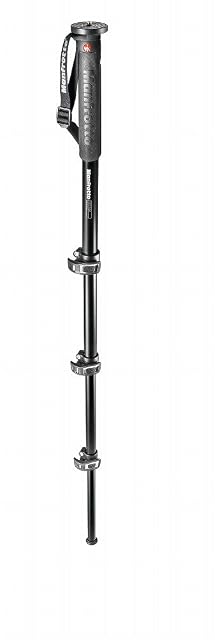
Four sections · D-profile tubes claimed for rigidity and stability · redesigned cold-resistant grip · named for professional work with telephoto lenses · no maximum height published · no folded length published · no lock type named · no declared load published · no foot described · no material named · no thread size published
Eighty euros for a page with five bullets, one number and three adjectives: four sections, D-profile tubes, and no height, load, foot or thread anywhere.
Best for: Someone who already knows this maker’s range and is buying the build rather than the specification.
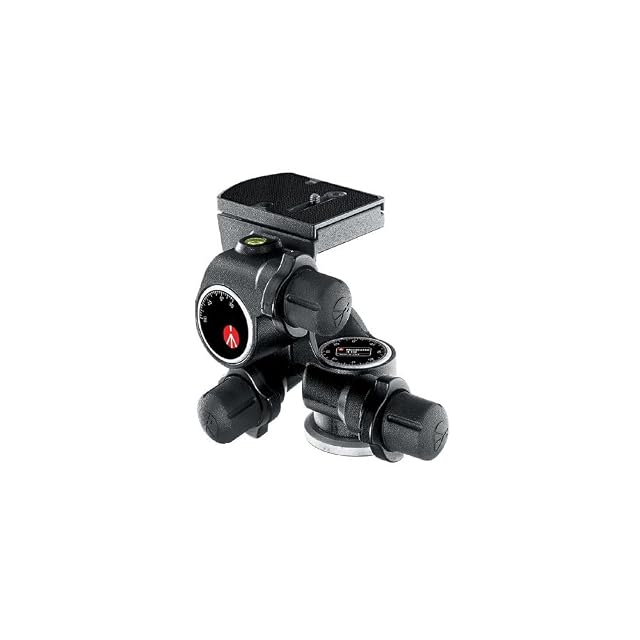
A geared head at 229 € — the only one here adjusted by turning knobs rather than releasing a ball — carrying 5 kg and weighing 1.22 kg, six times the 205 g K&F beside it.
Head type
A geared head, and it is the only one in this catalogue. The first bullet claims extreme precision control in three directions from the gearing and the bubble level. The hub above describes a three-way head as separating the axes so one can be adjusted without disturbing the others; a geared head goes further — each axis is driven by a worm gear, so it moves by fractions of a degree and cannot slump when released
Declared load
5 kg, in the fifth bullet, alongside the weight of 1.22 kg. It is the smallest rating of the three heads here — a third of the NEEWER’s 15 kg — and it is the one figure that sits within reach of the tripods next door, which top out at 6.35 kg
Plate standard
The Manfrotto 410 plate, named in the third bullet as supplied. It is a proprietary profile, which the hub above warns commits every future clamp to the same maker. That is the cost of this head: the plates are not the dovetail most third-party gear is cut for
Mounting thread
Not published. Five bullets describe the gearing, the locking, the plate, the format range and the weight, and no thread size appears — so whether it takes 3/8 inch alone or both is unknown before it arrives
Panning base and markings
Not described as a separate base. The first bullet claims precision in three directions and the gearing implies markings on each axis, but no scale and no independent panning foot is named. On a head sold for precision that is a surprising silence
Locking and friction controls
A locking system named in the second bullet as allowing fast and secure movement between shots. On a geared head the gear itself is the friction — nothing is released and re-caught, which is precisely why architectural and product photographers buy them
Published weight
1.22 kg, in the fifth bullet. It is six times the K&F on this shelf and nearly four times the NEEWER, and it is the honest price of gearing: three worm drives and their housings weigh what they weigh
Amazon reference
B000JLI4Q2 (same reference on 6 Amazon marketplaces)
EAN
0719821156376
Geared adjustment on three axes, the only head in this catalogue that moves by fractions of a degree
Nothing slumps when a control is released, which is what makes a framing repeatable
A proprietary plate profile, which ties every future clamp to one maker
Best for: Architecture, product and copy work on a solid tripod, where a framing has to be adjusted by millimetres and held exactly.
Each amount in a write-up is what the listing showed when that page was written. The figure next to the product is pulled in as you read, and it is the one that counts.