Take-off weight decides which rules apply to you, before anything else · review
GQBVPN mini drone, 1080p on a 90 degree tilt, brushless motors review
The cheapest of the four aircraft here at 31 €, sold on brushless motors and a camera that tilts, with no take-off weight and no flight time published anywhere.
The bottom line Brushless motors and a tilting camera for thirty-one euros is a real proposition, and the page then omits the two figures a buyer needs: how long it flies and what it weighs. Judged on what it publishes, it answers three of the nine things this shelf is compared on.
On the listing
A mini drone with 120 degree wide-angle HD photo and video, transmitting a live view to an app, with a stable hover claimed for beginners; a 1080p camera on a 90 degree adjustable mount, with optical flow positioning; a flip function turning the aircraft through 360 degrees, and one-key launch and landing; three speeds, headless mode and altitude hold; double-folding arms for carrying; and a closing bullet naming children, teenagers and beginners as the intended pilots.
Brushless motors at the bottom of the shelf
The title names them and it is the best thing on the page. Brushed motors are what a thirty-euro aircraft normally carries, and they wear: the brushes are a contact surface that degrades. Brushless motors do not have them, run cooler, and hold against wind better. Over a year of garden flying that is the difference between a working drone and a drawer ornament.
Two figures a pilot needs, and neither is here
No flight time. The other three aircraft on this shelf all publish one, and this page describes altitude hold, headless mode and one-key launch without ever saying how long any of it lasts.
No take-off weight, and no class. In Europe the mass decides which category an aircraft falls into and what a pilot must do before flying it. Two aircraft here publish a figure against that threshold; this one publishes nothing, so the position cannot be read from the page at all.
The camera tilts, it is not stabilised
Ninety degrees of adjustment is a mount set before take-off, not a gimbal correcting in flight. The distinction runs through this whole shelf, and the aircraft one place up publishes a three-axis gimbal for comparison.
What optical flow does, and does not
It holds the aircraft over a patch of ground by reading its texture, which is why the hover is described as stable. It looks down. Nothing on this page claims anything looking outward, so trees and walls remain the pilot’s problem.
Availability
Between 31 € and 34 € on the German, Italian and Spanish Amazon stores when this page was last checked.
Listed in the French Amazon catalogue with nothing on sale against the entry: the camera has a page there and no seller behind it.
Nothing came back from the American and British Amazon stores at all, so the button for those countries runs a search instead of opening an entry that is not there.
Everything in this section is the figure Keepa carried on the day of the last update to this page. Availability and prices shift without notice.
Prices quoted in this text were read on 13 September 2026. The live price is at the top of the page.
What it does well, and what it gives up
Strengths
Brushless motors at 31 €, stated in the title, where that is normally a dearer aircraft’s feature
The camera tilts through 90 degrees, so the view can be set down rather than fixed forward
Optical flow positioning and altitude hold are both named, which is what lets a beginner let go of the sticks
Compromises
No flight time anywhere on the page, where the three other aircraft here all publish one
Neither a take-off weight nor a class, so nothing about the registration position can be read
No transmission range in metres, and optical flow is not obstacle detection
Specifications
Take-off weight and class
Neither is published on the listing — six bullets cover the wide angle, the camera, the flip, the flight modes, the folding design and beginner friendliness, and no mass and no European class marking appear anywhere. Without either figure the registration position cannot be read from this page, and two of the four aircraft here do publish one
Sensor
Not published on the listing — the second bullet gives a 1080p HD camera on a 90 degree adjustable mount, and never a sensor type or size
Video modes
1080p, stated in the second bullet. Live transmission to an app is named in the first. No frame rate is published
Flight time claimed
Not published on the listing — the most striking absence on the page, given that the three other aircraft here all quote a figure. Altitude hold is described without any statement of how long it can be held
Transmission range
Not published in metres — the first bullet describes real-time image transmission to an app without stating how far it reaches
Obstacle sensing directions
Not published on the listing — optical flow positioning is named in the second and fourth bullets, which holds position over ground texture rather than detecting obstacles. They are different capabilities
Gimbal axes
None — the camera is described as adjustable through 90 degrees, which is a tilt mount set before flight and not a stabilised gimbal. No axis count appears
Folded size
Not published in millimetres — the fifth bullet describes double-folding arms and calls the size just right for carrying, without a measurement
Amazon reference
B0HBPCPL49 (same reference on 4 Amazon marketplaces)
EAN
0717201806019
What people ask before they commit
What do brushless motors change on a cheap drone?
They have no contact brushes to wear, so they run cooler, quieter and longer than the brushed motors usual at this price, and they hold power better against wind. The title names them and the fourth bullet repeats the point. It is the one specification here that a buyer will feel over months rather than minutes.
Is optical flow the same as obstacle avoidance?
No, and the distinction matters. Optical flow reads the texture of the ground through a downward camera to hold position without drifting; obstacle avoidance looks outward for things to hit. This listing names the first and never claims the second, which is correct for the price — and it means the aircraft will sit still in the air and still fly into a wall.
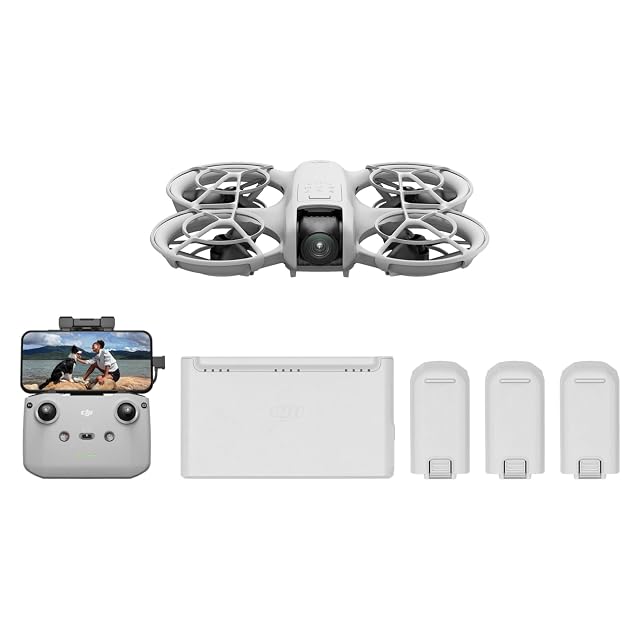
135 g published · class C0 stated, flyable in A1/A3 without examination · 4K UHD · palm launch, voice control, app or RC-N3 controller · eight QuickShot modes, Smart Follow · wind resistance level 4 · integrated propeller guards · three batteries in the combo · no gimbal axis count published
The only aircraft of the four here to publish both halves of the regulatory claim — 135 g and class C0 — and the only one that launches from the palm with no controller at all.
Best for: Flying without paperwork and without a controller — a barbecue, a walk, a family picnic — where 135 g and class C0 are the specification that matters.
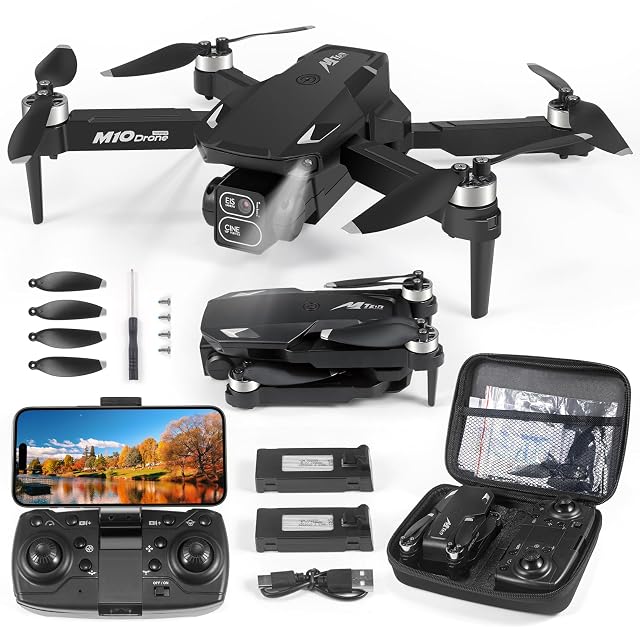
No take-off weight published · no class stated · 4K claimed · motorised 90 degree camera mount · two cameras, front and downward, switchable · brushless motors · two batteries, flight time not stated per charge · obstacle avoidance claimed without directions · carry case · German market only
A folding 4K aircraft with a motorised camera mount and a second downward camera, whose obstacle avoidance is claimed in a feature list and never described, and which no store outside Germany was offering.
Best for: Someone in Germany who wants a motorised tilt and a downward camera for fifty euros and will discover the flight time by flying it.
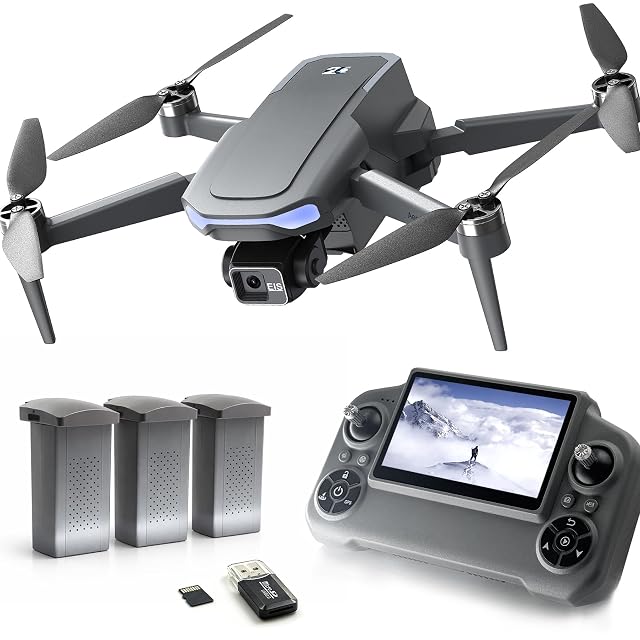
Under 249 g stated as a registration threshold, not a measurement · no class marking published · 4K · three-axis gimbal · 3000 m transmission stated · 4.5 inch screen on the controller · 90 minutes TOTAL across three batteries · GPS, auto return, follow me · brushless motors · folding
The only aircraft under two hundred euros here with a three-axis gimbal and a screen built into its controller, whose 90 minutes is three batteries added together rather than one flight.
Best for: A first serious aerial camera, where a real gimbal and a controller screen matter more than obstacle sensors.