Take-off weight decides which rules apply to you, before anything else · review
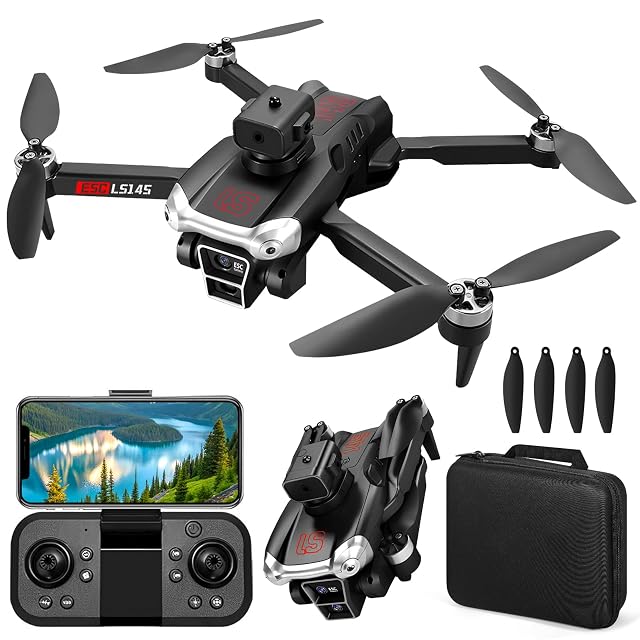
Bfhdbdt P8, 4K on a motorised 90 degree mount, dual cameras, two batteries review
A folding 4K aircraft with a motorised camera mount and a second downward camera, whose obstacle avoidance is claimed in a feature list and never described, and which no store outside Germany was offering.
The bottom line The motorised mount and the second camera are real and unusual at fifty euros. Against them, the title advertises long flight time and obstacle avoidance while the page publishes neither a minute count nor a sensing direction, and only the German store had it.
On the listing
An HD 4K camera on a motorised 90 degree adjustable mount; a switchable pair of cameras, one facing forward and one looking down for optical flow positioning; brushless motors credited with stability, efficiency, wind resistance and longer flight than brushed equivalents; a feature list naming automatic hover, altitude hold, FPV, one-key launch and landing, one-key rotation and trajectory flight; and a folding design with a durable carry case for travel.
Two cameras, and one of them is not for pictures
Forward and downward, switchable. The downward camera is how the aircraft holds position: it reads ground texture and corrects drift, which is what makes a hover look effortless. The forward camera is the one that films.
Selling both in one bullet is honest enough, and it is worth separating them, because the downward camera is also the reason this aircraft sits still — not a stabilised gimbal, which it does not have.
The title makes two claims the page never supports
Long flight time, with no minutes anywhere across five bullets. And obstacle avoidance, with no directions and no sensing method. Both are the sort of phrase that reads as a specification and turns out to be a word.
The second matters more. Avoidance that looks only forward leaves a pilot to worry about everything else, and a buyer who assumes otherwise finds out expensively. This page gives nothing to work from.
The motorised mount is the genuine advantage
Ninety degrees, changed in the air rather than on the ground. The aircraft below it on this shelf has the same range of tilt and no motor, so the angle is chosen before take-off and lived with.
One store
The German catalogue carried it the day this page was checked and no other did. That is reported in the Availability section below exactly as it was found.
Availability
About 50 € on the German Amazon store when this page was last checked.
Nothing came back from the American, British, French, Italian and Spanish Amazon stores at all, so the button for those countries runs a search instead of opening an entry that is not there.
Everything in this section is the figure Keepa carried on the day of the last update to this page. Availability and prices shift without notice.
Prices quoted in this text were read on 13 September 2026. The live price is at the top of the page.
What it does well, and what it gives up
Strengths
The camera mount is motorised, so the tilt can be changed in flight rather than set on the ground
Two cameras, forward and downward, switchable in flight, which the other aircraft at this price do not offer
A carry case is included, named in the fifth bullet
Compromises
Obstacle avoidance appears in the title and is never described — no directions, no sensing method
No flight time figure at all, on a page whose title advertises long flight time
Listed in the German catalogue only, with no offer in any other store the day this page was checked
Specifications
Take-off weight and class
Neither is published on the listing — five bullets cover the camera, the dual-camera switch, the motors, the feature list and the carry case, with no mass and no class marking anywhere. The registration position therefore cannot be read from this page at all
Sensor
Not published on the listing — the first bullet gives an HD 4K camera on a motorised 90 degree mount and names no sensor
Video modes
4K, stated in the title and the first bullet, with FPV live transmission over WiFi named in the title. No frame rate is published for it
Flight time claimed
Not published as a figure — the title says two batteries and long flight time, and the third bullet credits brushless motors with longer flight than brushed ones, without a single minute count anywhere. It is the only aircraft here to omit the number entirely while advertising the quality
Transmission range
Not published in metres — FPV over WiFi is named in the title and the third bullet mentions control range without stating it
Obstacle sensing directions
Claimed without directions — the title lists Hindernisvermeidung, obstacle avoidance, and the fourth bullet lists functions without naming how many directions are sensed or by what means. The downward camera named in the second bullet is optical flow, which is positioning rather than avoidance
Gimbal axes
None — the mount is described as motorised through 90 degrees, which is remote tilt rather than stabilisation. No axis count appears
Folded size
Not published in millimetres — the fifth bullet describes a folding design with a durable carry case and gives no measurement
Amazon reference
B0H1592G6K (same reference on 1 Amazon marketplace)
EAN
0739719774116
What people ask before they commit
Can obstacle avoidance be trusted when the page does not describe it?
It cannot be judged from this listing. Real avoidance names its directions — forward, backward, downward — and its method, because a sensor that looks forward does nothing about a branch to the side. Here the phrase sits in a title and a feature list with neither. The downward camera the second bullet describes is optical flow, which holds position over ground and is not the same capability.
Why does a motorised mount matter more than a fixed tilt?
Because the angle can be changed while the aircraft is in the air. A fixed 90 degree mount is set before take-off and committed to for the flight; a motorised one lets a pilot look down at a subject and then out at a horizon in the same pass. It is not stabilisation — nothing corrects for the aircraft rocking — but it is the difference between one usable angle and several.
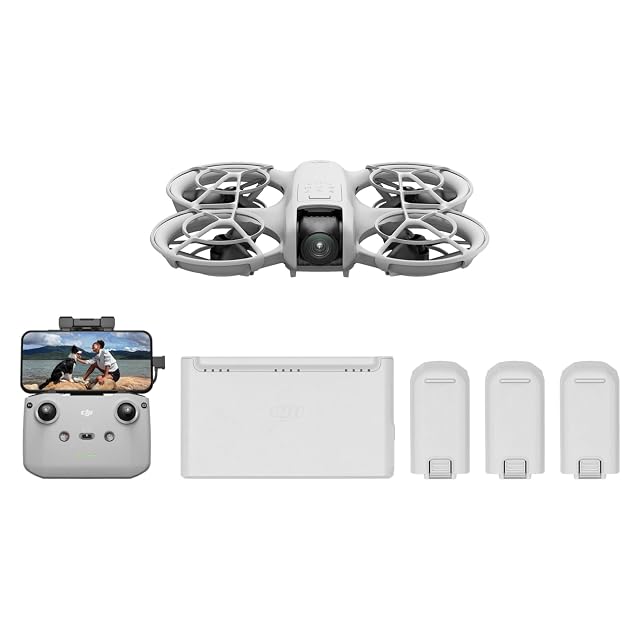
135 g published · class C0 stated, flyable in A1/A3 without examination · 4K UHD · palm launch, voice control, app or RC-N3 controller · eight QuickShot modes, Smart Follow · wind resistance level 4 · integrated propeller guards · three batteries in the combo · no gimbal axis count published
The only aircraft of the four here to publish both halves of the regulatory claim — 135 g and class C0 — and the only one that launches from the palm with no controller at all.
Best for: Flying without paperwork and without a controller — a barbecue, a walk, a family picnic — where 135 g and class C0 are the specification that matters.
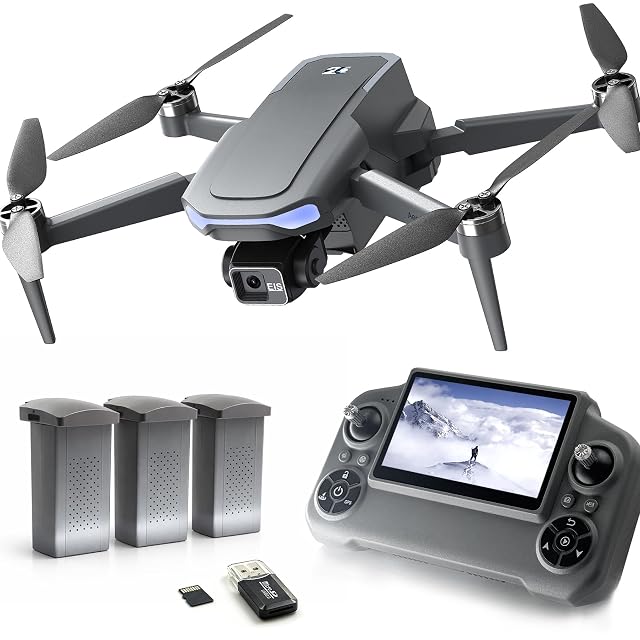
Under 249 g stated as a registration threshold, not a measurement · no class marking published · 4K · three-axis gimbal · 3000 m transmission stated · 4.5 inch screen on the controller · 90 minutes TOTAL across three batteries · GPS, auto return, follow me · brushless motors · folding
The only aircraft under two hundred euros here with a three-axis gimbal and a screen built into its controller, whose 90 minutes is three batteries added together rather than one flight.
Best for: A first serious aerial camera, where a real gimbal and a controller screen matter more than obstacle sensors.
No take-off weight published · no class stated · 1080p · 120 degree wide angle · camera tilts through 90 degrees · brushless motors · optical flow positioning · altitude hold, headless mode, one-key launch · folding arms · no flight time published
The cheapest of the four aircraft here at 31 €, sold on brushless motors and a camera that tilts, with no take-off weight and no flight time published anywhere.
Best for: A first flight indoors or in a garden, for a child or a beginner, where the brushless motors are the part that lasts.