Skip to content

A second lens after the kit: and what it drags with it

A second lens is never only a lens. It arrives with a filter thread that either matches what you already own or starts a second set, and with a front element that wants a hood. This guide is ordered by what the lens is for — reach, then width, then close focus, then a fast prime — and closes with the two accessories that the choice imposes. Every thread diameter cited is published on the listing it comes from.

A second lens is never only a lens

It arrives with a filter thread that either matches what is already owned or starts a second set, and with a front element that wants a hood. Both are small purchases, and both are decided by the lens rather than chosen freely — which is why they close this list rather than opening it.

Reach, width, close focus, speed

Those are the four directions a kit zoom does not go, and each is a different lens. Buying for the complaint you actually have beats buying to complete a list: if frames are blurred indoors that is speed, if subjects are small that is reach, and no amount of the other one fixes it.

The thread on the front decides the next three purchases

Filters, hoods, close-up lenses and step rings all bolt to that diameter. Buying for the largest thread in the bag and stepping down with rings costs a few euros; buying one set per diameter costs the price of the filters again.

Eighty-nine euros to eight hundred and eighteen

That is the span of the lenses on this list, and the gap is not sharpness. It is aperture, build, weather sealing and autofocus — and a manual prime at the bottom of that range out-resolves a kit zoom at any price.

What arrives with it, whether or not you buy it

A hood shades the front element from light that was never in the frame and takes the knock that would otherwise reach the glass. It is the cheapest improvement to contrast there is, and the one most often left in the box.

What goes in the bag, and why

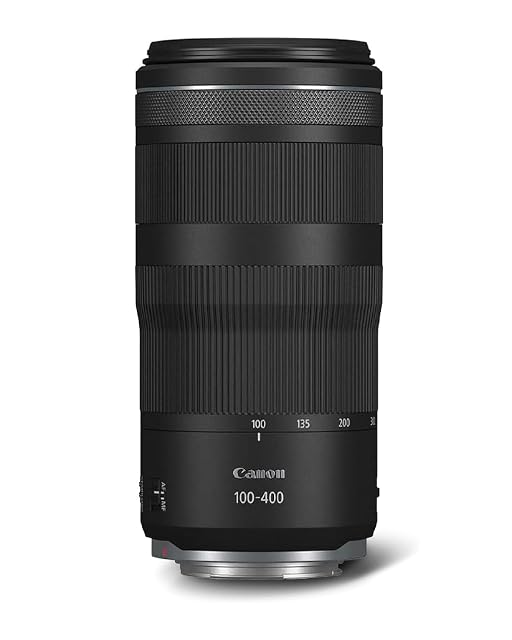
  1. Canon RF 100-400mm F5.6-8 IS USM, 635 g

    RF mount · 100-400mm · F5.6 at the short end, F8 at the long one · 5.5 stops of stabilisation claimed · UD glass · 635 g · 164.7mm long · no tripod collar published · no minimum focus published · no filter thread published · no sealing claimed

    The only lens on this shelf that publishes its weight and its length — 635 g and 164.7mm for 400mm of reach — with 5.5 stops of stabilisation claimed, and a page that names two different autofocus motors in two different places.

    Best for: Daylight sport and wildlife on an EOS R body, carried rather than mounted, where 635 g and 5.5 stops matter more than the last stop of aperture.

    ≈ $699 / £669 / 659 €
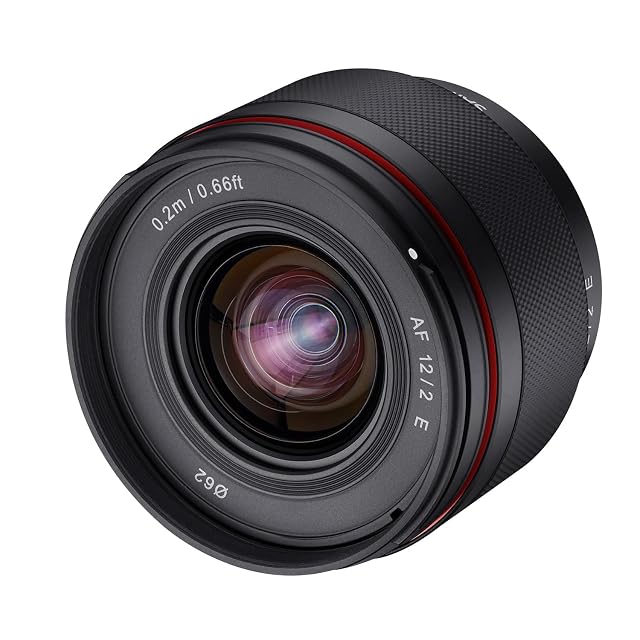
  2. Samyang AF 12mm F2.0 E, 213 g, 62mm thread

    Sony E mount · APS-C · 12mm · F2.0, closing to F22 · 99.1 degree angle of view · 62mm filter thread · minimum focus 19 cm · 12 elements in 10 groups · UMC coating · weather protection claimed · 213 g · 59mm long · detachable hood supplied

    The best-documented page of the five here: 213 g, 62mm of thread, 19 cm of close focus, 99.1 degrees, twelve elements in ten groups and a weather-protection claim, for 283 €.

    Best for: Astrophotography and interiors on a Sony APS-C body, for someone who wants an ultra wide that autofocuses and whose filters cost what filters normally cost.

    ≈ $430 / £256 / 283 €

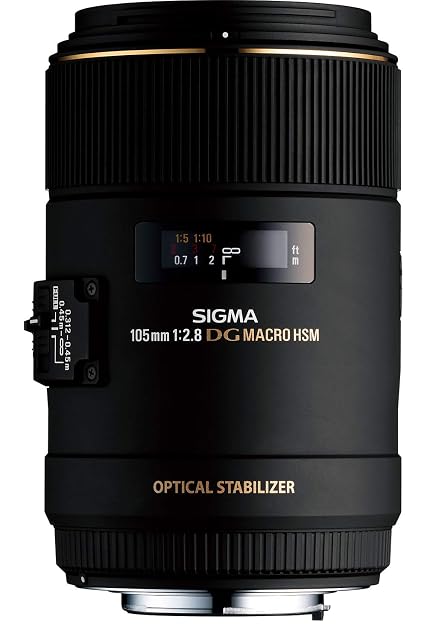
  3. Sigma 105mm F2.8 EX Macro DG OS HSM for Canon EF

    Canon EF mount · full frame, from the DG designation · 105mm · F2.8 · 1:1 magnification · Hyper Sonic Motor · optical stabilisation in the product name only, no figure published · no working distance published · no internal focus stated · no filter thread published · no weight published

    A 1:1 macro at 105mm whose page states the ratio and then four adjectives — with an optical stabiliser announced in the product name and described in none of the five bullets.

    Best for: Life-size work on a Canon EF body at the longest focal length on this shelf, for a buyer who will find the specification somewhere other than the listing.

    ≈ 430 €

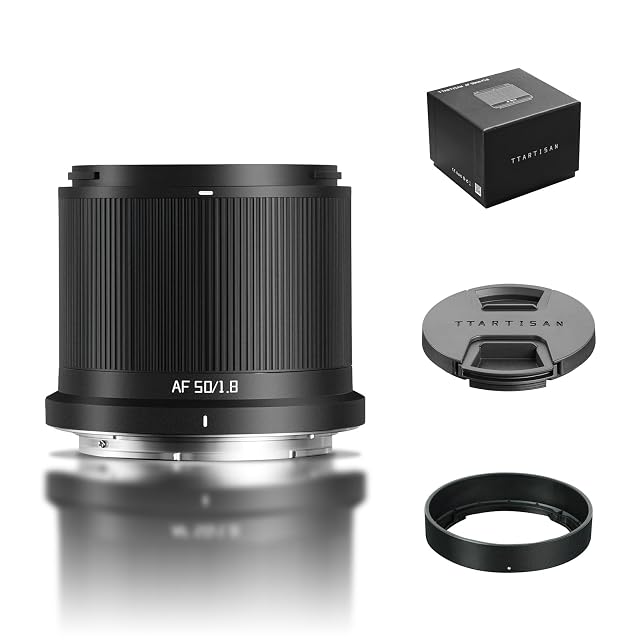
  4. TTARTISAN AF 50mm F1.8 Neo E, 156 g, no focus ring

    Sony E mount · full frame · 50mm · F1.8 · STM drive with eye and subject autofocus · no focus ring fitted · minimum focus 0.48 m · 156 g · glass-fibre reinforced body · 45 degree angle of view · no blade count published · no filter thread published · no sealing claimed

    The cheapest lens of the eight here at 99 €, weighing 156 g, focusing by motor only — the fourth bullet states there is no focus ring at all, which is a design decision rather than an omission.

    Best for: A first prime on a full-frame E-mount body, for someone who wants the camera to do the focusing and the lens to weigh nothing.

    ≈ £89 / 99 €

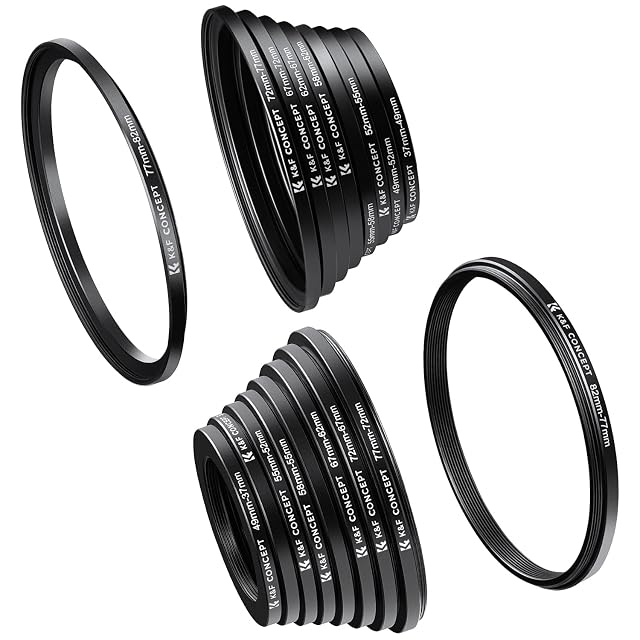
  5. K&F CONCEPT Eighteen rings, nine up and nine down

    JOINS FILTER THREADS, NOT MOUNTS: eighteen rings · NINE STEP-UP, 37-49, 49-52, 52-55, 55-58, 58-62, 62-67, 67-72, 72-77 and 77-82 mm · NINE STEP-DOWN, 49-37, 52-49, 58-55, 55-52, 62-58, 67-62, 72-67, 77-72 and 82-77 mm · no electronic contacts · no function claimed beyond fitting · no optical element · no tripod foot · no aperture ring · described as extremely robust and light, with no material named

    Eighteen rings for 23 €, nine up and nine down — the only set on this shelf that can fit a smaller filter to a larger lens, with the vignetting that implies.

    Best for: A bag where a filter is sometimes larger than the lens and sometimes smaller — a compact lens borrowing a big filter one day, a big lens borrowing a small one the next.

    ≈ $28 / £22 / 23 €

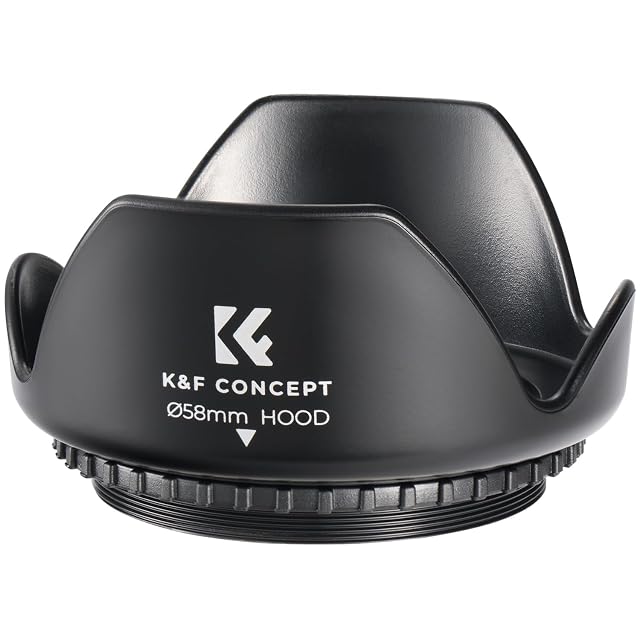
  6. K&F CONCEPT 58 mm petal, screw mount, matt interior

    SHAPE: PETAL — Blume, flower — stated in the title · LENSES: universal for any 58 mm thread, naming Canon, Nikon, Sony, Pentax, Olympus and Fuji, with no individual lens named · SCREW MOUNTING, in the second bullet, described as more secure · FILTER ACCESS REFUSED: the page states it CANNOT be mounted together with a filter · reversibility not mentioned · material not named · MATT INTERIOR, named in the fifth bullet as limiting stray light · TWO WARNINGS FROM THE MAKER: not suitable for wide-angle work, and it vignettes at 25 mm or less · the first bullet explains where the thread size is printed

    A petal hood with a matt interior for 8 € — and a page that tells you it vignettes below 25 mm and will not take a filter underneath.

    Best for: A 58 mm lens at 25 mm or longer, used without a filter, where a matt-lined petal hood for 8 € is the point.

    ≈ $9 / £9 / 8 €

What people ask before they commit

How do I avoid buying filters twice?

Buy for the largest thread in the bag and step down with rings. A step-up ring costs a few euros and sits slightly further forward, which can vignette on a very wide lens — the close-up shelf on this site names 35 mm as the floor below which that starts to matter. One set of large filters plus rings beats three sets of small ones.

Is a prime worth it when the kit zoom covers the same length?

For the aperture, and for what it teaches. A prime that opens to f/1.8 gathers roughly eight times the light of a kit zoom at f/5.6, which is the difference between a usable indoor frame and a blurred one. It also stops you zooming, which is how most people discover which focal length they actually like.

Does a hood matter more than a protective filter?

For the image, yes. A hood stops light that was never part of the picture from entering the lens and lowering contrast, and it takes the knock that would otherwise reach the front element. A filter adds two glass surfaces in front of everything — which is worth it on a beach and a downgrade in a studio.

Each amount in a write-up is what the listing showed when that page was written. The figure next to the product is pulled in as you read, and it is the one that counts.

The tool we use ourselves

Settled on a lens? Now buy it at the right price.

Bodies, lenses and lighting are marked down almost continuously, and a struck-through figure says nothing by itself about what the same reference was actually asking a month ago. UniverTrack holds the week-by-week record of every retailer, so a reduction is measured against a price that genuinely stood rather than one written for the banner — and it says when the moment to buy has really arrived.

Real price historyBuy-now alertsAI buying assistant
Try free for 14 days →
No commitment · Cancel in one click · 5 languages