One focal length, and usually the widest aperture the money buys · review
TTARTISAN AF 50mm F1.8 Neo E, 156 g, no focus ring review
The cheapest lens of the eight here at 99 €, weighing 156 g, focusing by motor only — the fourth bullet states there is no focus ring at all, which is a design decision rather than an omission.
The bottom line Ninety-nine euros for 156 g with eye autofocus is the most that has been asked of a price in this catalogue, and the page is honest about what pays for it: no focus ring, no blade count, no thread, no seal. As a first prime that lives in a pocket it answers four of the nine lines here and gets the important ones right.
On the listing
Five bullets, all written in the second person. A light design at 156 g in glass-fibre reinforced material, described as sitting in a pocket or a hand all day and suited to travellers catching spontaneous street moments; a simple design in which the STM drive locks onto eyes and objects instantly, with no focus ring and no learning curve; an invitation to customise the barrel with stickers, 3D-printed covers or individual colours; a bokeh bullet giving F1.8, a 0.48 m close focus and eye autofocus holding the subject sharp; and a closing bullet on the natural 45 degree angle that mirrors human vision.
A hundred and fifty-six grams, and no focus ring
Both facts come from the same design. Take out the manual focus mechanism and the barrel that houses it, build the shell in reinforced glass fibre, and 156 g is what is left. The second bullet does not hide the consequence, it leads with it: the lens is aimed, and the motor does everything else.
Forty-eight centimetres, published
Half this shelf publishes no close-focus distance at all. This page gives 0.48 m in the middle of a bullet about background blur, which is the right place for it — at that distance and F1.8 on a 50mm lens, the background is well gone.
Stickers, and what that says about the buyer
The third bullet asks to be decorated. A lens that invites 3D-printed covers is a lens understood as an accessory rather than an heirloom, and at 99 € for 156 g that reading is coherent all the way through the page.
The four lines it does not answer
No blade count. The bokeh is described at length and the aperture that shapes it is never counted.
No thread, no seal, no minimum aperture. Three of the nine things this shelf compares are simply absent, on a page that is otherwise unusually clear about what it is.
Availability
About 99 € on the German, French, Italian and Spanish Amazon stores when this page was last checked.
The British Amazon store carry it too, priced in local currency. Those amounts are deliberately absent from the range above, which reads euro stores only.
Listed in the American Amazon catalogue with nothing on sale against the entry: the camera has a page there and no seller behind it.
Everything in this section is the figure Keepa carried on the day of the last update to this page. Availability and prices shift without notice.
Prices quoted in this text were read on 13 September 2026. The live price is at the top of the page.
What it does well, and what it gives up
Strengths
156 g and 99 €, the cheapest lens of the eight here
Eye and subject autofocus on an STM drive, at a price where manual focus is the norm
A minimum focus of 0.48 m published, where most of this shelf gives none
Compromises
No focus ring at all, so focus cannot be taken over by hand when the motor chooses wrongly
No blade count, no filter thread and no sealing claim
The 45 degree angle holds on full frame only, and the page never addresses APS-C bodies
Specifications
Focal length
50mm, fixed, in the title. The fifth bullet gives what it produces: a natural 45 degree angle said to mirror human vision, on the full-frame format named in the same title
Format
Full frame, stated in the title and repeated in the third and fourth bullets. On a full-frame body the 45 degree figure holds; on an APS-C body the same lens frames considerably tighter, and the page does not mention that case
Maximum aperture
F1.8, in the title. The fourth bullet describes what it does — silky bokeh, pet hair and flower veins standing out while cluttered backgrounds disappear — and no minimum aperture is published
Blade count and shape
Not published on the listing. Five bullets describe the weight, the focusing, the customisation, the bokeh and the angle of view, and none of them counts the blades or says whether they are rounded
Autofocus motor
STM, named in the second bullet, with eye and subject detection. The same bullet then states the unusual part: there is no focus ring, and no learning curve — the lens is aimed and the motor does the rest
Minimum focus
0.48 m, published in the fourth bullet alongside the bokeh claim. Just under half a metre on a 50mm lens is ordinary rather than close, and it is a published figure, which on this shelf is not ordinary at all
Filter thread
Not published in millimetres. The third bullet describes 3D-printed lens covers and custom colours as things that can be added to the barrel, and no diameter appears anywhere
Sealing
Not claimed. The body is described as glass-fibre reinforced, which is a material statement, and nothing on the page mentions dust or moisture
Weight
156 g, published in the first bullet, which adds that the material feels smooth and that the lens sits in a pocket or a hand all day. One of only three weights published here, at 156 g
Amazon reference
B0GWZRHH1X (same reference on 6 Amazon marketplaces)
EAN
0744963279249
What people ask before they commit
A lens with no focus ring — is that a fault?
It is a decision, and the second bullet presents it as one: no ring, no learning curve, point and shoot. The consequence is real. When the eye detection locks onto the wrong subject, or in a scene with too little contrast for the motor to work with, there is no manual override. For most photographs that never arises; for the few where it does, nothing can be done from the lens.
What does the 45 degree angle mean here?
It is the diagonal field of view on the full-frame format the title names, and the fifth bullet compares it to natural human vision. Fifty millimetres on full frame has always been the focal length that neither compresses nor stretches a scene, which is why it is the traditional first prime. On a smaller sensor the same lens would frame much tighter, and the page does not cover that.
Why does the listing talk about stickers and 3D-printed covers?
The third bullet invites them explicitly, calling the lens a wearable piece of art. It is an unusual pitch, and it tells you who the lens was built for: someone for whom 156 g and a 99 € price make the lens an accessory to be personalised rather than an instrument to be preserved. It is also consistent with the glass-fibre body rather than a metal one.
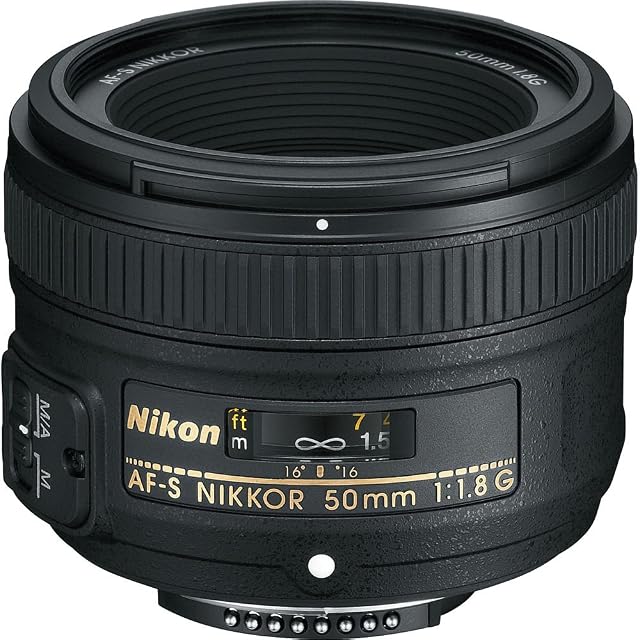
Nikon F mount · FX format, framing as 75mm on a DX body · 50mm · f/1.8 · Silent Wave Motor · two focus modes, autofocus and manual · aspherical element · 58mm filter thread · no blade count published · no minimum focus published · no sealing claimed · no weight published
The classic normal prime on the F mount at 219 €, publishing a 58mm thread, a Silent Wave Motor and its DX framing — on a page that prints the same five bullets twice over.
Best for: A normal prime on an FX body, or a short portrait lens on a DX one, where a motor in the lens and a cheap thread matter as much as the glass.
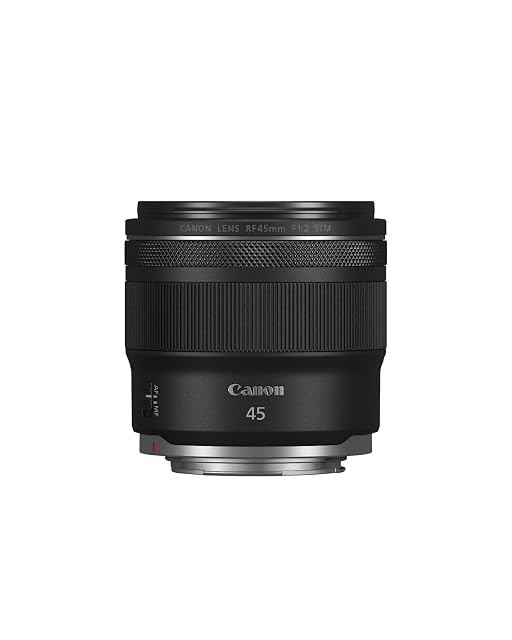
RF mount · 45mm · F1.2 · STM motor · configurable control ring · stated as weighing less than 400 g, which is a ceiling rather than a measurement · no blade count published · no minimum focus published · no filter thread published · no sealing claimed
The widest aperture in this entire lot at F1.2 for 439 €, in a barrel the page says weighs less than 400 g — a ceiling rather than a figure — with no blade count, no thread and no close-focus distance published.
Best for: Street portraits on an EOS R body where F1.2 is the entire point, and the control ring replaces the settings a spare hand would otherwise reach for.
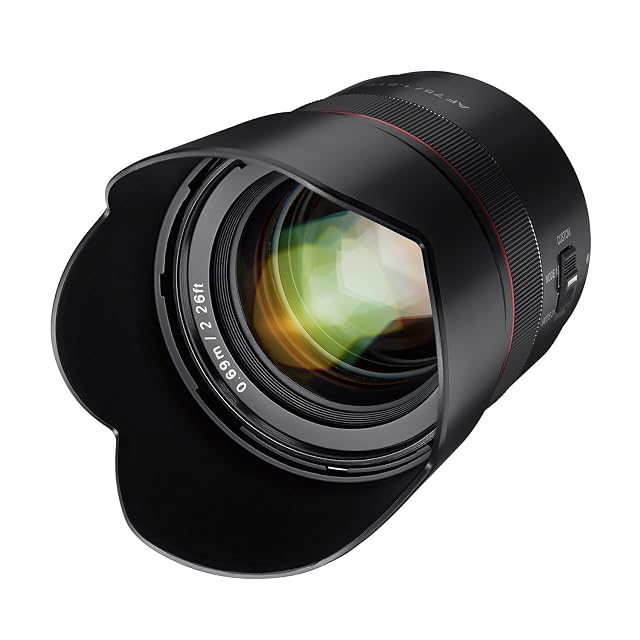
Sony E mount · full frame, and APS-C · 75mm · F1.8, closing to F22 · 9 aperture blades · LSTM autofocus, under 0.2 seconds and 23 dB · minimum focus 69 cm · 58mm filter thread · 230 g · 69mm long · 10 elements in 9 groups, 3 ED and 2 HR · angles of view 32.9 degrees on full frame and 21.9 on APS-C · no sealing claimed
Eight of the nine lines this shelf compares, answered with figures: 230 g, nine blades, 58mm of thread, 69 cm of close focus, and an autofocus timed at under 0.2 seconds and measured at 23 decibels.
Best for: Portraits on a Sony full-frame body where the lens has to stay light, and video where 23 decibels of focusing noise is the specification that matters.