One focal length, and usually the widest aperture the money buys · review
Nikon AF-S NIKKOR 50mm f/1.8G, 58mm thread review
The classic normal prime on the F mount at 219 €, publishing a 58mm thread, a Silent Wave Motor and its DX framing — on a page that prints the same five bullets twice over.
The bottom line A thread in the title, a motor in the lens, manual override and both framings published make this the most practical page on the shelf, and the price sits in the middle at 219 € in Germany, 194 € in France and 245 € in Italy. The listing repeats itself word for word and never gives a close-focus distance, a blade count or a weight.
On the listing
Five bullets, and then the same five again. A 50mm standard lens for the FX format, with the angle of view on a DX-format Nikon reflex corresponding to 75mm in 35mm terms; a high speed of 1:1,8, called ideal for low light and portraits; an aspherical element credited with outstanding image quality; a Silent Wave Motor for fast, quiet autofocus; and two focus modes, autofocus and manual, on an especially light and compact body. The second set differs from the first only in punctuation.
Five bullets, printed twice
The page carries ten entries and contains five facts. It is a catalogue artefact rather than anything about the lens, and the useful consequence is small: nothing is added by the repetition, and nothing should be read into the doubled emphasis on lightness.
Fifty-eight millimetres, in the title
One of four filter diameters published among the eight here, and the second cheapest. For a lens bought as a first prime, knowing before purchase that a polariser costs very little is worth more than another optical adjective.
FX glass and what DX does to it
The same lens is two different tools. On full frame it is the normal lens that neither compresses nor stretches; on a DX body it frames like a 75mm and becomes a portrait lens that needs a step backwards. The first bullet states both cases, which most of this shelf leaves the buyer to work out.
A motor in the lens, and a ring that still works
The Silent Wave Motor makes this lens autofocus on bodies that have no motor of their own, and the fifth bullet confirms both focus modes. The cheapest lens on this shelf has no focus ring at all; this one keeps the option.
What the repetition never gets round to
No minimum focus distance, no magnification ratio, no blade count, no weight, no sealing claim. Ten bullets, and five of the nine lines this shelf compares stay blank.
Availability
Between 194 € and 245 € on the German, French, Italian and Spanish Amazon stores when this page was last checked.
The American and British Amazon stores carry it too, priced in local currency. Those amounts are deliberately absent from the range above, which reads euro stores only.
Everything in this section is the figure Keepa carried on the day of the last update to this page. Availability and prices shift without notice.
Prices quoted in this text were read on 13 September 2026. The live price is at the top of the page.
What it does well, and what it gives up
Strengths
A 58mm filter thread published in the title, an ordinary and cheap size
A Silent Wave Motor with both autofocus and manual modes, so focus can always be taken over by hand
Both framings given: 50mm on FX, and the equivalent of 75mm on a DX body
Compromises
All five bullets are printed twice on the same page, which is a listing fault rather than a lens one
No minimum focus distance and no magnification ratio
No blade count, no weight and no sealing claim
Specifications
Focal length
50mm, fixed, in the title and in the first bullet, which adds what it becomes on the smaller format: the angle of view on a DX-format Nikon reflex corresponds to 75mm in 35mm terms. Both framings are published, which is what this shelf needs and rarely gets
Format
FX, Nikon’s full-frame designation, stated in the first bullet. The same bullet covers the DX case explicitly rather than leaving a buyer to work it out, which makes this one of only three pages on this shelf to address both formats
Maximum aperture
f/1.8, in the second bullet, written in the ratio form 1:1,8 and credited with low-light shooting and portraiture. No minimum aperture is published
Blade count and shape
Not published on the listing. Portraiture is named as a use twice over and the aperture is never counted
Autofocus motor
Silent Wave Motor, named in the fourth bullet for fast and quiet autofocus. The fifth adds two focus modes, autofocus and manual, so unlike the cheapest lens on this shelf the ring can take over. On the F mount the motor in the lens is also what makes this lens autofocus on bodies that have no motor of their own
Minimum focus
Not published on the listing, and no magnification ratio — an odd blank on a page that repeats everything else it does say
Filter thread
58mm, published in the title. It is a common and inexpensive size, and it is one of only four thread diameters printed among the eight here
Sealing
Not claimed. Nothing on the listing mentions dust or moisture
Weight
Not published in grams. The fifth bullet calls the body especially light and compact, twice, and never gives the figure
Amazon reference
DE B004Y1AYAC · US B004Y1AYAC · GB B009DL0X5O · FR B004Y1AYAC · IT B004Y1AYAC · ES B004Y1AYAC
EAN
0018208021994
What people ask before they commit
What does the Silent Wave Motor change?
Two things. It focuses quietly, which matters when the camera is also recording sound, and it means the lens focuses itself rather than relying on a motor inside the camera body. Several Nikon DX bodies have no focus motor at all, and on those a lens without one focuses only by hand. The fourth bullet names it, and the fifth confirms that manual focus is still available.
Why does the first bullet mention 75mm?
Because the lens is an FX design that many buyers will put on a DX body. The engraved 50mm does not change, but the smaller DX sensor crops the image circle, and the resulting framing matches what a 75mm lens would give on 35mm. That turns a normal lens into a short portrait lens — a different tool from the same glass, and the page says so.
What is the aspherical element for?
The third bullet names one and credits it with image quality. A spherical surface does not bring rays through the outer part of the glass to the same point as those through the centre, which softens the edges and is worse at wide apertures. An aspherical surface is figured to correct that. On a lens whose selling point is f/1.8, it is aimed at exactly the aperture people buy it for.
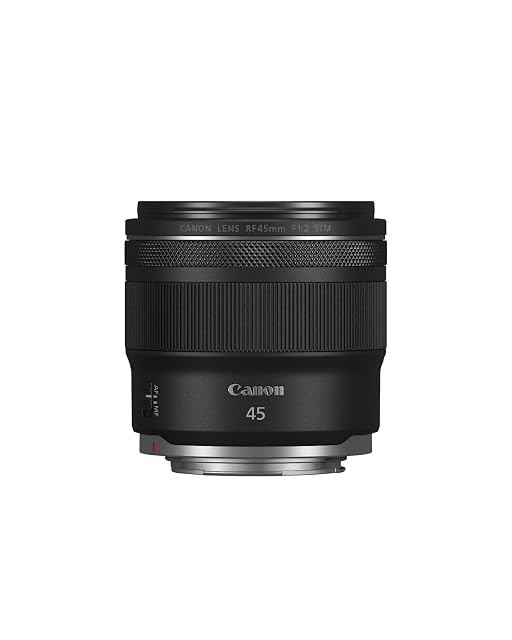
RF mount · 45mm · F1.2 · STM motor · configurable control ring · stated as weighing less than 400 g, which is a ceiling rather than a measurement · no blade count published · no minimum focus published · no filter thread published · no sealing claimed
The widest aperture in this entire lot at F1.2 for 439 €, in a barrel the page says weighs less than 400 g — a ceiling rather than a figure — with no blade count, no thread and no close-focus distance published.
Best for: Street portraits on an EOS R body where F1.2 is the entire point, and the control ring replaces the settings a spare hand would otherwise reach for.
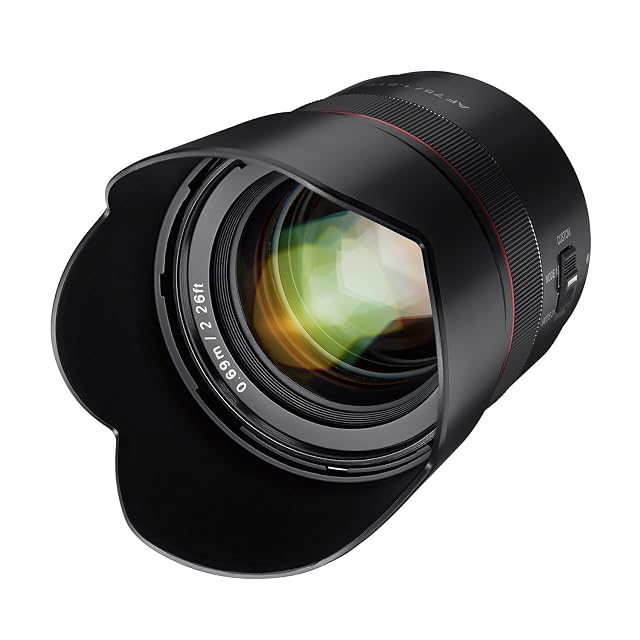
Sony E mount · full frame, and APS-C · 75mm · F1.8, closing to F22 · 9 aperture blades · LSTM autofocus, under 0.2 seconds and 23 dB · minimum focus 69 cm · 58mm filter thread · 230 g · 69mm long · 10 elements in 9 groups, 3 ED and 2 HR · angles of view 32.9 degrees on full frame and 21.9 on APS-C · no sealing claimed
Eight of the nine lines this shelf compares, answered with figures: 230 g, nine blades, 58mm of thread, 69 cm of close focus, and an autofocus timed at under 0.2 seconds and measured at 23 decibels.
Best for: Portraits on a Sony full-frame body where the lens has to stay light, and video where 23 decibels of focusing noise is the specification that matters.
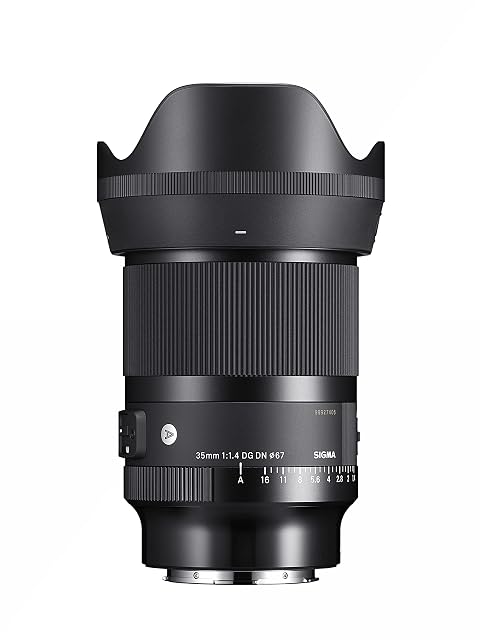
Sony E mount · full frame, from the DG designation · 35mm · F1.4 · Super Multi-Layer coating against flare and ghosting · autofocus described as fast and quiet, motor not named · no blade count published · no minimum focus published · no filter thread published · no sealing claimed · no weight published
The dearest lens of the eight here at 879 €, a full-frame 35mm at F1.4 from Sigma’s Art line — sold on five phrases that publish the aperture and nothing else measurable.
Best for: Full-frame reportage where F1.4 at 35mm is the requirement and the specification sheet will be found somewhere other than the listing.