One focal length, and usually the widest aperture the money buys · review
Lightdow 85mm F1.8 manual-focus portrait lens for Canon EF review
An 85mm portrait prime at F1.8 for 141 €, focusing entirely by hand, with a metal body and a hood — and a page that publishes the focal length, the aperture and no other measurement.
The bottom line Eighty-five millimetres at F1.8 for 141 € is a real offer and the metal body and hood are more than the price suggests. Everything else is missing: no autofocus, no close-focus distance, no blade count, no thread, no weight. It is a lens for someone who already knows how to use it.
On the listing
Five bullets, each with a bracketed heading. Manual focus described as full control, ideal for portraiture, cinematic bokeh and low light; an F1.8 aperture and sharp optics credited with professional portraits and creamy background blur even in difficult conditions; the 85mm length presented as the portrait focal length, giving natural skin tones and harmonious separation for weddings, events and creative projects; a robust metal housing with a hood, said to be durable yet light enough for comfortable handheld shooting; and a compatibility bullet listing Canon bodies from the EOS R series with an adapter through the 90D and 80D to the 6D Mark II, 5D Mark IV and 7D Mark II.
Manual focus is the product, not a shortcoming
The title says it and the first bullet is entirely about it. At 141 € for this focal length and aperture, autofocus is precisely what has been left out to reach the price, and the page makes that case openly rather than burying it in a specification list.
Eighty-five millimetres on two formats
The title names full frame and APS-C together. Both will work; they will not look the same. On APS-C the frame tightens enough that the photographer stands noticeably further back, and the listing never separates the two.
A metal barrel and no measurements
Robust metal housing, and no grams. The one physical claim on the page is a material, and the figure that would let anyone judge it is absent.
Two bullets about blur, and no blade count. The hub above explains that blade count and shape describe how out-of-focus highlights are drawn. This page sells the effect twice and never gives the number behind it.
What a portrait lens should publish and this one does not
The minimum focus distance decides how close a head can be framed, and it appears nowhere. Neither does a magnification ratio, a filter thread or any statement about sealing.
Availability
Between 134 € and 142 € on the German, French, Italian and Spanish Amazon stores when this page was last checked.
The American and British Amazon stores carry it too, priced in local currency. Those amounts are deliberately absent from the range above, which reads euro stores only.
Everything in this section is the figure Keepa carried on the day of the last update to this page. Availability and prices shift without notice.
Prices quoted in this text were read on 13 September 2026. The live price is at the top of the page.
What it does well, and what it gives up
Strengths
An 85mm F1.8 portrait prime for 141 €, a focal length and aperture combination that costs several times that from the camera makers
A metal housing with a hood included, stated in the fourth bullet
Manual focus presented as the design rather than disguised, with a long list of compatible Canon bodies
Compromises
No autofocus at all, on the focal length where a subject’s eye moving by two centimetres matters most
Neither a minimum focus distance nor a magnification, on a lens sold for portraits
No blade count, no thread, no weight and no sealing claim — five of the nine lines here are blank
Specifications
Focal length
85mm, fixed, in the title. The third bullet gives the reason for it: 85mm is the classical portrait length, credited there with natural skin tones and a harmonious separation of subject from background
Format
Full frame and APS-C both, stated in the title. On an APS-C body an 85mm frames considerably tighter than on full frame, which turns a portrait lens into a head-and-shoulders one — the page names both formats and never distinguishes their results
Maximum aperture
F1.8, in the title and argued in the second bullet: professional portraits with soft depth and creamy background blur, even in difficult light. No minimum aperture is published
Blade count and shape
Not published on the listing. Two of the five bullets are about background blur and neither counts the blades that produce it, which is the specification the hub above says makers publish and rarely explain
Autofocus motor
None — this is a manual-focus lens, stated in the title and made the subject of the first bullet, which presents precise manual focus as creative control for portraiture, cinematic bokeh and low light. There is nothing to name here because there is no motor
Minimum focus
Not published on the listing, and no magnification ratio. On a portrait lens the working distance is what decides how a head is framed, and the page gives neither
Filter thread
Not published in millimetres. The fourth bullet names a hood as part of the build and no diameter appears
Sealing
Not claimed. The fourth bullet claims a robust metal housing for durability, which is a construction statement rather than protection against dust or water
Weight
Not published in grams. The same bullet calls the lens light enough for comfortable handheld shooting, which is the adjective without the figure — and on a metal-bodied 85mm the figure is the one a buyer would want
Amazon reference
B00VZYR2LA (same reference on 6 Amazon marketplaces)
EAN
6979972594258
What people ask before they commit
How hard is manual focus at F1.8 on an 85mm lens?
It is the demanding case. At that aperture and focal length the depth of field at portrait distance is a few centimetres, so a subject who leans forward slightly has moved out of it. Modern mirrorless bodies help with focus magnification and peaking; an optical viewfinder gives far less assistance. The first bullet frames this as creative control, which it is for a patient photographer and is not for a moving one.
Does the lens frame the same on APS-C as on full frame?
No. The title names both formats because the lens will mount and cover both, but an APS-C sensor takes a smaller rectangle out of the image circle, so the framing is tighter — an 85mm becomes a longer portrait lens in practice and needs more distance from the subject. The listing never separates the two cases.
What does the included hood do on a portrait lens?
It shades the front element from light arriving outside the frame, which would otherwise bounce inside the barrel and lower contrast. On a fast lens used against the light — a common portrait situation, with the sun behind the subject — it is the difference between a controlled glow and a washed-out frame. The fourth bullet lists it as part of the build rather than an extra.
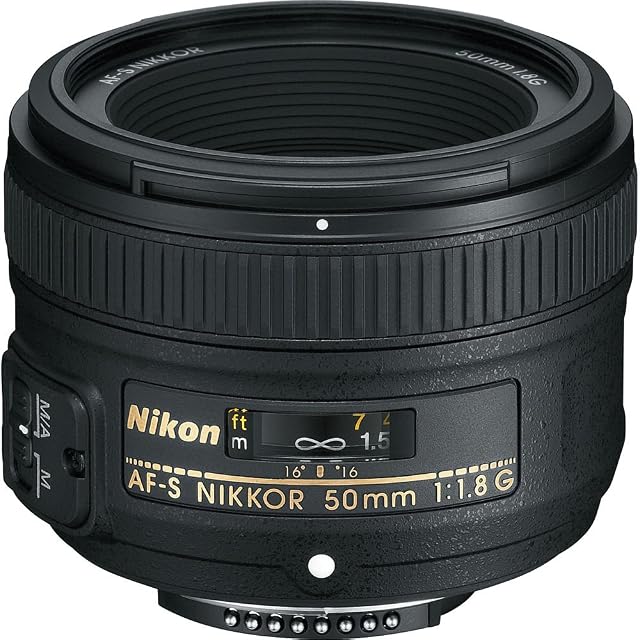
Nikon F mount · FX format, framing as 75mm on a DX body · 50mm · f/1.8 · Silent Wave Motor · two focus modes, autofocus and manual · aspherical element · 58mm filter thread · no blade count published · no minimum focus published · no sealing claimed · no weight published
The classic normal prime on the F mount at 219 €, publishing a 58mm thread, a Silent Wave Motor and its DX framing — on a page that prints the same five bullets twice over.
Best for: A normal prime on an FX body, or a short portrait lens on a DX one, where a motor in the lens and a cheap thread matter as much as the glass.
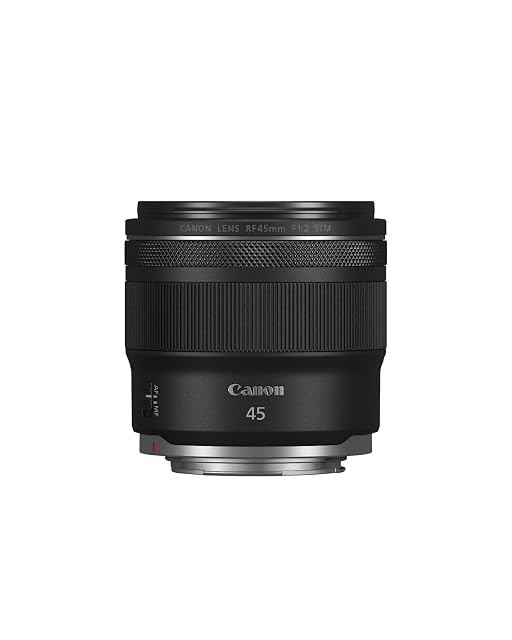
RF mount · 45mm · F1.2 · STM motor · configurable control ring · stated as weighing less than 400 g, which is a ceiling rather than a measurement · no blade count published · no minimum focus published · no filter thread published · no sealing claimed
The widest aperture in this entire lot at F1.2 for 439 €, in a barrel the page says weighs less than 400 g — a ceiling rather than a figure — with no blade count, no thread and no close-focus distance published.
Best for: Street portraits on an EOS R body where F1.2 is the entire point, and the control ring replaces the settings a spare hand would otherwise reach for.
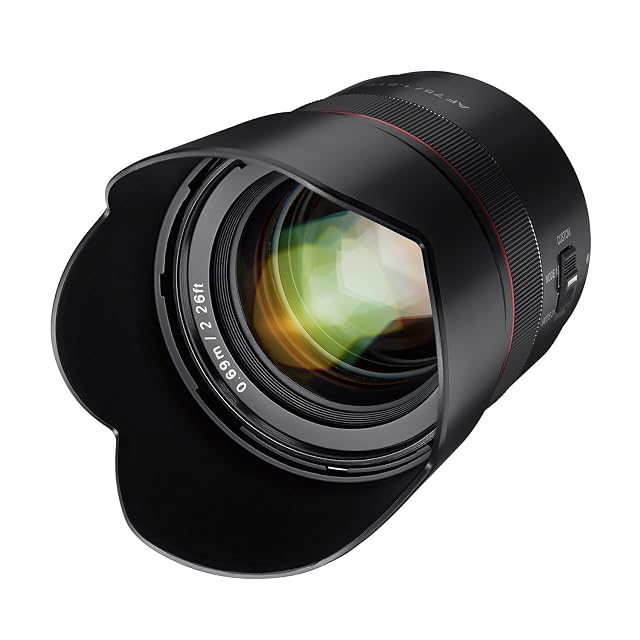
Sony E mount · full frame, and APS-C · 75mm · F1.8, closing to F22 · 9 aperture blades · LSTM autofocus, under 0.2 seconds and 23 dB · minimum focus 69 cm · 58mm filter thread · 230 g · 69mm long · 10 elements in 9 groups, 3 ED and 2 HR · angles of view 32.9 degrees on full frame and 21.9 on APS-C · no sealing claimed
Eight of the nine lines this shelf compares, answered with figures: 230 g, nine blades, 58mm of thread, 69 cm of close focus, and an autofocus timed at under 0.2 seconds and measured at 23 decibels.
Best for: Portraits on a Sony full-frame body where the lens has to stay light, and video where 23 decibels of focusing noise is the specification that matters.