One focal length, and usually the widest aperture the money buys · review
Panasonic Lumix G 25mm F1.7, 125 g, 46mm thread review
A 125 g normal prime for Micro Four Thirds at 159 €, publishing its equivalence, its angle of view, its aperture range, its close focus, its thread and its weight — six figures, on a page of five short bullets.
The bottom line Six figures published in five short bullets makes this the most efficiently described lens in this catalogue, and the numbers are good ones: 125 g, 46mm, 0.25 m, F1.7 and a normal field of view. The blade count and the motor are missing, and nothing is claimed about sealing.
On the listing
Five bullets, each one a fact. The lens named for Micro Four Thirds mounts with a 35mm equivalent of 50mm and a diagonal angle of view of 47 degrees; a 25mm fixed focal length with a very large F1.7 aperture closing to F22, called ideal for portraits and for shooting in poor light; a compact and light design; a weight of about 125 g and a filter diameter of 46mm; and a minimum focus of 0.25 m.
A hundred and twenty-five grams, forty-six millimetres
Both numbers in one bullet, and both are the smallest here. A lens this light changes what a camera is for: it stops being something to plan an outing around. The 46mm thread is the other half of the same argument, because it makes filters an afterthought rather than a budget.
Fifty millimetres, in the language of another format
The first bullet gives the equivalence and then does better by publishing the angle itself: 47 degrees on the diagonal. An angle needs no format to be understood, and it is the figure that survives every comparison.
Twenty-five centimetres
Close enough that a plate, a book or a hand fills the frame at F1.7. On a normal lens that turns one purchase into two uses, and it is published as a number rather than as a claim about versatility.
The two lines it leaves blank
No blade count, on a page that sells the aperture for portraiture.
No motor type. The lens autofocuses and the page never says with what, so nothing can be said about how quietly it does so near a microphone.
Availability
Between 159 € and 175 € on the German, French, Italian and Spanish Amazon stores when this page was last checked.
The American and British Amazon stores carry it too, priced in local currency. Those amounts are deliberately absent from the range above, which reads euro stores only.
Everything in this section is the figure Keepa carried on the day of the last update to this page. Availability and prices shift without notice.
Prices quoted in this text were read on 13 September 2026. The live price is at the top of the page.
What it does well, and what it gives up
Strengths
Six published figures on a five-bullet page: equivalence, angle of view, aperture range, close focus, thread and weight
About 125 g and a 46mm thread, the lightest lens of the eight here and the smallest filter size among them
0.25 m minimum focus, close enough to make the lens useful for small objects as well as faces
Compromises
No blade count, on a lens the second bullet sells for portraits
No autofocus motor named, so nothing can be said about focusing noise near a microphone
No sealing claim of any kind
Specifications
Focal length
25mm, fixed, with the first bullet doing the translation: 35mm equivalent 50mm. Publishing both halves is what the hub above asks for, and on this shelf only two pages do it
Format
Micro Four Thirds, stated in the title and in the first bullet, which names the mount and adds compatibility with Panasonic and Olympus bodies. It is the format that makes 25mm a normal lens rather than a wide one
Maximum aperture
F1.7, with the second bullet giving the full range down to F22 and naming portraits and poor light as the uses. A third of a stop faster than the F1.8 lenses on this shelf, which is a small but real advantage on the smallest sensor here
Blade count and shape
Not published on the listing. The second bullet sells the aperture for portraits without counting what forms it
Autofocus motor
Not named on the listing. The lens is an autofocus design — nothing describes it as manual — and no motor type appears, so whether it is quiet enough to sit near a microphone cannot be read from the page
Minimum focus
0.25 m, published in the fifth bullet. A quarter of a metre on a 25mm lens is genuinely close, and combined with F1.7 it is what makes this a usable lens for objects on a table as well as for people
Filter thread
46mm, published in the fourth bullet next to the weight. It is the smallest thread of the eight here, which means the least costly filters to buy for it
Sealing
Not claimed. The third bullet claims a compact and light design and no protection against dust or moisture appears anywhere
Weight
About 125 g, published in the fourth bullet. The lightest lens in this entire lot, and the figure is given rather than implied
Amazon reference
B014X35XLU (same reference on 6 Amazon marketplaces)
EAN
5025232835126
What people ask before they commit
Why does the listing give both 25mm and 50mm?
Because the engraved figure and the framing are different things. Twenty-five millimetres is the actual focal length; on the Micro Four Thirds sensor it frames as a 50mm lens would on 35mm film, which is the reference most people carry in their heads. The first bullet prints both, along with the 47 degree diagonal angle, which is the figure that needs no translation at all.
Is F1.7 on this format the same as F1.7 on a larger one?
For exposure, yes: the same aperture and shutter speed give the same brightness on any format. For depth of field it is not, because the smaller sensor requires a shorter focal length for the same framing, and shorter focal lengths keep more in focus. The practical result is that backgrounds fall away less at F1.7 here than they would on a larger sensor at the same aperture.
What does a 46mm filter thread save?
Money, mostly. Filter prices rise steeply with diameter, and 46mm is the smallest size of the eight here — against 62mm on the Samyang and 82mm on the TTARTISAN telephoto. A polariser or a neutral density filter for this lens is an inexpensive purchase, which matters more than it sounds when a lens is bought to be carried everywhere.
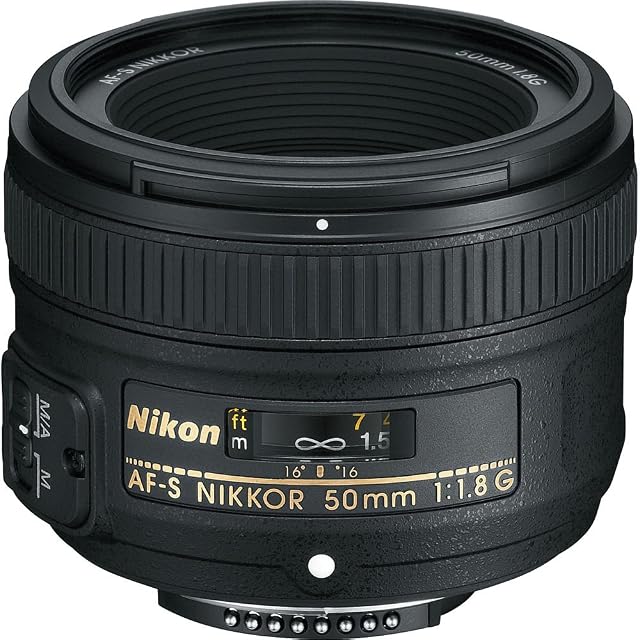
Nikon F mount · FX format, framing as 75mm on a DX body · 50mm · f/1.8 · Silent Wave Motor · two focus modes, autofocus and manual · aspherical element · 58mm filter thread · no blade count published · no minimum focus published · no sealing claimed · no weight published
The classic normal prime on the F mount at 219 €, publishing a 58mm thread, a Silent Wave Motor and its DX framing — on a page that prints the same five bullets twice over.
Best for: A normal prime on an FX body, or a short portrait lens on a DX one, where a motor in the lens and a cheap thread matter as much as the glass.
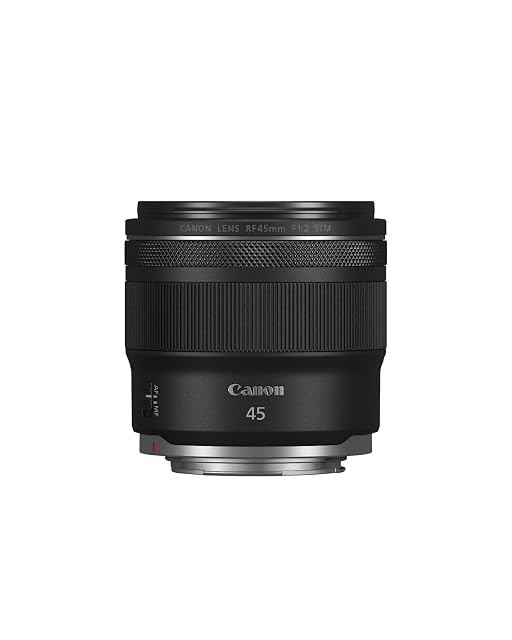
RF mount · 45mm · F1.2 · STM motor · configurable control ring · stated as weighing less than 400 g, which is a ceiling rather than a measurement · no blade count published · no minimum focus published · no filter thread published · no sealing claimed
The widest aperture in this entire lot at F1.2 for 439 €, in a barrel the page says weighs less than 400 g — a ceiling rather than a figure — with no blade count, no thread and no close-focus distance published.
Best for: Street portraits on an EOS R body where F1.2 is the entire point, and the control ring replaces the settings a spare hand would otherwise reach for.
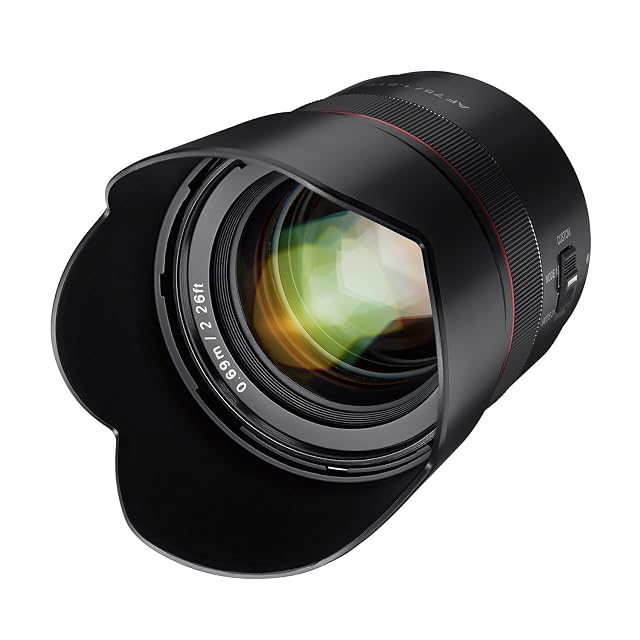
Sony E mount · full frame, and APS-C · 75mm · F1.8, closing to F22 · 9 aperture blades · LSTM autofocus, under 0.2 seconds and 23 dB · minimum focus 69 cm · 58mm filter thread · 230 g · 69mm long · 10 elements in 9 groups, 3 ED and 2 HR · angles of view 32.9 degrees on full frame and 21.9 on APS-C · no sealing claimed
Eight of the nine lines this shelf compares, answered with figures: 230 g, nine blades, 58mm of thread, 69 cm of close focus, and an autofocus timed at under 0.2 seconds and measured at 23 decibels.
Best for: Portraits on a Sony full-frame body where the lens has to stay light, and video where 23 decibels of focusing noise is the specification that matters.