Skip to content

A support that holds still: from one leg to three

The order here is not price but permission and reach. A monopod goes where three legs are refused and steadies a long lens without ever holding a long exposure; a tripod does the exposure and is turned away at the door of half the venues worth photographing. These five run from the one that travels furthest to the one that holds hardest, and the figure to read on each is the declared load — which is static, and says what the support holds still rather than what it holds while being moved.

One leg goes where three are refused

That is the first fork, and it is not about steadiness. Museums, concert halls, cathedrals and most stadiums admit a monopod and turn away a tripod — so the support that is allowed inside beats the better one left in the car.

Fourteen euros to a hundred, on this shelf

The monopods here span that range, and what the money buys is not height: it is a lock that holds under load without creeping, and a foot that grips a hard floor instead of skating on it.

Three decisions, not one

Legs, head and plate are bought together and replaced separately. Legs last decades. The head is what you touch every time. The plate profile the head imposes then decides every quick-release plate bought afterwards — which is why a plate standard matters more than any single head’s rating.

A declared load is measured standing still

It says what the support holds motionless, not what it holds while being panned. A head rated at 8 kg can creep under a 2 kg telephoto in motion, because friction rather than capacity is what resists a moving load.

Where a support stops being the limit

When the camera is steady and the frame is still soft, the problem has moved to shutter speed or focus. A support cannot fix either, and buying a dearer one will not change that.

What goes in the bag, and why

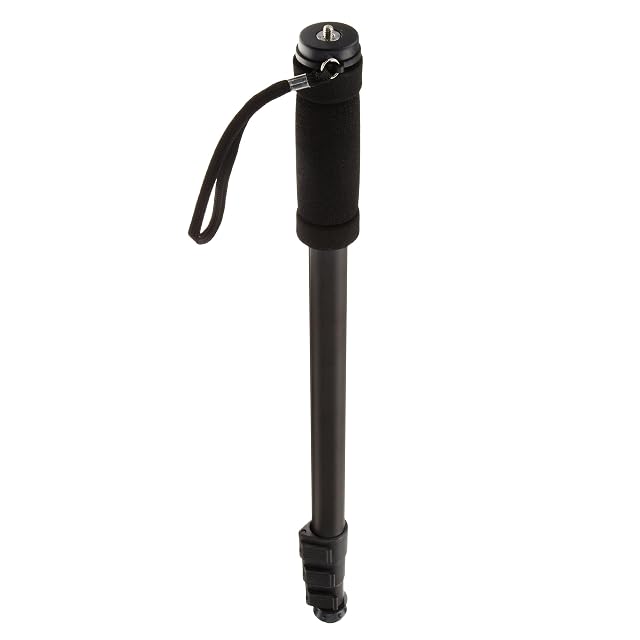
  1. Amazon Basics WT1003, 54 to 170 cm, 3 kg, four sections

    54 to 170 cm · four leg sections · declared load 6.6 lbs, about 3 kg · 1/4 inch universal thread · rubber foot with retractable spikes · padded grip and adjustable wrist strap · carry bag · aluminium · no folded length published · no head included

    Eighteen euros, level with the PATONA on this shelf, with a rubber foot that hides retractable spikes and a wrist strap — and no folded length anywhere on the page.

    Best for: A first monopod for a long lens at a match or in a hide, where the spikes and the strap matter more than a published packed length.

    ≈ $18 / £12 / 18 €
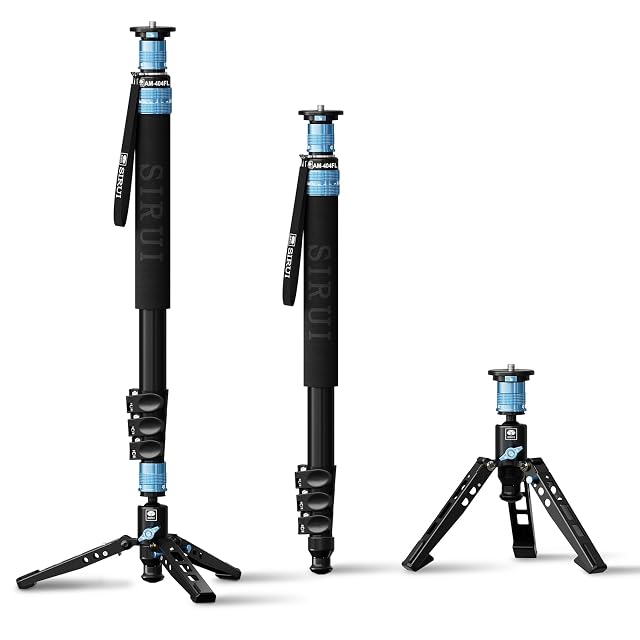
  2. SIRUI AM-404FL, 190 cm, 12 kg, 3-in-1 base

    190 cm maximum · four sections · declared load 12 kg · three-in-one base usable as a monopod with adjustable feet, a free-standing extension pole or a low tripod · extended feet of 15 cm with a reinforced base structure · patented quick-release thread in 1/4 and 3/8 inch · textured collar giving 360 degree panning without a head · aluminium · no folded length published

    Twelve kilograms declared and 190 cm of reach for 129 €, with a base that turns the pole into a low tripod and a collar that pans through 360 degrees without any head at all.

    Best for: A long telephoto at a match or in a hide, where 12 kg, 190 cm and panning without a head are worth the price and the weight.

    ≈ $109 / £93 / 110 €

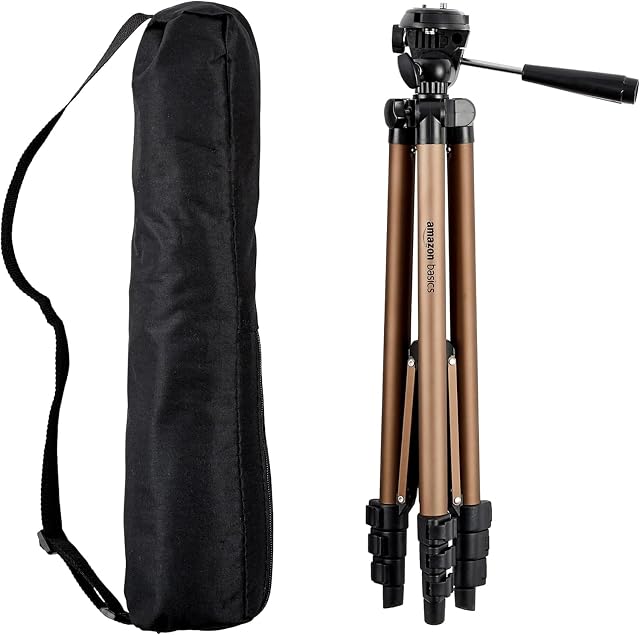
  3. Amazon Basics WT3130T, 127 cm, 560 g, 2 kg ceiling

    40.9 to 127 cm · folded 42.8 cm · 3 sections · lever locks · equipment ceiling of 2 kg, stated as a limit rather than a load · aluminium, 560 g · 3-way head with a bubble level and a quick-release plate · zipped bag

    The cheapest support here at 13 €, weighing 560 g, with a 3-way head and a bag — and a page that names what must not go on it: nothing over 2 kg, no heavy reflex, no long lens.

    Best for: A compact camera, a phone or a small mirrorless body on a budget, where 560 g in the bag matters more than reaching eye level.

    ≈ $20 / £15 / 12 €

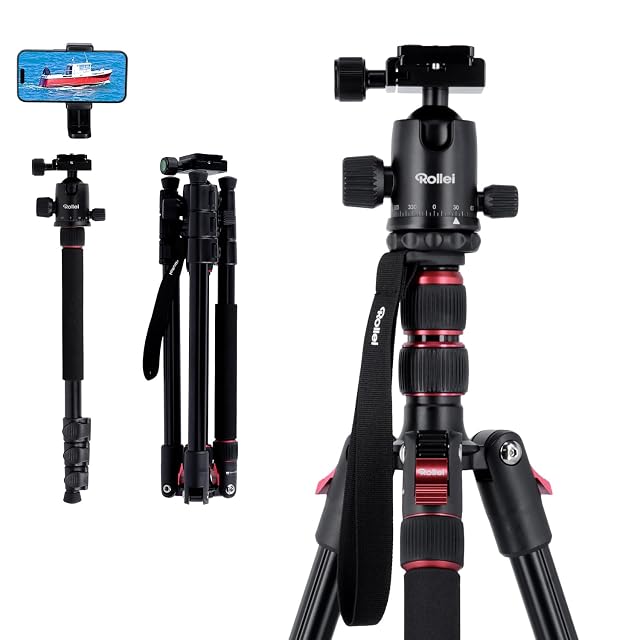
  4. Rollei Compact Traveler No.2, 180 cm, 5 kg, 1.46 kg

    44 to 180 cm · folded 44 cm · folding leg locks · ball head with 360 degrees of rotation, invertible through 180 degrees · declared load 5 kg · aluminium, 1.46 kg · converts to a monopod · mountable spikes · 1/4-20 and 3/8 threads, plus a 1/4 inch socket in each leg · phone holder supplied

    A ball head rather than a 3-way, 5 kg declared, spikes for soft ground and a 1/4 inch socket in every leg — the most versatile support here at 56 €, and the only one that becomes a monopod.

    Best for: Travel and outdoor work where one support has to be a tripod, a monopod and a macro rig, and the ground is not always flat.

    ≈ 56 €

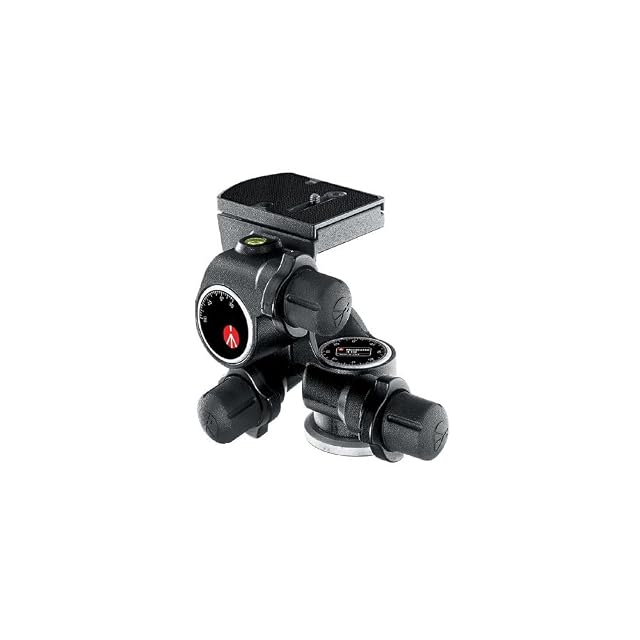
  5. Manfrotto 410 Junior geared head, 5 kg, 1.22 kg

    Geared three-axis head, adjusted by knobs rather than a released ball · declared load 5 kg · Manfrotto 410 quick-release plate supplied, proprietary profile · bubble level · locking system for fast movement between shots · named for 35 mm and medium-format cameras · 1.22 kg · no mounting thread published · no panning scale published

    A geared head at 229 € — the only one here adjusted by turning knobs rather than releasing a ball — carrying 5 kg and weighing 1.22 kg, six times the 205 g K&F beside it.

    Best for: Architecture, product and copy work on a solid tripod, where a framing has to be adjusted by millimetres and held exactly.

    ≈ $219 / £229 / 229 €

What people ask before they commit

Why is a declared load not the weight it will carry?

Because it is measured static. A head rated at 8 kg holds 8 kg still; the same head panning with a 2 kg telephoto can creep, because friction rather than capacity is what resists a moving load. The answers shelf on this site sets this out in full — and it is why a head bought for its rating alone often disappoints.

Do I need a separate head?

If the tripod came with one you dislike, yes, and it is the cheapest useful upgrade there is. Legs last decades and heads are what you touch: the plate profile the head imposes then decides every quick-release plate bought afterwards, which is why the plate standard matters more than the head’s own specification.

Is a cheap tripod worth anything?

For a light camera on a flat floor, yes — it is a different object rather than a compromised version of a dear one. What it will not do is stand on uneven ground under a long lens in wind, and no amount of care substitutes. Knowing which of the two situations you are in is the whole decision.

Each amount in a write-up is what the listing showed when that page was written. The figure next to the product is pulled in as you read, and it is the one that counts.

The tool we use ourselves

Settled on a lens? Now buy it at the right price.

Bodies, lenses and lighting are marked down almost continuously, and a struck-through figure says nothing by itself about what the same reference was actually asking a month ago. UniverTrack holds the week-by-week record of every retailer, so a reduction is measured against a price that genuinely stood rather than one written for the banner — and it says when the moment to buy has really arrived.

Real price historyBuy-now alertsAI buying assistant
Try free for 14 days →
No commitment · Cancel in one click · 5 languages