The shelf-filler, from 18 € triggers to 449 € monitors
Where it turns up
Flash triggers and on-camera flashes; studio heads and softboxes; LED panels and ring lights; sliders and tripod heads; field monitors and teleprompters; polarising filters, rain covers, batteries and grips. There is scarcely a shelf on this site without a NEEWER entry, and the range runs from an 18 € trigger to a 449 € monitor.
What the listings usually publish
More than most. The F700 monitor gives its dimensions, two weights, its runtimes and its charging voltages; the PB020 rain cover publishes 150 g and a 950 by 850 mm sheet; the RF-110 reflector names four ways to support it. When a NEEWER page is thin, it is thin about coatings and colour accuracy rather than about sizes.
What to read twice
The equivalence claims. A softbox kit sold as “700 W equivalent” is two 35 W LED bulbs, and the useful figure in the same bullet is 3450 lumens apiece. Where NEEWER publishes a measurement it is specific; where it publishes a comparison, the comparison is with incandescent bulbs nobody supplies.
The pattern across shelves
Second-cheapest, better specified than the cheapest, and available in a pack. On the shelves where that matters — triggers, batteries, filters — it is why the brand appears so often. On the shelves where a single well-built item wins, it is usually not the top entry.
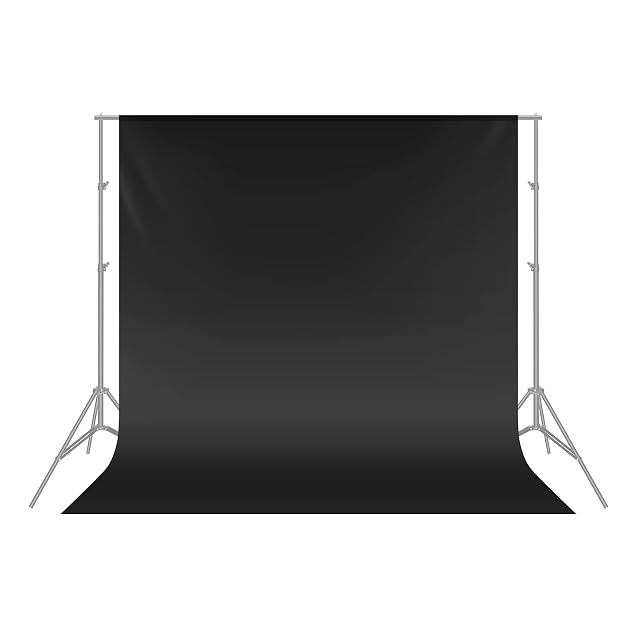
100 per cent pure polyester, described as especially thick with good elasticity and resistant to light · 1.8 by 2.8 m — 5.9 by 9.3 ft, sold as 6 by 9 ft · creases admitted as normal after shipping, with TWO remedies: hang for 12 to 24 hours, or steam-iron the BACK ONLY below 40 °C — a dry iron is forbidden · SUPPORT NOT INCLUDED: no stand, frame or poles · pole pocket on EACH top edge, so it drapes or hangs either way up · edges finished against tearing · foldable and easy to clean · no weight per square metre published
One metre eighty by two metre eighty of thick black polyester for 26 €, with a pole pocket on each top edge and the only instruction on this shelf to iron the back only, below 40 °C.
Best for: A seated portrait or a head-and-shoulders setup on an existing frame, where a black cloth has to stay black under repeated flash.
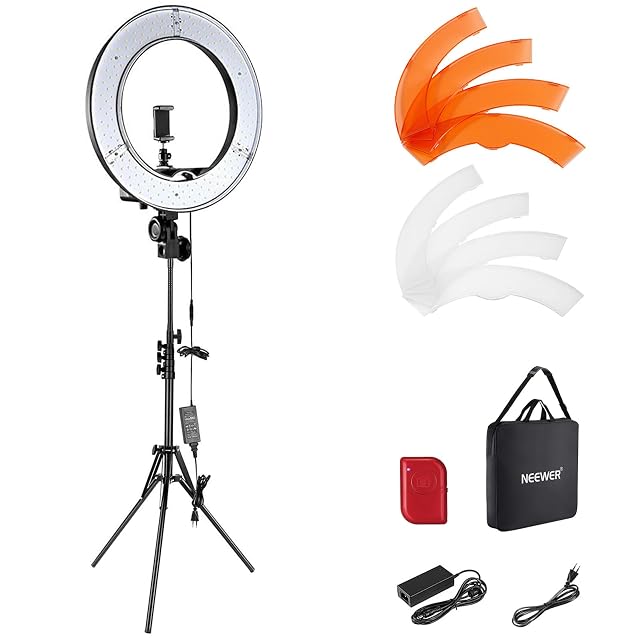
18 inch, 45 cm outer diameter · 55 W · fixed 5600K · 240 LEDs · dimmable 0 to 100 per cent · no colour accuracy index · 155 cm aluminium-alloy light stand · colour filter set supplied instead of bi-colour mixing · soft tube, ball head and hot shoe adapter for cameras · phone holder · universal mains adapter · carry bag · no UV or IR emission claimed
The largest and dearest ring here — 18 inches, 45 cm, 55 W of daylight from 240 LEDs — with a camera shoe adapter, colour filters and a 155 cm stand, at 107 €.
Best for: Portrait, beauty and salon work at a proper distance, where 45 cm of daylight-balanced source and a camera mount are the reasons to buy.
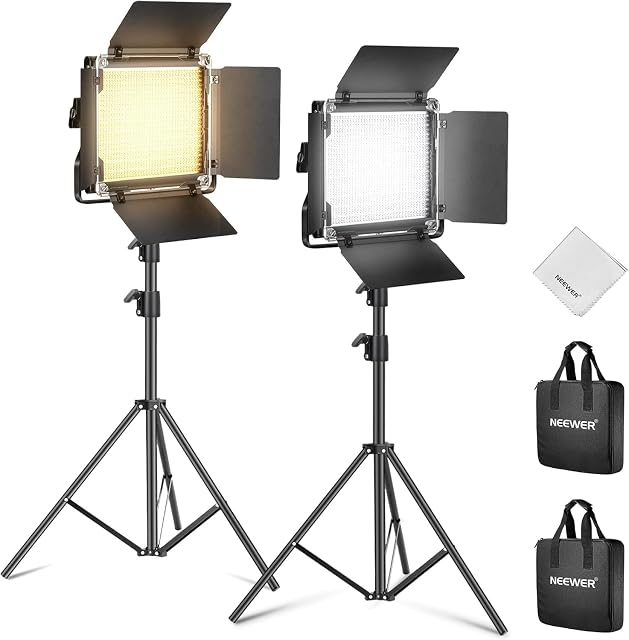
Two panels of 660 LEDs, 330 warm and 330 cool · 40 W each · 3300 lux at 1 m · 3200K to 5600K · CRI 96 or better · brightness 0 to 100 per cent · mains adapter supplied or NP-F550 and NP-F970 cells, not supplied · barn doors and U-brackets with 360 degree tilt · two stands from 66 to 190 cm · panels 232 by 200 by 48 mm · LCD screen · two carry bags
The only light of the four here that publishes an illuminance with its distance — 3300 lux at 1 m — as a pair of 660-LED panels with stands, barn doors and bags for 194 €.
Best for: A two-light setup for portraits, product work or streaming where the panels go on stands, the barn doors control spill, and a socket is available.
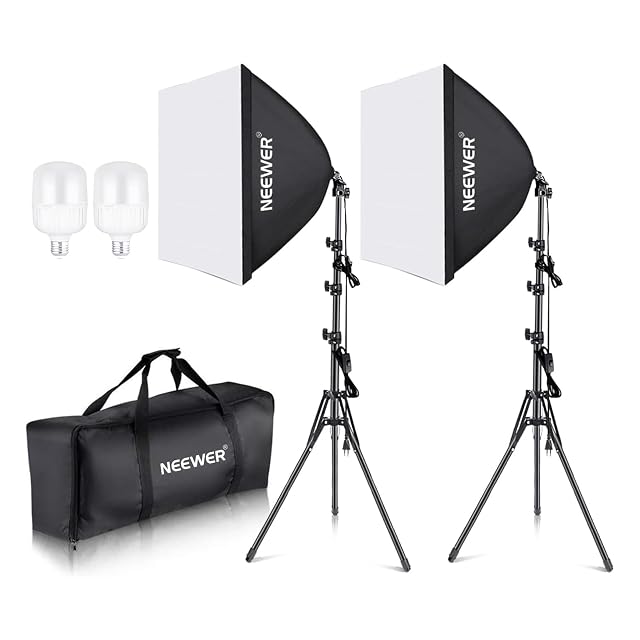
A COMPLETE KIT: two 60 by 60 cm boxes, two 35 W LED bulbs at 5700K, two 210 cm stands, a carry bag · 3450 lumens claimed per bulb · described as equivalent to 350 W incandescent each, 700 W in total · E27 fitting taking bulbs, fluorescent tubes or slave flashes · aluminium-alloy stands with single quick locks · no mount type published · no depth published · no dimming described · no grid
Two 60 by 60 cm boxes, 35 W LED bulbs at 5700K, 210 cm stands and a bag for 122 € — with an E27 socket that also takes a slave flash, which nothing else here mentions.
Best for: A home or small studio setup that may later be fired with flash rather than continuous light, where the E27 socket keeps that option open.
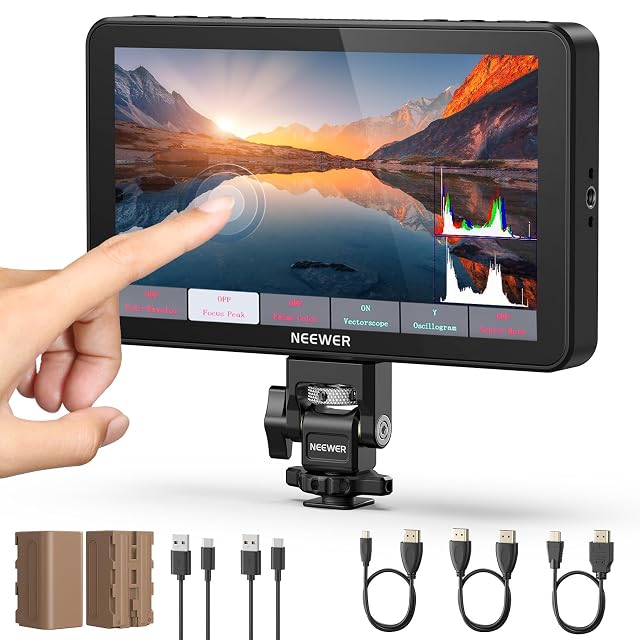
7 inches, IPS touchscreen, buttons AND touch (touch disableable) · 1920 by 1080, 1000:1, 16:9, 160° · 2000 NITS, with manual and AUTOMATIC backlight adjustment from 1 to 100 · 4K HDMI loop in and out, with the full format list published, plus a 3.5 mm headphone socket · false colour, zebras, histogram, oscillogram, full waveform, vectorscope, HDR, single colour, peak focus, audio bar, with F1, F2 and F3 shortcut keys · FIFTEEN preinstalled 3D LUTs and up to SIXTY custom ones by SD card · NP-F550/750/970, DC input, Type-C charging, and an 8 V 1.5 A DC OUTPUT as a dummy battery; two NP-F750 cells give 2.4 h each, 4.8 h together · quarter-inch threads on the base AND the side, a cold shoe, 180° adjustment, BUILT-IN FANS · 175 by 107 by 25 mm · 445 g bare, 857 g with two batteries
Two thousand nits with automatic backlight, fifteen lookup tables preinstalled, built-in cooling fans — and the only monitor here that publishes its dimensions and two weights.
Best for: Long days in changing light on a camera or a rig that can carry 857 g, where log footage has to look right without any setup.
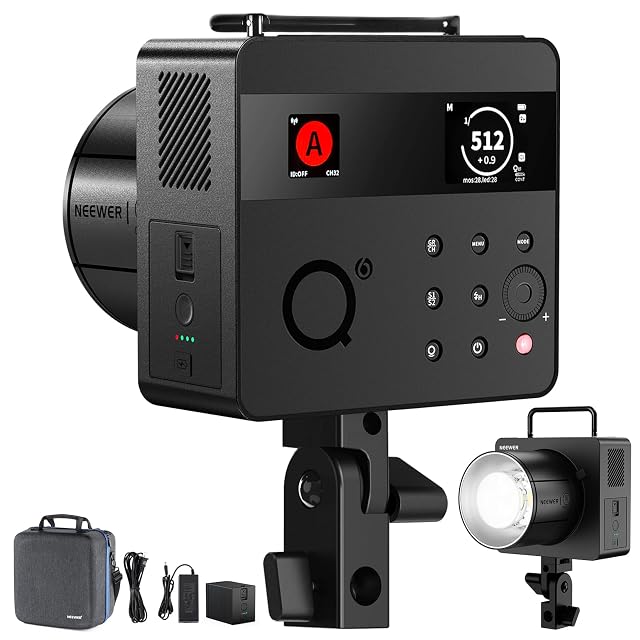
600Ws · 1/1 to 1/512 in 0.1-stop increments, nine stops · no recycle time published · 30 W bi-colour LED modelling lamp, 2700K to 6500K, CRI 95+ · colour temperature 5700K plus or minus 100K across the whole power range · TTL, manual and multi modes · HSS to 1/8000 s · NEEWER 2.4G Q system, 5 groups, 32 channels, 99 IDs, 100 m · Bluetooth app control · two TFT displays · quartz tube rated about 300,000 flashes
Nine stops of adjustment in tenth-stop increments, a 30 W bi-colour modelling lamp with a published colour index, and a tube rated for 300,000 flashes — at 449 €, with no recycle time anywhere on the page.
Best for: Portrait work away from a studio where nine stops and stable colour matter, for someone already inside the NEEWER Q system or willing to enter it.
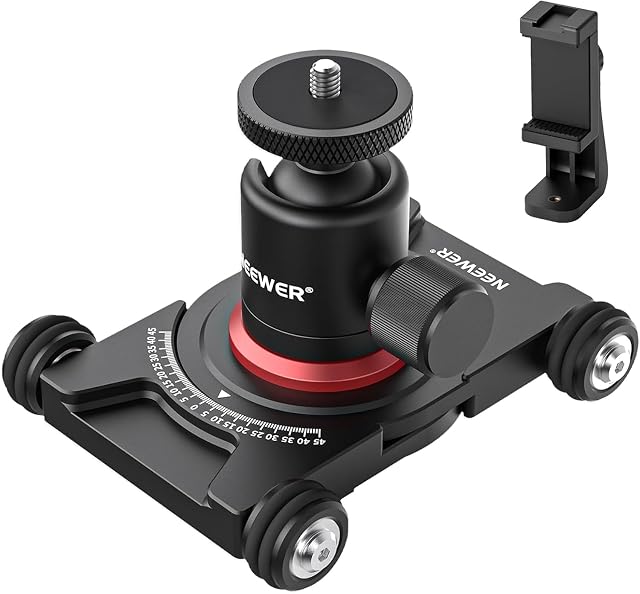
A wheeled dolly rather than a rail · straight-line or circular movement with wheels set between minus 45 and plus 45 degrees · rubber-padded wheels for quiet running · ball head with 360 degrees of pan and 90 of tilt on a 1/4 inch screw · phone holder and a cold shoe · 100 by 84 by 20 mm · 200 g · aluminium · not for telephoto lenses · no declared load published
A 200 g pocket dolly at 37 €, running on rubber wheels that turn through 90 degrees to trace a circle — with a ball head in the box and a warning against telephoto lenses.
Best for: Table-top product and food video where a small camera or a phone has to drift or circle, and the surface is already smooth.
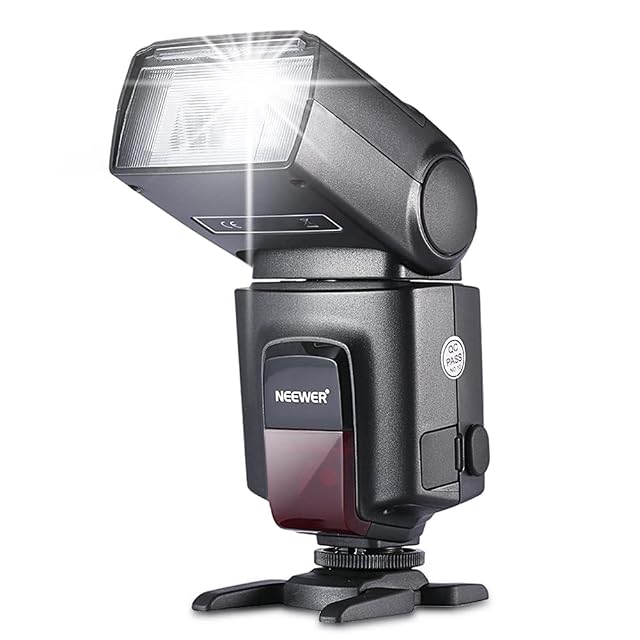
Universal single-contact hot shoe · GN38 at ISO 100 · 8 manual levels from 1/128 to 1/1, seven stops · 5600K plus or minus 200K · recycle 0.1 to 5 s · flash duration 1/300 to 1/20,000 s · head tilts 0 to 90 degrees and swivels 0 to 270 · S1 and S2 optical slave modes and PC sync · 4 AA cells, not supplied, with a socket for a CP-E4 external pack · no TTL, no high-speed sync, no camera-menu control
The only flash here that publishes its guide number with the sensitivity behind it — GN38 at ISO 100 — and a head that tilts through 90 degrees and swivels through 270, for 51 €, with a first bullet that is four warnings.
Best for: Bounced flash on a budget, on almost any camera with a centre-contact shoe, for someone who sets the power by hand and owns rechargeable AA cells.
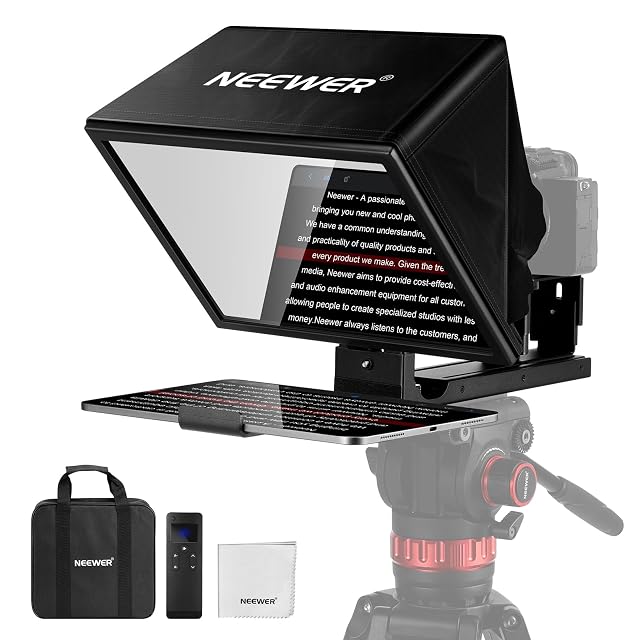
A BEAM SPLITTER with a special coating and a PUBLISHED 75 PER CENT LIGHT TRANSMISSION — the only ratio figure on this shelf · 12 inches, for tablets and cameras, text readable to 10 ft / 3 m · an ADJUSTABLE APERTURE that reduces glare · a flip-up platform keeping the lens centred · aluminium alloy, folds flat into a rigid carry case · the RT113 remote plus the NEEWER Teleprompter app for iOS 11 and Android 6 or later, controlling play, pause, scroll speed, page turns and font size · AAA battery NOT included · THE PAGE STATES TWICE THAT IT IS NOT SUITABLE FOR SHOOTING WITH A SMARTPHONE, and not for use as a monitor or for self-view
The only prompter on this shelf that publishes its mirror — 75 per cent transmission on a 12-inch beam splitter — and the only one that twice states what it cannot do.
Best for: A tablet and a camera on a tripod, for courses and tutorials, where the mirror’s light loss has to be known in advance.
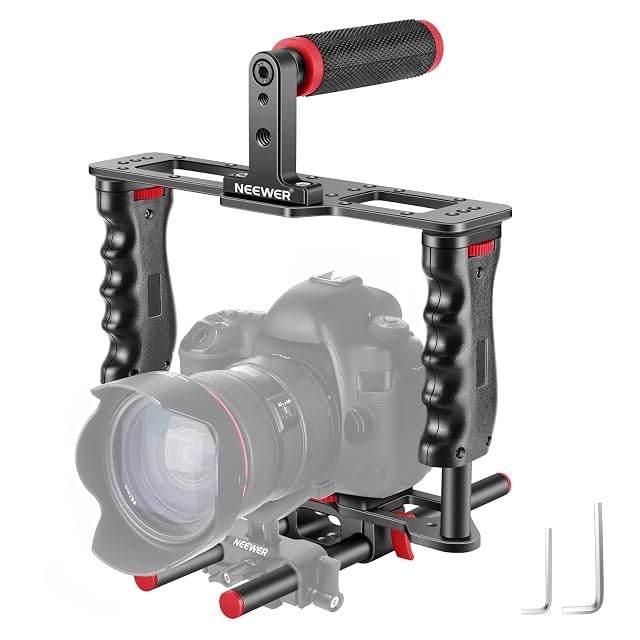
A universal cage at 63 € whose real specification is its rod base — two 15 mm rods at 60 mm spacing — carrying a follow focus, a matte box or a lens support.
Bodies named
None precisely, and that is the trade. The first bullet claims wide compatibility and lists examples — Canon 5D Mark II and III, 600D, 700D, Nikon, Sony, Fujifilm, Pentax and other reflex bodies and camcorders — rather than a definitive set. The hub above says the model list IS the specification for a cage; a universal cage replaces it with an adjustable clamp and a screw, which fits more cameras and fits none of them exactly
Thread and pin provision
Multiple 1/4 inch and 3/8 inch threaded holes on the top of the cage, in the fourth bullet, for articulating arms, microphones, cold shoe mounts and field monitor mounts. No ARRI locating pins are named, so an accessory is held by its screw alone and can rotate
Cold shoes
Not counted. The fourth bullet names cold shoe MOUNTS as something that can be attached to the threads, which is the opposite arrangement from the Hersmay: there the shoes are built into the handle, here they are an accessory screwed on
NATO rails
Not described. What takes their place is the rod base — the second bullet gives two 15 mm rods with a 60 mm rail spacing, which is the cinema standard for mounting a follow focus, a matte box or a lens support in front of the camera
Cable clamp
Not described. As on the Hersmay, the page provides threads and handles and nothing for the strain of an HDMI or USB lead
Battery and card access
Not stated. The third bullet describes a built-in 1/4 inch knurled screw allowing the camera to be mounted and removed quickly without tools, which is a partial answer — a cage that comes off in seconds makes a battery change possible without disassembly, even if the door itself is not reachable
Base profile
Not described as a tripod plate. The third bullet names silicone padding stabilising the camera against movement and protecting it from scratches, and the base is where the 15 mm rods are carried
Material
Aircraft-grade aluminium alloy, CNC machined with an anodised finish, in the fifth bullet
Published weight
Not published. The Hersmay beside it gives 230 g; this page gives no figure at all, on a cage that adds two handles and a rod base to a camera
Amazon reference
B0722L8J2Y (same reference on 6 Amazon marketplaces)
EAN
0191073013513
A 15 mm dual-rod base at 60 mm spacing, which is what a follow focus and a matte box mount onto
Two ergonomic hand grips and a top silicone handle for low-angle work
No published weight, on the heavier-looking of the two cages here
Best for: A reflex or camcorder rig that needs rods in front — a follow focus, a matte box or a lens support — rather than a cage machined around one body.
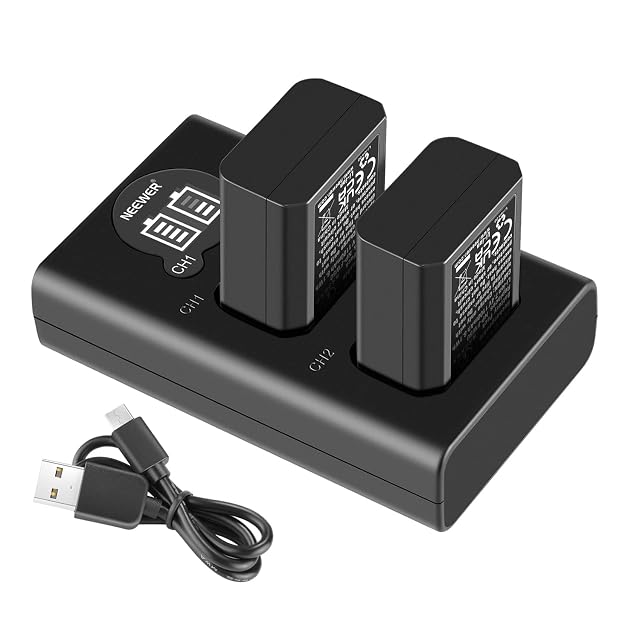
Two cells and a twin charger with an LCD readout for 36 € — the only charger on this shelf, and the only capacity published with its watt-hours and nothing contradicting them.
Bodies named
Fourteen models and one range, in the fourth bullet: the ZV-E10, a7, a7R, a7R II, a7 II, a7S II, a7S, a3000, a5000, a6000, a6300, a6400, a6500 and the RX10 series
Capacity in mAh and watt-hours
1100 mAh and 8.1 W, both in the first bullet — and unlike the 29 € ENEGON here, no second figure contradicts them. Eleven hundred milliamp-hours is the LOWEST capacity on this shelf and the CLOSEST to Sony’s own rating of about 1020 mAh, which is the more credible position for a third-party cell to take
Voltage
NOT PUBLISHED. Every other battery on this shelf gives 7.2 or 7.4 V, and this page gives watt-hours and milliamp-hours without the volts between them — 8.1 Wh over 1100 mAh implies about 7.4 V, which the reader has to derive
Chip communication described
Not described. The charger’s LCD reports the state of each cell instead, which answers the question outside the camera rather than inside it
Charger contents
A DUAL CHARGER WITH AN LCD DISPLAY — the only charger on this shelf. The first and third bullets give the detail: 2.1 A charging, micro-USB OR USB-C input, and power from a wall charger, a car charger or an external power bank, with the display clearly showing each battery’s charge state. The second bullet adds that the set triples the camera’s running time
Stated protection
FOUR circuits, in the fifth bullet: overcharge, short circuit, overheating and over-voltage, in a high-quality fire-resistant construction. One fewer than the ENEGON’s five, and four more than the DuraPro’s none
Amazon reference
B07QWP7KTB (same reference on 6 Amazon marketplaces)
EAN
0191073100701
A dual charger with an LCD showing each cell’s state, alone on this shelf
Two point one amp charging from micro-USB or USB-C, wall, car or power bank
No voltage published, alone on this shelf
Best for: A Sony body with no charger at all, or one whose original has been lost — the set that arrives complete.
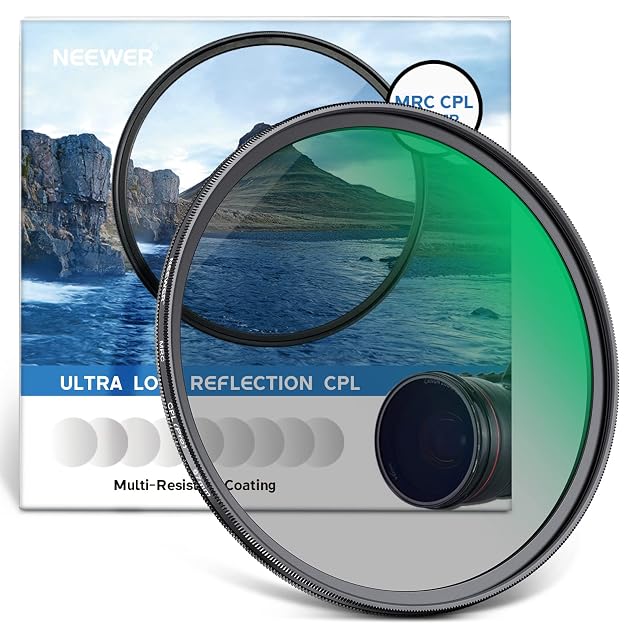
Thirty coating layers, reflection under 0.1 per cent and a published 5.9 mm magnalium frame — the only polariser here that describes how its ring turns.
Thread size
67 mm, in the title and the fifth bullet, supplied with a protective case and a cleaning cloth
Type
CIRCULAR, in the title, built on what the first bullet calls an imported polarising film. Circular is what keeps autofocus and metering intact, as the hub above explains
Light loss stated
NOT STATED — no figure in stops, as on all four polarisers here. What this page does publish is the other side of the transaction: 99.9 per cent of reflections from non-metallic surfaces eliminated, and a minimum light reflection of under 0.1 per cent off the filter’s own surfaces. Both are real numbers; neither is the exposure penalty the hub above asks for
Coating description
THIRTY LAYERS of polarising film on both sides of the filter, in the second and third bullets — the highest count on this shelf — with four properties named: water-repellent, oil-repellent, antistatic and scratch-resistant. The same bullet claims ultraviolet blocking from 300 to 380 nm, which is a stated waveband rather than a vague claim
Frame thickness
PUBLISHED, and in two parts: an ultra-thin 5.9 mm frame in MAGNALIUM ALLOY, plus a 3.8 mm front bezel that the fourth bullet says effectively prevents vignetting on wide-angle lenses. The 18 € K&F here is thinner overall at 5.3 mm; this is the only page that separates the frame from the bezel
Rotation mechanism
DESCRIBED — alone on this shelf. The fourth bullet gives black anodised threads with precision machining for effortless installation, and straight wheels for smooth rotation. A polariser is operated by turning it, and this is the one page that treats the turning as a specification
Amazon reference
B09HGHKN2R (same reference on 6 Amazon marketplaces)
EAN
0191073121478
Thirty coating layers, with reflection under 0.1 per cent and a stated 300-380 nm UV band
The only description of a rotation mechanism on this shelf
No light loss in stops, as everywhere on this shelf
Best for: A 67 mm lens whose polariser gets turned constantly — landscapes, water, glass — where a smooth ring and a wipeable coating earn the extra 10 €.
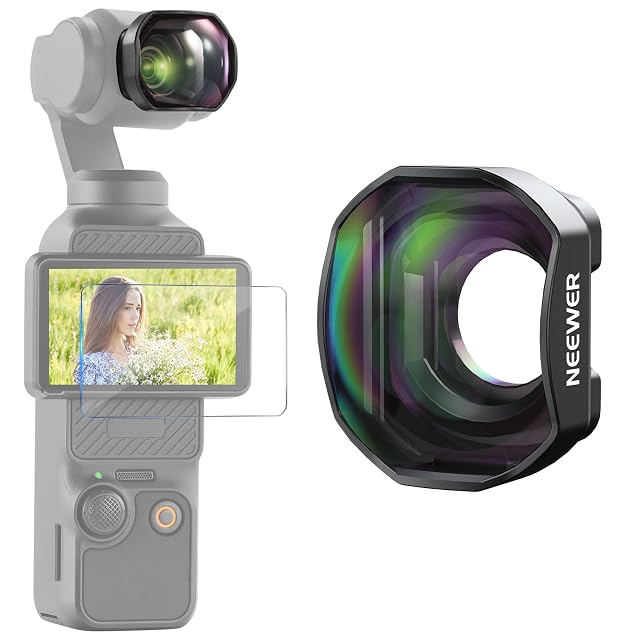
Sixty-four euros for a magnetic converter that clips to an Osmo Pocket 3 or 4 — and whose only published magnification is the 2× digital zoom already in the camera.
Magnification
NOT PUBLISHED for the converter itself. The second bullet says a higher magnification factor is reached by using the camera’s 2× DIGITAL zoom, which is a function of the camera and not of this glass. Every other page on this shelf leads with a factor — 1.4× or 2× — and this one leads with the camera’s crop
Lenses named as compatible
No lenses: two cameras. The first bullet says it is compatible only with the DJI Osmo Pocket 4 and Pocket 3, and the title says the same. This catalogue carries the Osmo Pocket 4 on its gimbal shelf, so the narrowest compatibility statement on this shelf is also the easiest to check
Light loss in stops
Not published. The intro above gives the arithmetic for converters that sit between a lens and a body — one stop for a 1.4×, two for a 2× — and this one attaches magnetically to the front of a fixed-lens camera, where that arithmetic does not apply. The page gives no figure either way
Autofocus limits stated
None. On a camera whose lens and body are one piece there is no aperture for the converter to reduce, and the page makes no claim about focus at all
Added length
Not published. The fourth bullet calls the lens light and slim and gives no millimetres — and on a pocket gimbal, length is exactly what decides whether it still fits in a pocket
Sealing
Not claimed as sealing. The third bullet describes multiple coatings that resist water, scratches and fingerprints, which protects the glass rather than the joint. Three converters on this shelf claim dust and splash protection; this is not one of them
Published weight
Not published — and not one of the six converters on this shelf publishes a weight, though the intro above asks for it
Amazon reference
B0G1RSMHRV (same reference on 6 Amazon marketplaces)
EAN
0191073127913
Four elements in three groups, multi-coated against water, scratches and fingerprints
A magnetic mount, so nothing is threaded onto a gimbal-mounted lens
No optical magnification figure anywhere on the page
Best for: An Osmo Pocket 3 or 4 used for interviews and distant subjects, where a longer view is wanted without cropping into the sensor.
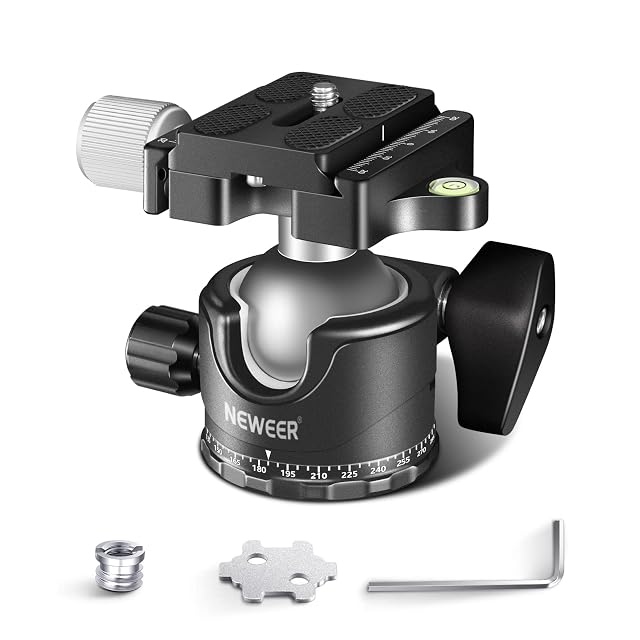
Fifteen kilograms declared and the only Arca-compatible plate named on this shelf, on a low-profile ball head weighing 310 g at 43 €.
Head type
A low-profile ball head with a 36 mm ball, in the title and the first bullet, which gives the reason for the shape: a lower centre of gravity makes the head more stable. The third bullet adds 360 degrees of pan and 90 of tilt in a U-shaped notch — the cutout that lets a camera drop into portrait orientation
Declared load
33 lb, 15 kg, in the first bullet — the largest figure on this shelf and more than twice what any tripod in this catalogue declares. The hub above says the lower of the head and legs governs, so this head will never be the limiting part of any assembly built from these pages
Plate standard
Arca-compatible, 38 mm, named explicitly in the second bullet with a 1/4 inch fixing screw and rubber pads to protect the camera. It is the ONLY page of the three here to name a profile, and the hub above says to read the plate before the load figure precisely because an Arca dovetail joins what most bags already contain
Mounting thread
A 3/8 inch thread below with a 3/8 to 1/4 inch screw adapter supplied, in the first bullet, said to fit most tripods, monopods and sliders. Supplying the adapter matters: it is the small brass ring that otherwise lives at the bottom of a bag until it is lost
Panning base and markings
A separate panning foot with a 360 degree scale, in the third bullet, credited with precise and smooth panoramic work, plus a bubble level for keeping the horizon straight. A panning base independent of the ball is what lets a level pan stay level — the K&F below it describes no such base
Locking and friction controls
Three locking knobs, in the fifth bullet: release them to set the ball freely, turn the camera gently for a panorama, release the plate. No separate friction adjustment is named, so the ball either holds or moves
Published weight
310 g, in the fourth bullet, with CNC-milled aluminium alloy named as the material. Half again the weight of the K&F, for half again the declared load
Amazon reference
B0B8CKD3TN (same reference on 6 Amazon marketplaces)
EAN
0191073122574
A 38 mm Arca-compatible plate, the only named profile on this shelf
Fifteen kilograms declared, more than twice what any tripod in this catalogue carries
No friction control, so the ball holds or releases with nothing in between
Best for: Any tripod, monopod or slider in this catalogue, for a photographer who already owns Arca-profile plates and wants the head to stop being the limit.
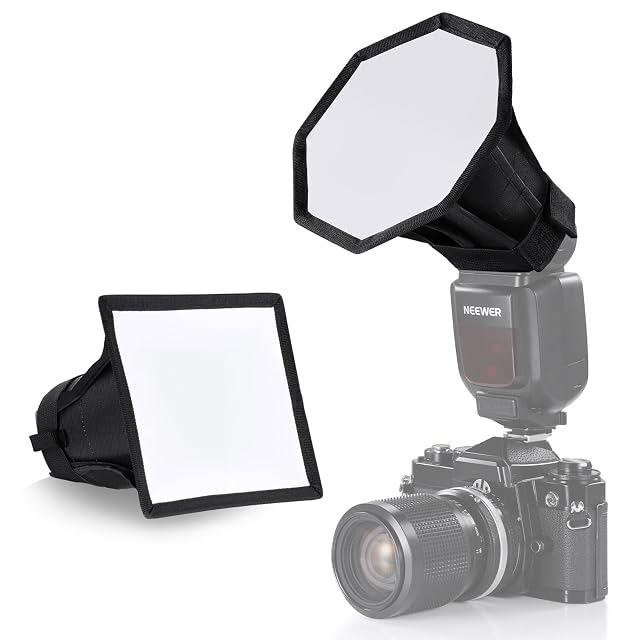
Two softboxes for 27 € — a 15 by 12.5 cm rectangle and a 15 cm octagon — with the longest named compatibility list on this shelf and the only materials stated anywhere in the family.
Type
Two softboxes rather than one, and the shapes do different jobs: the second bullet says the 6 by 5 inch rectangle gives a linear, extended output that emphasises the features of a subject, and the third says the 6 inch octagon widens the source for balanced, comprehensive lighting that removes shadows. Both enlarge the source, which the hub above notes is the type that works outdoors as well as in
Flash heads named
The longest list on this shelf, by model. Round heads: NEEWER Z1 and Z2. Square heads: Godox TT600, TT685, V860II, V860III and V1, plus NEEWER Z760, NW700, NW620, TT560, NW635II, NW645II, NW655, NW665, NW670 and 750II, with Canon, Nikon and Sony named too. The hub above warns that a universal fitting on a large head slides off; a list of models is the opposite of that gamble, and the TT560 flashgun in this catalogue is on it
Mounting method
Elastic strips with velcro fasteners, in the fifth bullet, which says they let the softboxes be fitted and removed easily and folded flat when not in use. Velcro in addition to elastic is what distinguishes it from the plain strap on the 6 € ANYUANKW
Open dimensions
Both published: a rectangle of 15 by 12.5 cm and an octagon of 15 cm, in the first bullet, restated in the second and third as 6 by 5 inches and 6 inches. The hub above calls this the figure that describes the size of the source, and this is the only page on the shelf to publish it for two separate modifiers
Packed size
Not published as a dimension. The fifth bullet says both fold flat and store in the supplied bag, which describes the behaviour rather than the figure — the same gap as on the two cheaper diffusers here
Material
Named on both surfaces, which nothing else on this shelf does: durable black nylon outside for longevity, silver PVC inside, which the fourth bullet says intensifies the light source while preserving a neutral colour temperature. Silver rather than white inside is a deliberate choice — it returns more light at the cost of some softness
Stated light loss
Not stated in stops. The fourth bullet claims the silver interior intensifies the source, which is a relative claim about the lining rather than a measurement of what the modifier costs. No page on this shelf publishes a figure
Amazon reference
B0CQ4BNXSY (same reference on 6 Amazon marketplaces)
EAN
0191073121027
Two softboxes, a 15 by 12.5 cm rectangle and a 15 cm octagon, both with published dimensions
A compatibility list by model covering round and square heads, including the TT560 flashgun in this catalogue
No packed dimension, only the claim that both fold flat
Best for: A hotshoe flash that is already on the compatibility list, where two shapes cover portraits and general fill and the fitting has to hold.
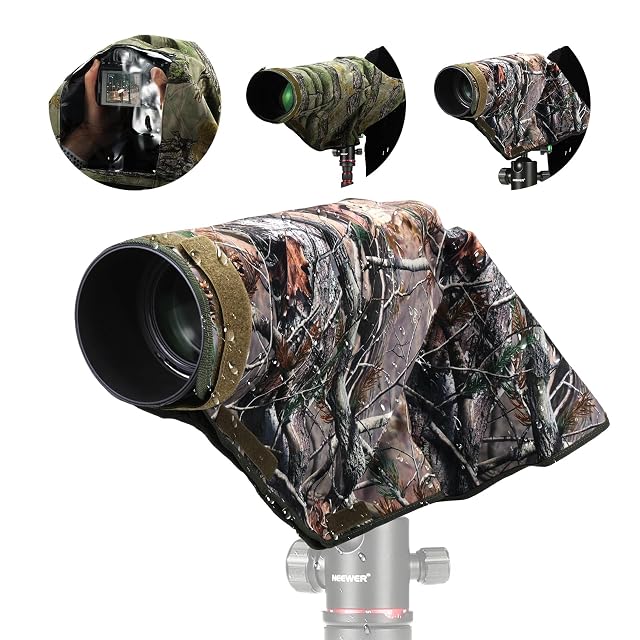
A 950 by 850 mm nylon sheet at 150 g that reverses between two camouflage patterns and takes a 400 mm telephoto — a 950 by 850 mm sheet at 150 g, at 37 €.
Lens length accommodated
THE LONGEST ON THIS SHELF: lenses up to 400 mm in the title, with the third bullet putting camera and lens combined UNDER 600 mm. Those are focal lengths rather than centimetres — a 400 mm telephoto is roughly 35 cm of barrel — and a cover cut for one is a cover for wildlife work
Eyepiece design
Not described, and on this cover it matters less: a 950 by 850 mm sheet is draped and folded rather than fitted, so the photographer looks in under the edge rather than through a window
Hand access
AN ENLARGED OPENING, in the fourth bullet, giving access to the important camera functions without removing the cover. It is the only page on this shelf to describe hand access at all — four others leave it unstated
Material and seams
NYLON, waterproof, in the fifth bullet, credited with long-lasting protection. Seams are not described
Closure method
VELCRO fasteners, in the fourth bullet: the cover is pulled over the equipment and the velcro secures it. Simple, adjustable to any size, and the reason the same sheet fits a 200 mm and a 400 mm lens
Packed size
Not published as a folded figure — but the WEIGHT is: 150 g, in the fifth bullet, the only weight on this shelf. A hundred and fifty grams of nylon folds to about the size of a fist, which is what the same bullet means by easy to fold and perfect for photography on the move
Amazon reference
B0CTCXY92S (same reference on 6 Amazon marketplaces)
EAN
0191073120976
A hundred and fifty grams published, the only weight on this shelf
An enlarged opening for the controls without removing the cover
A draped sheet rather than a fitted cover — no window and no eyepiece
Best for: A long telephoto on a tripod in the field, where the cover has to blend in, fold to nothing and let the controls be reached.
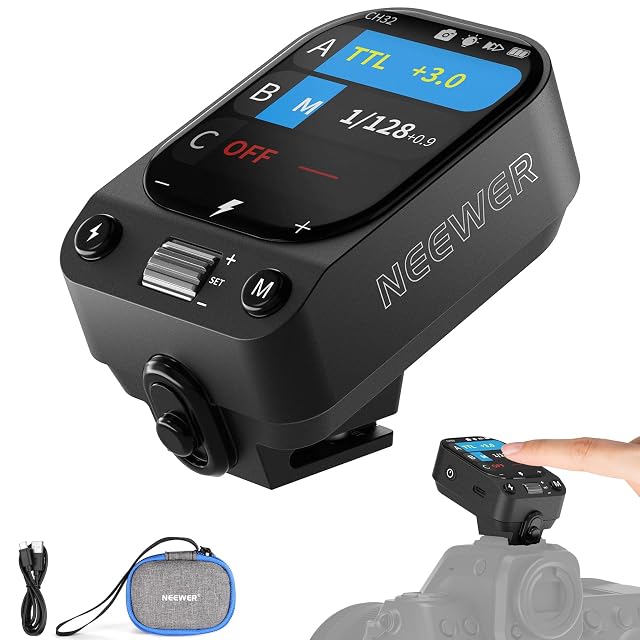
The dearest trigger here at 93 €, with a touchscreen, five groups, thirty-two channels, remote power from 1/256 to 1/1 and high-speed sync to 1/8000 — and it fires Godox lights as well as its own.
Radio system named
The NEEWER 2.4G Q system, with its own lights listed — Z3R-N, Z2PRO-N, Z2-N, Z1-N, Z880-N, NW760-N, S101-400W Pro, S102-400W Pro, Q4, Q4PRO, Q6, Q300, Q200 and Q120 — and then the unusual part: Godox iT32, V1 and V100 flashguns and the AD200 Pro II and AD100 Pro II outdoor heads are supported too, with current firmware. A named system that also reaches into a rival’s is rare, and the Q6 head in this catalogue is among the lights it drives
Camera mounts supported
Nikon, listed at length in the closing bullet — Z9, Z8, Zfc, Z50, Z30, Z5, Z6, Z7, Z6 II, Z7II and reflex bodies from the D4 and D5 to the D7500 — with one explicit exclusion: not compatible with the D810. An exclusion stated plainly is worth more than a list that implies everything works
Channel and group counts
5 groups, 32 channels and IDs from 01 to 99, with channel search, over a range given as 328 feet — about 100 m. It is the most granular addressing on this shelf: groups to control lights separately, channels to avoid others, and IDs to separate two photographers using the same channel
Remote power control
Yes, in full: flash power from 1/256 to 1/1, plus or minus 3 EV of exposure compensation, modelling light control and group control, all from the touchscreen. The second bullet adds automatic or manual zoom from 20 to 200 mm, which sets the beam of a compatible flash from the transmitter
Metering and sync modes claimed
TTL, manual and strobe, with 1/8000 s high-speed sync and S1 and S2 optical modes, in the first two bullets. The first carries a working note: the single-contact mode must be disabled for TTL and strobe to function. It is the only trigger on this shelf claiming metering and high-speed sync at all
Power source
A 1000 mAh lithium cell, fully charged in 2.5 hours, with a real-time battery display and firmware upgrades, in the fourth bullet. The same bullet gives the forced shutdown gesture — hold the power and test buttons together — which is the kind of detail that only appears after people have needed it
Amazon reference
B0G4QVWJTX (same reference on 6 Amazon marketplaces)
EAN
0191073129207
Five groups, 32 channels and 99 IDs, the most complete addressing on this shelf
Remote power from 1/256 to 1/1, exposure compensation, modelling light and zoom from 20 to 200 mm
Ninety-three euros, more than four times the 17 € Andoer
Best for: A Nikon body running several NEEWER Q or compatible Godox lights, where power, zoom and modelling light are set from a touchscreen rather than at each head.
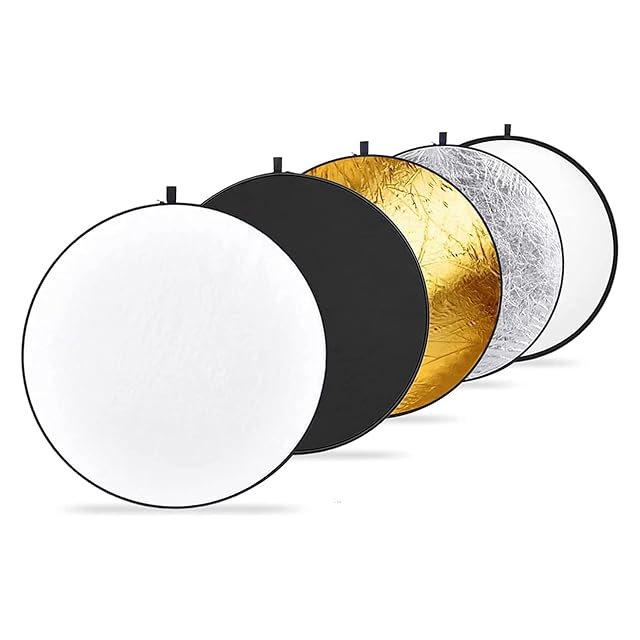
One hundred and ten centimetres for 32 €, in high-reflectivity nylon, with a sewn-in loop and three other ways to hold it — and no folded size anywhere on the page.
Diameter
110 cm, or 43 inches, in the title. That is a surface that covers a standing figure from the waist up, and the intro above explains why the size follows the subject: a disc held close and wide wraps the light, a small one at a distance is only another hard source
Shape
Round. A circle of 110 cm behaves differently outdoors from a 60 cm one — it catches wind like a sail, which is the practical limit on a disc this wide
Surfaces supplied
Five, in the first bullet: a translucent panel for diffusion inside a reversible sleeve with four colour effects — gold for warm fills, silver for cool clear fills, white for soft neutral fills, black for eliminating excessive reflections. The last bullet itemises it as one diffusion panel plus one four-sided sleeve
Frame construction
Not named. The second bullet describes high-reflectivity nylon, which is the fabric; the hoop is never mentioned
Folded size
NOT PUBLISHED. The fourth bullet says only that the reflector folds easily into the shape of a disc and comes with a carry bag. Three of the four discs on this shelf publish a packed figure — 20 cm, 27 cm, 40 cm — and this is the one that does not, on the widest disc of the four
Fabric described
High-reflectivity nylon, in the second bullet, credited with even scattering and reflection whether the source is a flash, a monolight, a continuous LED or the sun. No percentage, where the 29 € K&F and the 33 € Selens both claim 90 per cent
Holder or bracket compatibility
The fullest answer on the shelf, in the third bullet: mount it on a standard holder, hang it from a crossbar, hook it by the built-in loop, or hold it in your hands. The loop is the part that matters — it is sewn in, and it lets a light stand do the holding
Amazon reference
B002ZIMEMW (same reference on 6 Amazon marketplaces)
EAN
0701413499497
One hundred and ten centimetres, enough to light a standing figure from the waist up
Four ways to support it, including a built-in loop and a standard holder
No folded size published, on the widest disc of the four here
Best for: A disc that will spend most of its life on a stand or a crossbar rather than in a hand, lighting whole figures rather than faces.
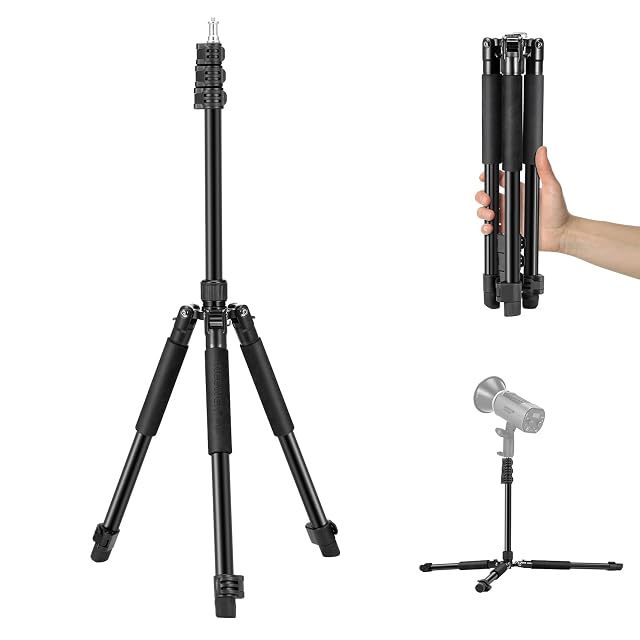
Legs that fold back through 180 degrees bring this stand to 44 cm packed — the shortest on this shelf — at 1 kg, with 2 kg of declared load for 39 €.
Maximum and minimum height
44 to 195 cm, in the third bullet, from a three-section centre column with a snap lock between each pair of segments. The minimum is the joint lowest on this shelf, which puts a light at table height or below
Folded length
44 cm, in the fifth bullet, and it is the shortest on this shelf by 29 cm. The reason is in the same bullet: the legs reverse through 180 degrees and fold up alongside the column instead of hanging below it
Section count
Three in the column, in the third bullet, with two-section telescopic legs in the fourth. It is the only page here to publish both counts
Spigot and thread sizes
A 1/4 inch screw, in the first bullet, named for continuous lights, ring lights, LED panels, monolights, softboxes, umbrellas and action cameras. As on the EMART, no 16 mm stud is mentioned — so studio fittings that expect a spigot receiver are not provided for
Declared load
4.4 lb, 2 kg, in the second bullet. It is the lowest rating on this shelf by more than half, and it is the honest consequence of a 1 kg stand: the second bullet calls it impressive, and 2 kg is a small flash or an LED panel, not a studio head
Leg spread
Three spread angles, in the fourth bullet, set by a snap construction, with advice to open the legs until the centre column touches the ground for maximum stability. No footprint diameter is published, but three published angles is more than any other page here offers
Material
Anodised aluminium described as rust-free, in the second bullet, at 2.2 lb or 1 kg in the fifth — tied with the EMART for the lightest here
Amazon reference
B0DCV8NXYF (same reference on 6 Amazon marketplaces)
EAN
0191073097247
Forty-four centimetres folded, the shortest on this shelf by a wide margin
Legs reversible through 180 degrees, and three published spread angles
Two kilograms declared, the lowest rating here
Best for: A ring light or an LED panel that has to travel, where 44 cm in the bag decides whether the stand comes at all.
Each amount in a write-up is what the listing showed when that page was written. The figure next to the product is pulled in as you read, and it is the one that counts.