What the maker commits to in print
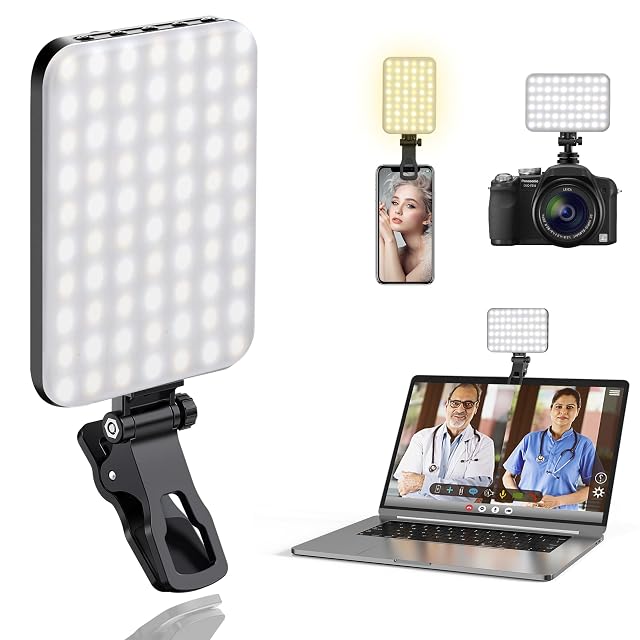
- Forty-five warm, forty-five cool and forty-eight RGB beads blended, delivering up to 1,090 lux at 0.5 m (1.6 ft)
- Three lighting modes — CCT, HSI and FX: CCT from 2700K to 7500K with stepless brightness from 0 to 100 per cent, HSI with 360-degree hue selection, and FX with 17 dynamic scene effects
- CRI 97 and 9 W, both in the title
- A built-in 4,000 mAh battery powering the light for up to 113 minutes at full brightness, rechargeable from a car charger, laptop or USB source — with a USB OUTPUT port so the light doubles as a portable charger
- A cold shoe adapter for a camera hot shoe, or 1/4 inch holes for a desk tripod
- 15 × 8 × 1.2 cm (5.9 × 3.1 × 0.5 in), 235 g, aluminum alloy
NOTHING about flicker. No TLCI.
It publishes the distance
One thousand and ninety lux AT HALF A Meter.
“The distance is part of the measurement and a figure given without it cannot be
compared with anything.”
Illuminance falls off with the square of distance, so 1090 lux at 0.5 m (1.6 ft) is about
270 at one meter and 120 at a meter and a half.
Of the nine American lights on this shelf: two publish both numbers, one publishes
lux with no distance, one publishes lumens instead, and five publish nothing.
When a page gives a bare lux figure, assume half a meter. It is the flattering
distance.
“Read the color accuracy index before the output figure. A dim light with
faithful color is easier to work with than a bright one that turns skin green.”
Ninety-seven is the joint highest among the American lights here, level with the
ALTSON D6, behind only the published Rollei’s 98.
Most of the error in a cheap white LED sits in deep red — which is where skin tone
lives. Between 95 and 97 the average gap is small and the red gap is usually
larger than the average suggests.
The ENEGON panel on this shelf publishes no index at all.
A hundred and thirteen minutes AT FULL
Which is a runtime stated at a brightness, and most of this shelf does not do
that.
“Up to 20 hours” on the ENEGON, at an unstated brightness, is a figure that cannot
be planned with. A hundred and thirteen minutes at 100 per cent can.
And a USB output, alone on this shelf
Four thousand milliamp-hours is roughly a phone charge.
The light is already in the bag, already charged, and has a port that gives it
back.
It is not a photographic specification. It is the one that gets used.
Seventeen scenes, which are decoration
A police light, a television flicker, a candle, a thunderstorm.
For narrative video they save building the effect with gels and a dimmer. For
product or portrait work they are the headline the marketing wanted.
The two modes that earn their keep are the first: CCT for white light, HSI for a
colored wash on a background.
And nothing about flicker
“Whether the light is flicker-free at the frame rates you record.”
Zero of the nine American lights on this shelf mention it.
On an RGB panel driven by pulse-width modulation, a flicker at 120 Hz photographs
as banding at 1/500 and as a rolling bar in slow motion — and no page here lets
you know in advance.
Availability
About $40 on the American Amazon store when this page was last checked.
Everything in this section is the figure Keepa carried on the day of the last update to this page. Availability and prices shift without notice.
Prices quoted in this text were read on 8 October 2026. The live price is at the top of the page.